
Research Article | Open
Access
|
Open
Access
|


 | Published online: 10 March 2026
Detection of UPI Mule Accounts Using Machine Learning and Streamlit-Based Predictive Analytics
| Published online: 10 March 2026
Detection of UPI Mule Accounts Using Machine Learning and Streamlit-Based Predictive Analytics
Ishita D. Sonawane,*  Priyanshi R. Suyal, Shradha Chavan* and Rudresh Shirwaikar*
School of Computer Science and Information Technology, Symbiosis Skills and Professional University, Pune, Maharashtra, 412101, India
*Email: ishita.sonawane@gmail.com (I. D. Sonawane), shradha.chavan@sspu.ac.in (S. Chavan), rudresh.shirwaikar@sspu.ac.in (R. Shirwaikar)
J. Inf. Commun. Technol. Algorithms Syst. Appl., 2026, 2(1), 26301 https://doi.org/10.64189/ict.26301
Received: 15 December 2025; Revised: 02 March 2026; Accepted: 09 March 2026




Abstract
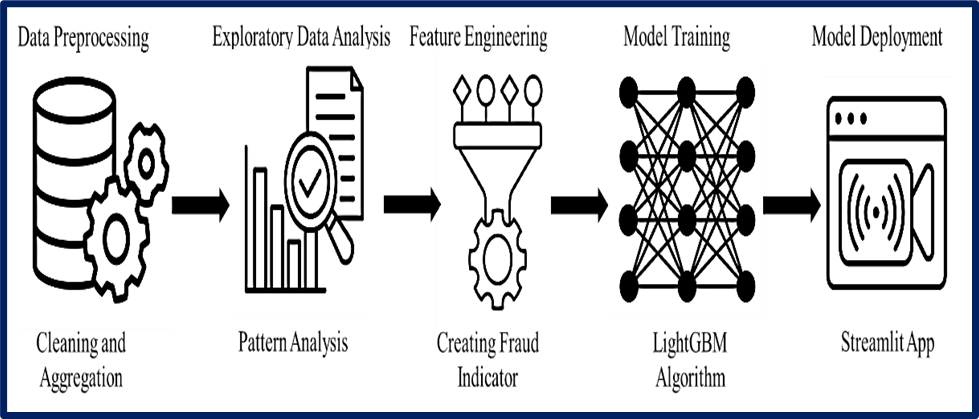
By facilitating quick and easy money transfers, the Unified Payments Interface (UPI), in particular, and the rapid growth of digital payment systems in India have drastically changed the financial landscape. However, the growing use of UPI has also resulted in an increase in fraudulent activity, particularly through mule accounts, which are used to route or launder money while hiding the identity of scammers. This study suggests a machine learning-based framework for identifying UPI mule accounts using transactional data to solve this problem. The suggested approach uses the Light Gradient Boosting Machine (LightGBM) algorithm to determine whether a transaction is authentic or fraudulent. Transaction-related characteristics such as transaction amount, time, user demographics, and fraud risk labels are included in the dataset, which was taken from a publicly accessible Kaggle repository. Methods for preprocessing data, such as label encoding, feature scaling, and Synthetic Minority Oversampling Technique (SMOTE), were used to address class imbalance and enhance model performance.With a Receiver Operating Characteristic–Area Under the Curve (ROC-AUC) score of 0.9962 and an accuracy of 96.55%, the trained LightGBM model proved to have a strong ability to distinguish between fraudulent and legitimate transactions. Additionally, a web application based on Streamlit was created to facilitate interactive model demonstration and real-time fraud risk prediction. The suggested framework offers a scalable and effective way to improve the UPI ecosystem's fraud monitoring systems.
Keywords:
Graphical Abstract
Novelty statement
This study proposes a LightGBM-based UPI mule detection framework with superior ROC-AUC (0.9962) and real-time analytics support.
