
Research Article | Open
Access
|
Open
Access
|


 | Published online: 19 March 2026
The Digital Divide: Challenges in Artificial Intelligence Adoption across Higher Education Institutions
| Published online: 19 March 2026
The Digital Divide: Challenges in Artificial Intelligence Adoption across Higher Education Institutions
Shubham Kishor Kadam,* Gaurav Mishra, Pankajkumar Anawade, Chhitij Raj, Deepak Sharma, and Anurag Luharia
Datta Meghe Institute of Higher Education and Research, Wardha, 442001, Maharashtra, India
*Email: kadamshubham1195@gmail.com (S. Kadam)
J. Inf. Commun. Technol. Algorithms Syst. Appl., 2026, 2(1), 26304 https://doi.org/10.64189/ict.26304
Received: 07 January 2026; Revised: 21 February 2026; Accepted: 14 March 2026




Abstract
Higher education is being increasingly transformed by Artificial Intelligence (AI), particularly through the emergence of Large Language Models (LLMs) that enable personalized learning, support research activities, and automate various administrative processes. However, the adoption of AI in higher education institutions is uneven, contributing to a widening digital divide between resource-rich Tier-1 urban universities and under-resourced Tier-3 rural institutions. This paper examines the structural, technological, pedagogical, and policy-related barriers that influence AI adoption across diverse institutional contexts. Using a qualitative comparative framework supported by global and Indian case studies, the study analyzes infrastructural constraints, faculty preparedness, digital literacy gaps, ethical considerations, and disparities in funding. Case studies from India and Rwanda illustrate both the grassroots challenges faced by developing regions and emerging policy-driven models of AI integration in the Global South. The findings indicate that infrastructural capacity, institutional readiness, faculty AI literacy, and sustained public–private collaboration are key factors enabling equitable AI integration. This study proposes a multitiered “AI for All” framework that emphasizes inclusive infrastructure development, curriculum reform, ethical governance, adoption of open-source technologies, and sustainable funding mechanisms. By integrating global policy perspectives with institutional-level analysis, this study offers a systematic roadmap for reducing digital inequality and promoting inclusive AI-enabled higher education systems.
Keywords:
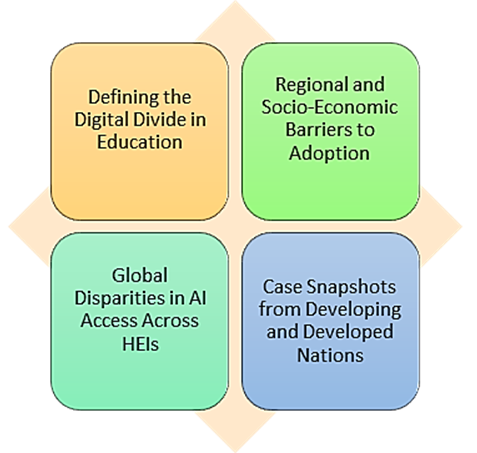
Graphical Abstract
Novelty statement
This study compares Tier-1 and Tier-3 institutions and proposes an inclusive AI adoption model addressing infrastructure, faculty readiness, funding, and ethics.
