
Research Article | Open
Access
|
Open
Access
|


 | Published online: 31 March 2026
Adversarial OSINT Detecting Manipulation in Public Data for Reliable Investigations
| Published online: 31 March 2026
Adversarial OSINT Detecting Manipulation in Public Data for Reliable Investigations
Nitin Soni* and Rakesh Poonia*
Department of Computer Applications, Engineering College, Bikaner, Rajasthan, 334004, India
*Email: nsoni6789@gmail.com (N. Soni), rakesh.ecb98@gmail.com (R. Poonia),
J. Inf. Commun. Technol. Algorithms Syst. Appl., 2026, 2(1), 26305 https://doi.org/10.64189/ict.26305
Received: 22 December 2025; Revised: 20 March 2026; Accepted: 30 March 2026




Abstract
Open-source intelligence (OSINT) has emerged as a critical component of digital investigations, particularly in domains such as cybercrime, national security, and fraud detection. However, the increasing prevalence of adversarial technologies, including deepfakes, synthetic text, social bots, and data poisoning, poses significant challenges to the reliability and integrity of OSINT. These malicious, nondefensive interventions contribute to what is termed adversarial OSINT, where manipulated or fabricated information undermines trust in open-source data. This study examines the evolving threat landscape associated with adversarial manipulation and proposes a multilayered detection framework to enhance OSINT reliability. The framework integrates computational analysis, digital forensic techniques, and cross-source verification mechanisms to identify and mitigate manipulated content effectively. Additionally, the research explores the dual role of simulated data, deepfakes, and controlled virtual environments, highlighting how they can be leveraged constructively to test and strengthen OSINT validation systems. Furthermore, the paper addresses key ethical, legal, and privacy considerations essential for the responsible deployment of OSINT methodologies. The findings emphasize that maintaining OSINT integrity requires a hybrid approach that combines automated detection techniques with human expertise and oversight. This integrated strategy ensures more robust, transparent, and trustworthy intelligence generation in adversarial environments.
Keywords:
Graphical Abstract
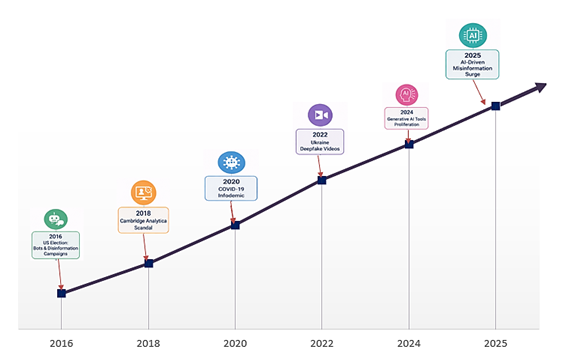
Novelty statement
This study proposes a novel hybrid adversarial OSINT detection framework integrating multi-modal analysis and human-in-the-loop validation, improving detection accuracy and reliability in complex misinformation environments.
