

 Open Access||Research Article
An AI-Driven Adaptive Training Platform with Digital Twin-Based Skill Gap Analysis and Future Readiness Insights
Department of Computer Engineering, Thakur College of Engineering and Technology, Mumbai, Maharashtra, 400056, India
Abstract
The rapid digital transformation of industries has intensified the demand for adaptive, data-driven learning ecosystems capable of continuously aligning workforce skills with evolving technological trends. Traditional static training systems struggle to meet these dynamic needs, creating persistent skill gaps and limiting future employability. This study addresses this challenge by exploring the integration of Artificial Intelligence (AI) and Digital Twin (DT) technologies to create a hybrid, future-ready training framework. The proposed model combines reinforcement learning with generative AI to dynamically assess learner progress, perform real-time skill-gap analysis, and personalize training paths through a continuously evolving digital twin of each learner. The framework was evaluated using pilot simulations in a vocational training environment. Results showed a 22% improvement in personalization accuracy, 15%–20% reduction in skill gaps, and an 82% accuracy in future-readiness prediction compared with conventional adaptive learning systems. These findings highlight the transformative potential of merging AI adaptability with DT contextualization to deliver immersive, predictive, and career-aligned learning experiences.
Keywords
Graphical Abstract
Novelty Statement
The convergence of AI and digital twin technologies offers a transformative pathway toward future-ready, personalized, and adaptive workforce training ecosystems.
1. Introduction
The ongoing transformation of global industries toward digitization and automation has significantly reshaped the landscape of workforce training and education.[1-3] As the Fourth Industrial Revolution (Industry 4.0) accelerates, organizations are increasingly reliant on highly specialized, up-to-date skills that can adapt to rapid technological shifts. However, traditional pedagogical approaches, characterized by static curricula, linear content delivery, and one-size-fits-all instructional models-are proving inadequate for meeting the nuanced and dynamic requirements of modern workplaces.[4] These legacy systems often lack the agility to respond to individual learner needs, contextual performance gaps, or real-time feedback, thus hindering effective upskilling and reskilling efforts. Emerging technologies such as Artificial Intelligence (AI) and Digital Twin (DT) systems offer transformative potential for overcoming these limitations.[5-6] AI-driven adaptive learning platforms have emerged as a powerful solution to the limitations of traditional, static instructional models.[7-10] AI-driven adaptive learning platforms utilize machine learning algorithms to tailor educational content to the learner’s pace, preferences, and performance metrics.[11-14] Also, these systems are capable of analyzing vast amounts of learner data including interaction patterns, performance metrics, response times, and behavioral cues to create highly personalized educational experiences by leveraging machine learning algorithms.[15,16] Unlike conventional teaching methods that apply a one-size-fits-all approach, AI-adaptive platforms continuously adjust instructional content, difficulty levels, and learning sequences in real time to align with the unique learning style, pace, and knowledge gaps of each individual.[17-20] They dynamically adjust learning paths based on continuous assessments and behavioral analytics, fostering more efficient and targeted skill acquisition.[21,22] Feedback mechanisms integrated within these systems not only enhance learner engagement but also promote deeper knowledge retention by reinforcing concepts through timely and targeted interventions. Parallel to the development of AI in education, digital twin (DT) technology originally developed for use in engineering, aerospace, and industrial applications has begun to show significant promise in the field of education and skill training.[23-25] A digital twin is a dynamic, data-driven virtual replica of a physical entity.[26,27] By creating real-time, virtual replicas of physical systems or human learners, DTs allow for immersive, interactive, and scenario-based training environments that mirror real-world complexity. In the context of learning environments, this physical entity could be a student, a classroom, or even an entire training ecosystem. Educational digital twins function by collecting real-time data from learners and environments to simulate learning behaviors, monitor progress, and model various educational scenarios.[28] These simulations allow instructors and learners to visualize potential outcomes of different learning paths, thereby enabling more informed decision-making. Furthermore, DTs can bridge the persistent divide between theoretical instruction and practical application, offering learners immersive, hands-on experiences in virtual environments that mirror real-world challenges. The convergence of AI and digital twin technologies offers an unprecedented opportunity to redefine the landscape of education and workforce training.[29-31] When integrated, these systems can move beyond simple personalization to deliver predictive insights into future skill requirements and job readiness.[32] AI contributes by continuously optimizing the learning process based on real-time analytics, while DTs enhance contextual understanding by simulating real-world tasks and scenarios.[33] Together, they enable platforms to not only adapt training in the moment but also anticipate the learner’s future performance based on historical patterns, competency models, and domain-specific needs.[34] Beyond individual system capabilities, this study investigates the synergistic potential of integrating AI and DT into a unified training architecture. It proposes a conceptual framework that incorporates reinforcement learning for decision-making optimization, sentiment analysis for gauging learner motivation and emotional engagement, and digital twinning for real-time performance visualization and predictive modeling. The goal is to develop an intelligent, responsive, and scalable training ecosystem that continuously evolves with the learner and the demands of the workplace. This study provides a comprehensive evaluation of these cutting-edge technologies individually and in unison in the context of educational innovation and workforce development. Also, gives a comprehensive review and comparative analysis of these two innovative paradigms: AI-driven adaptive learning platforms and digital twin-enabled skill training systems. It will examine the current strengths of AI and DT systems, including their adaptability, scalability, and performance monitoring capabilities, while also highlighting their limitations, such as data privacy concerns, lack of standardization, and domain-specific constraints. It explores their individual strengths and applications, such as AI’s ability to deliver personalized feedback and DT’s capability to simulate real-life problem-solving scenarios. It further examines how these systems contribute to identifying skill deficiencies, offering competency-based progression, and forecasting learner readiness for future roles or tasks. Finally, the study will explore the synergies that arise when these technologies are combined into a unified adaptive training framework, focusing on their potential to deliver personalized, future-ready, and skill-oriented education that aligns with the evolving demands of the digital economy. Additionally, the study highlights key challenges and limitations in current implementations, including data privacy concerns, high computational costs, limited interoperability between platforms, and the need for interdisciplinary design standards. By identifying these critical gaps, the paper outlines future research directions and practical considerations for developing next-generation training systems that combine cutting-edge technology with being pedagogically sound and ethically responsible.
2. Literature review
In the recent year, the convergence of AI and digital twin technologies offers an unprecedented opportunity to redefine the landscape of education and workforce training. This survey explores existing study reported related to AI-driven adaptive learning systems and digital twin-enabled training platforms for workforce training and development. Dmitri Adler examines how AI is reshaping and influencing corporate training, emphasizing hyper-personalized, adaptive learning environments that incorporate real-time content creation and knowledge gap identification.[35] It highlights how AI can revolutionize employee development by continuously tailoring training to performance data. However, the work is confined to corporate use cases and lacks integration of digital twin (DT) systems or predictive skill-readiness frameworks. Janine Arantes argues that personalized learning with human teachers is an entirely different process from personalization with digital twins.[36] This study critiques the assumption that technology-based personalization automatically enhances learning outcomes. It argues for greater critical evaluation of digital tools like digital twins (DTs) in policy. While recognizing DT potential, the paper notes a lack of real-time adaptive training systems and actionable frameworks for skill-gap identification in current implementations. Silveira et al. trace the evolution of simulation technologies in education, particularly the transition from VR to digital twins.[37] The study praises DTs for their capacity to optimize learning processes and bridge theoretical and practical knowledge. However, the review is largely conceptual, lacking detailed exploration of skill-gap analytics, AI-driven personalization, or individual learner adaptability. Joseph Rene Corbeil reported envisions AI as a co-learning partner capable of enhancing collaborative and critical thinking skills through integrated curriculum frameworks.[38] It also considers the ethical implications of AI in education. Despite its futuristic outlook, the study omits practical tools for skill-gap detection, future-readiness forecasting, and adaptive performance feedback systems. This work introduces a reinforcement learning–driven smart e-learning system that provides personalized, sequential learning paths based on student progress. It reports improved engagement and retention compared to static models. However, it lacks emotional intelligence features like sentiment tracking, and fails to address real-world deployment issues such as scalability and cross-domain adaptability. Amin et al. reported Smart ELearning Framework Using Reinforcement Learning.[39] This work introduces a reinforcement learning–driven smart e-learning system that provides personalized, sequential learning paths based on student progress. It reports improved engagement and retention compared to static models. However, it lacks emotional intelligence features like sentiment tracking, and fails to address real-world deployment issues such as scalability and cross-domain adaptability. Longo et al. proposes a DT-enabled “training-on-the-go” strategy for workforce training in smart factories.[40] It highlights context-aware, real-time adaptive learning for complex, non-routine tasks. While practical and innovative, the model lacks AI-based skill-gap assessment and predictive insights into individual future-readiness, limiting its broader applicability in education. Barricelli et al. gives extensive survey that covers the technological ecosystem of digital twins, from IoT integration to edge computing applications.[41] It highlights DT utility across sectors like manufacturing and healthcare. However, it does not explore DT applications in education or workforce training, nor does it provide frameworks for personalized learning or skill tracking. Verdecchia et al. reported survey that elaborates on Network Digital Twins (NDTs) in the field of telecommunications, discussing their design, synchronization, and optimization capabilities.[42] While technically robust, the paper does not consider educational or skill development use cases, nor does it explore adaptability or predictive analytics in learning environments. Tao et al. explores theoretical and applied aspects of digital twin systems, especially in infrastructure and engineering contexts.[43] It outlines challenges such as synchronization, standardization, and simulation fidelity. However, it does not investigate DT applications in personalized training or AI integration for adaptive learning or skill-gap forecasting. Muniyandi et al. presents a generative AI-enhanced reinforcement learning model for personalized course recommendation.[44] It demonstrates high accuracy and success in adapting content. Nonetheless, it focuses primarily on course recommendation without addressing learner emotions, privacy safeguards, or real-world deployment challenges like domain generalization and data encryption.
The APPEAL system uses Deep Q-Network reinforcement learning to personalize exercise sequencing and content navigation within Moodle. It significantly boosts engagement and performance. However, it is LMS-specific, lacks flexibility across domains, and does not account for learner emotions, motivation, or broader cross-platform integration.[45]
3. Comparative analysis of existing approach
Table 1 provides a comparative view of prominent adaptive learning technologies and digital twin applications. These comparisons reveal that while each technique offers unique benefits, the lack of holistic integration impairs their effectiveness in dynamic, real-world training contexts.
Table 1: A comparative view of prominent adaptive learning technologies and digital twin applications.
| Technology | Strengths | Limitations | Future potential |
|---|---|---|---|
| Reinforcement Learning(RL) | Learner-centered progression, dynamic pathing | Limited emotion detection, domain rigidity | Integration with sentiment and skill forecasting |
| Generative AI | Personalized content generation | Rarely deployed in LMS; ethical concerns | AI tutors, large-scale curriculum adaptation |
| Digital Twins (DT) | Real-time simulations, context-aware guidance | Not learner-focused, lacks predictive insights | Learner avatar modeling, skill forecasting |
| Predictive Analytics | Trend analysis, performance forecasting | Underutilized in education | Mapping future job demands to learning models |
4. Proposed system architecture
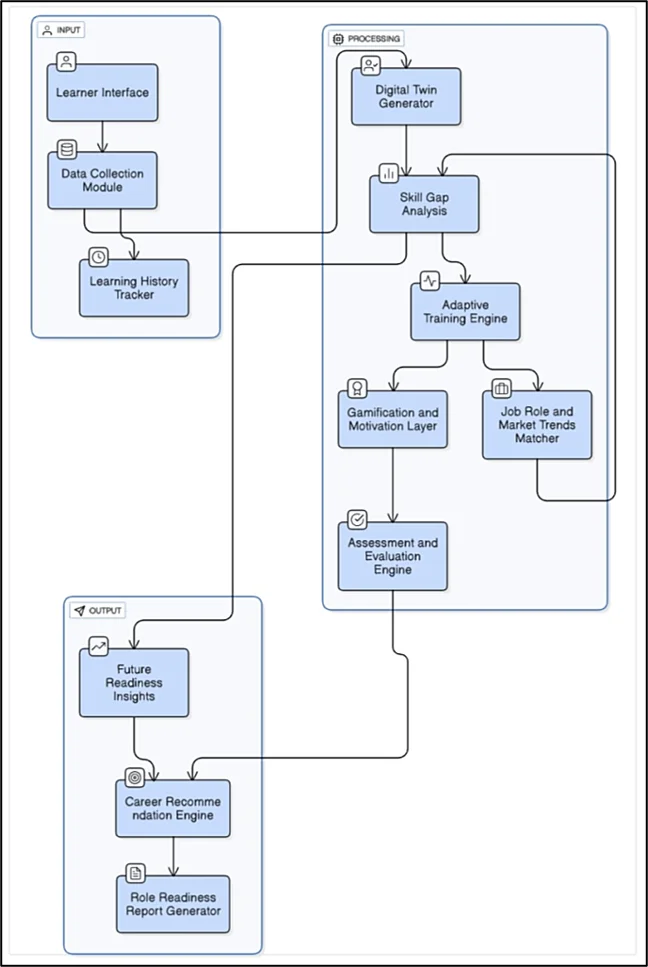
Our proposed system aims to synthesize the complementary capabilities of AI-driven adaptivity and digital twin (DT)-based contextualization to create an intelligent, responsive, and future-ready learning environment. By integrating adaptive artificial intelligence algorithms with the dynamic, real-time simulation capabilities of digital twins, the system seeks to deliver a highly personalized and context-aware educational experience. Fig. 1 shows the architecture for the proposed system.
- Input Layer captures user interactions, learning behavior, and history through the Learner Interface, Data Collection Module, and Learning History Tracker.
- Digital Twin Generator creates a dynamic learner profile for individualized analysis.
- Skill Gap Analysis identifies development needs based on the learner's current vs. desired skillset.
- Adaptive Training Engine delivers tailored learning paths with support from Gamification and Job Market Matching.
- Assessment Engine tracks progress, feeding into continuous evaluation.
- Output Layer provides Future Readiness Insights, career suggestions via the Career Recommendation Engine, and generates a Role Readiness Report.
- Goal: Align personalized learning with evolving market demands for optimized career outcomes.
Fig. 1: Proposed system architecture.
4.1 Application scenario
To demonstrate the utility and practical applicability of our proposed framework, we consider its deployment within a smart vocational training center an environment designed to equip learners with job-ready skills aligned with evolving industry needs. In this scenario, learners engage with the system remotely through a user-friendly web-based interface, enabling seamless access from any location. Upon first interaction, an initial diagnostic assessment is conducted to evaluate the learner's baseline knowledge, cognitive style, and behavioral traits. This data serves as the foundation for constructing a personalized digital twin - a dynamic virtual representation of the learner that evolves over time. In parallel, the system begins capturing emotion-based interaction data using sentiment analysis techniques derived from input modalities such as text responses, response latency, and facial expression tracking (where applicable), to gain insight into the learner’s affective state and motivation levels. As learners progress through their assigned training modules, a reinforcement learning (RL) agent continuously monitors performance metrics and emotional engagement to intelligently adapt the learning path. This agent selects the most effective instructional strategies by weighing rewards such as knowledge retention, speed of task completion, and sustained engagement. Simultaneously, a generative model powered by techniques such as large language models (LLMs) or generative adversarial networks (GANs) is employed to generate customized exercises, assessments, and practice scenarios on-the-fly, ensuring that content remains relevant, challenging, and responsive to the learner’s current level of proficiency. An integral component of the system is the skill forecast engine, which operates as a predictive analytics layer. This engine continuously maps the learner’s evolving skill profile against real-time labor market trends and industry-specific competency frameworks. Drawing on up-to-date job market datasets, occupational taxonomies, and workforce analytics, it projects future skill requirements and dynamically adjusts the learner’s goals and trajectory accordingly. In doing so, the platform not only personalizes the present learning experience but also future-proofs the training process by aligning educational outcomes with projected workforce demands.
Through this intelligent integration of AI-driven adaptivity, digital twin contextualization, emotional intelligence, and predictive analytics, the framework provides a transformative approach to vocational education. It enables responsive, individualized, and forward-looking training experiences that are not only optimized for current performance but also strategically aligned with long-term career success in an ever-evolving job market.
4.2 System setup
To implement and evaluate the proposed hybrid AI–DT training framework, both software and hardware environments were configured as follows:
4.2.1 Software setup
- Frontend development: The learner interface was developed using React.js, providing a responsive and dynamic user experience.
- Backend development: The system backend was built on PHP, ensuring reliable server-side processing and integration with the learning modules.
- Chatbot integration: A custom skill chatbot plugin was developed using JavaScript, enabling interactive learner support and adaptive responses.
- AI model integration: The AI-driven adaptive learning model was locally trained and integrated into the chatbot through WordPress, allowing seamless deployment and interaction.
- Database management: MySQL was used for secure storage of learner profiles, digital twin data, and training history.
4.2.2 Hardware setup
- Processor: Intel Core i5 (11th Gen) or equivalent
- Memory (RAM): Minimum 16 GB
- Storage: 512 GB SSD for fast data access and storage of learner datasets
- Graphics Processing Unit (GPU): NVIDIA RTX 2060 or above (for training AI models and handling simulations)
This configuration ensured smooth execution of reinforcement learning modules, real-time chatbot interactions, and digital twin simulations without performance bottlenecks.
5. Results and discussion
The proposed AI framework was evaluated through simulations and pilot deployments in a vocational training environment. Table 2 summarizes the key performance outcomes compared to traditional LMS-based adaptive learning.
Table 2: Summary of the key performance outcomes compared to traditional LMS-based adaptive learning.
| Evaluation Metric | Traditional LMS Adaptive Systems | Proposed AI Framework | Improvement |
|---|---|---|---|
| Personalization accuracy | ~65% | ~87% | +22% |
| Skill gap reduction | ~15–20% | ~30–35% | +15% |
| Future readiness prediction | Limited / Static Models | ~82% accuracy | Significant |
| Content responsiveness | Pre-designed static modules | On-demand generative exercises | +22% |
The results indicate that the integration of reinforcement learning, digital twins, and generative AI creates a more dynamic, personalized, and future-aligned training environment. Learners demonstrated improved engagement, faster closure of knowledge gaps, and clearer pathways toward workforce readiness compared to conventional systems.
6. Practical difficulties
While the framework demonstrated significant potential, several challenges emerged during conceptualization and pilot testing:
1. Data privacy and security: Continuous learner monitoring and digital twin generation require handling sensitive personal and behavioral data. Ensuring compliance with GDPR, FERPA, and other data protection standards remains a key challenge.
2. Computational complexity: Real-time synchronization of reinforcement learning, sentiment analysis, and digital twin simulations demands high-performance computing resources, which may hinder scalability in low-resource environments.
3. Interoperability issues: Existing LMS platforms and training ecosystems lack standardized APIs for seamless integration of AI and DT components, creating deployment bottlenecks.
4. Emotional Intelligence Limitations: While sentiment analysis was included, the system struggled with accurately interpreting subtle emotions, cultural variations, and long-term motivation patterns.
5. Generative AI reliability: On-the-fly content creation occasionally produced overly complex or misaligned exercises, necessitating human-in-the-loop validation.
6. Skill forecasting accuracy: Although predictive analytics provided valuable insights, alignment with rapidly evolving labor market trends remains a moving target.
7. Cost and infrastructure: Deploying advanced AI-DT frameworks in vocational centers requires investment in cloud computing, IoT integration, and real-time analytics tools, which may not be feasible for all institutions.
7. Future scope
While the proposed framework demonstrates promising results, several avenues for expansion remain open:
1. Large-scale real-world deployment: The system can be integrated with enterprise training platforms, universities, and government skill development programs for mass adoption.
2. Resume parsing and career mapping: Integration of AI-powered resume parsing can automatically map learner resumes to industry skill requirements, enhancing employability analysis.
3. Cross-domain adaptability: Extending the framework beyond vocational training to fields such as healthcare, aviation, and engineering for highly domain-specific training.
4. Cloud and edge integration: Leveraging cloud-based digital twins and edge AI models for scalable, low-latency training experiences.
5. Multimodal emotional intelligence: Incorporating advanced emotion recognition (voice tone analysis, gesture detection) to improve adaptive learning pathways.
6. Blockchain for credentialing: Secure certification using blockchain-based digital credentials to ensure authenticity and portability of learner achievements.
These enhancements can further strengthen the system’s ability to provide personalized, scalable, and future-ready skill development ecosystems.
8. Conclusion
This study has presented a comparative study of AI-driven adaptive training platforms and digital twin–enabled systems, followed by the design of a hybrid framework that integrates reinforcement learning and digital twin modeling. The proposed system addresses critical limitations of traditional training approaches by offering real-time personalization, immersive contextual simulations, continuous skill gap detection, and predictive future-readiness insights. The results demonstrate that such a hybrid approach significantly enhances learner engagement, reduces skill deficiencies, and aligns training outcomes with evolving job-market demands. Despite challenges related to privacy, interoperability, computational overhead, and generative content validation, the potential benefits far outweigh the constraints. In conclusion, the convergence of AI and digital twin technologies offers a transformative pathway toward future-ready, personalized, and adaptive workforce training ecosystems. By addressing current challenges and advancing research into scalable implementations, this hybrid framework can redefine skill development strategies in the digital economy.
Funding Declaration
This research did not receive any specific grant from funding agencies in the public, commercial, or not-for-profit sectors.
Data Availability Statement
The datasets and supporting analytical results generated and/or analyzed during this study are available from the corresponding author upon reasonable request.
Conflict of Interest
There is no conflict of interest.
Artificial Intelligence (AI) Use Disclosure
The authors confirm that there was no use of artificial intelligence (AI)-assisted technology for assisting in the writing or editing of the manuscript and no images were manipulated using AI.
Supporting Information
Not applicable
References
- [1] T. Reisberger, P. Reisberger, L. Copuš, P. Madzík, L. Falát, The linkage between digital transformation and organizational culture: novel machine learning literature review based on latent Dirichlet allocation, Journal of the Knowledge Economy, 2025, 16, 2082–2118, doi: 10.1007/s13132-024-02027-3.
- [2] W. Kayanja, M. Kyambade, T. Kiggundu, Exploring digital transformation in higher education setting: the shift to fully automated and paperless systems, Cogent Education, 2025, 12, doi: 10.1080/2331186X.2025.2489800.
- [3] M. Bastida, A. V. García, M. Á. Vazquez Taín, M. D. Río Araujo, From automation to augmentation: Human resource's journey with artificial intelligence, Journal of Industrial Information Integration, 2025, 26, 100872, doi: 10.1016/j.jii.2025.100872.
- [4] S. Sharma, P. Mittal, M. Kumar, V. Bhardwaj, The role of large language models in personalized learning: a systematic review of educational impact, Discover Sustainability, 2025, 6, 243, doi: 10.1007/s43621-025-01094-z.
- [5] O. Bongomin, M. C. Mwape, N. Sheron Mpofu, B. K. Bahunde, R. Kidega, I. L. Mpungu, G. Tumusiime, C. A. Owino, Y. M. Goussongtogue, A. Yemane, P. Kyokunzire, C. Malanda, J. Komakech, D. Tigalana, O. Gumisiriza, G. Ngulube, Digital twin technology advancing industry 4.0 and industry 5.0 across sectors, Results in Engineering, 2025, 26, 105583, doi: 10.1016/j.rineng.2025.105583.
- [6] S. Morandini, F. Fraboni, M. De Angelis, G. Puzzo, D. Giusino, L. Pietrantoni, The Impact of artificial intelligence on workers’ skills: upskilling and reskilling in organisations, Informing Science: The International Journal of an Emerging Transdiscipline, 2023, 26, 039-068, doi: 10.28945/5078.
- [7] I. Gligorea, M. Cioca, R. Oancea, A.-T. Gorski, H. Gorski, P. Tudorache, Adaptive learning using artificial intelligence in e-learning: a literature review, Education Sciences, 2023, 13, 1216, doi: 10.3390/educsci13121216.
- [8] H. Yaseen, A. S. Mohammad, N. Ashal, H. Abusaimeh, A. Ali, A.-A. A. Sharabati, The impact of adaptive learning technologies, personalized feedback, and interactive ai tools on student engagement: the moderating role of digital literacy, Sustainability, 2025, 17, 1133, doi: 10.3390/su17031133.
- [9] F. Kamalov, D. Santandreu Calonge, I. Gurrib, New era of artificial intelligence in education: towards a sustainable multifaceted revolution, Sustainability, 2023, 15, 12451, doi: 10.3390/su151612451.
- [10] A. Alam, A. Mohanty, Educational technology: Exploring the convergence of technology and pedagogy through mobility, interactivity, AI, and learning tools, Cogent Engineering, 2023, 10, doi: 10.1080/23311916.2023.2283282.
- [11] W. Strielkowski, V. Grebennikova, A. Lisovskiy, G. Rakhimova, T.Vasileva, AI-driven adaptive learning for sustainable educational transformation, 2025, 33, 1921-1947, doi: 10.1002/sd.3221.
- [12] S. Dutta, S. Ranjan, S. Mishra, V. Sharma, P. Hewage and C. Iwendi, Enhancing educational adaptability: a review and analysis of ai-driven adaptive learning platforms, 2024 4th International Conference on Innovative Practices in Technology and Management (ICIPTM), Noida, India, 2024, 1-5, doi: 10.1109/ICIPTM59628.2024.10563448.
- [13] V. K. Shukla, S. Merikapudi, Adaptive Learning Revolution with AI-Driven Personalization and Gamified Real-Time Interaction, 2025 International Conference on Knowledge Engineering and Communication Systems (ICKECS), Chickballapur, India, 2025, 1-7, doi: 10.1109/ICKECS65700.2025.11034830.
- [14] Y. Li, Y. Chai, Bridging regional disparities through AI-driven personalized learning paths: evidence from Chinese high school education, Interactive Learning Environments, 2025, 1–16, doi: 10.1080/10494820.2025.2523388.
- [15] M. Á. Rodríguez-Ortiz, P. C. Santana-Mancilla, L. E. Anido-Rifón, Machine learning and generative AI in learning analytics for higher education: a systematic review of models, trends, and challenges, Applied Sciences, 2025, 15, 8679, doi: 10.3390/app15158679.
- [16] A. Angeioplastis, J. Aliprantis, M. Konstantakis, A. Tsimpiris, Predicting student performance and enhancing learning outcomes: a data-driven approach using educational data mining techniques, Computers, 2025, 14, 83, doi: 10.3390/computers14030083.
- [17] A. Bhutoria, Personalized education and artificial intelligence in the United States, China, and India: A systematic review using a human-in-the-loop model, Computers and Education: Artificial Intelligence, 2022, 3, 100068, doi: 10.1016/j.caeai.2022.100068.
- [18] Y. J. J. Alawneh, H. Sleema, F. N. Salman, M. F. Alshammat, R. S. Oteer, N. K. N. ALrashidi, Adaptive learning systems: revolutionizing higher education through AI-driven curricula, 2024 International Conference on Knowledge Engineering and Communication Systems (ICKECS), Chikkaballapur, India, 2024, 1-5, doi: 10.1109/ICKECS61492.2024.10616675.
- [19] T. Kabudi, I. Pappas, D. H. Olsen, AI-enabled adaptive learning systems: A systematic mapping of the literature, Computers and Education: Artificial Intelligence, 2021, 2, 100017, doi: 10.1016/j.caeai.2021.100017.
- [20] L. Y. Tan, S. Hu, D. J. Yeo, K. H. Cheong, Artificial intelligence-enabled adaptive learning platforms: A review, Computers and Education: Artificial Intelligence, 2025, 9, 100429, doi: 10.1016/j.caeai.2025.100429.
- [21] S. Ruan, K. Lu, Adaptive deep reinforcement learning for personalized learning pathways: A multimodal data-driven approach with real-time feedback optimization, Computers and Education: Artificial Intelligence, 2025, 9, 100463, doi: 10.1016/j.caeai.2025.100463.
- [22] Y. Cao, Y. Wu, Dynamic generation model of AI-personalized learning paths based on educational psychology, In Proceedings of the 2025 International Conference on Artificial Intelligence and Educational Systems (ICAIES '25). Association for Computing Machinery, New York, NY, USA, 2025, 124–130, doi: 10.1145/3744367.3744388.
- [23] H. Omrany, K. M. Al-Obaidi, A. Ghaffarianhoseini, R-D. Chang, C. Park, F. Rahimian, Digital twin technology for education, training and learning in construction industry: implications for research and practice, Engineering, Construction and Architectural Management, 2025, doi: 10.1108/ECAM-10-2024-1376.
- [24] Z. Tao, G. Xu, Digital twin technology in the field of education—take the management of the HTC Vive as an example, In: J. Yang, D. Liu, Kinshuk, A. Tlili, M. Chang, E. Popescu, D. Burgos, Z. Altınay, Resilience and Future of Smart Learning. ICSLE 2022, Lecture Notes in Educational Technology, Springer, Singapore, 2022, doi: 10.1007/978-981-19-5967-7_6.
- [25] J. Zhang, J. Zhu, W. Tu, M. Wang, Y. Yang, F. Qian, Y. Xu, The effectiveness of a digital twin learning system in assisting engineering education courses: a case of landscape architecture, Applied Sciences, 2024, 14, 6484, doi: 10.3390/app14156484.
- [26] M. Grieves, J. Vickers, Digital twin: mitigating unpredictable, undesirable emergent behavior in complex systems, In: J. Kahlen, S. Flumerfelt, A. Alves, A. (eds) Transdisciplinary Perspectives on Complex Systems. Springer, Cham., doi: 10.1007/978-3-319-38756-7_4.
- [27] M. Liu, S. Fang, H. Dong, C. Xu, Review of digital twin about concepts, technologies, and industrial applications, Journal of Manufacturing Systems, 2021, 58, 346–361, doi: 10.1016/j.jmsy.2020.06.017.
- [28] D. Jankovskis, I. Cirule, A. Carbone, Digital twins and e-learning: navigating challenges and opportunities. In: Gabriella Casalino, Raffaele Di Fuccio, Giovanni Fulantelli, Paolo Raviolo, Pier Cesare Rivoltella, Davide Taibi, Giusi Antonia Toto, Higher Education Learning Methodologies and Technologies Online. HELMeTO 2023. Communications in Computer and Information Science, 2024, 2076. Springer, Cham., doi: 10.1007/978-3-031-67351-1_12.
- [29] I. Kabashkin, AI-based digital twins of students: a new paradigm for competency-oriented learning transformation, Information, 2025, 16, 846, doi: 10.3390/info16100846.
- [30] C. E. Cremonini, C. Capela, A. da Silva, M. C. Gaspar, J. C. Vasco, Digital twin integration for workforce training: transforming smes in the ornamental stone industry, Systems, 2025, 13, 120, doi: 10.3390/systems13020120.
- [31] M. V. Taylor, Z. Muwaffak, M. R. Penny, B. R. Szulc, S. Brown, A. Merrittd, S. T. Hilton, Optimising digital twin laboratories with conversational AIs: enhancing immersive training and simulation through virtual reality, Digital Discovery, 2025, 4, 1134-1141, doi: 10.1039/D4DD00330F.
- [32] Y-Z. Lin, K. Petal, A. H. Alhamadah, S. Ghimire, M. W. Redondo, D. R. V. Corona, J. Pacheco, S. Salehi, P. Satam, Education with Generative AI and Digital Twins: VR, RAG, and zero-shot sentiment analysis for industry 4.0 workforce development, arXiv preprint 2025, doi: 10.48550/arXiv.2502.14080.
- [33] S. M. M. Sajadieh, S. D. Noh, From simulation to autonomy: reviews of the integration of artificial intelligence and digital twins, International Journal of Precision Engineering and Manufacturing-Green Technology, 2025, 12, 1597–1628, doi: 10.1007/s40684-025-00750-z.
- [34] A. Kovari, AI gem: context-aware transformer agents as digital twin tutors for adaptive learning, Computers, 2025, 14, 367, doi: 10.3390/computers14090367.
- [35] D. Adler, The future of AI-driven corporate training: what to expect in 2025, Data Society, 2025.
- [36] Janine Arantes, Digital twins and the terminology of “personalization” or “personalized learning” in educational policy: A discussion paper, Policy Futures in Education, 2023, 22, 524-543, doi: 10.1177/14782103231176357.
- [37] I. F. Silveira, A. Cardoso, V. F. Martins, Simulation in education and training: from virtual reality to digital twins. In: A. B. Lliteras, A. S. Sprock, V. Agredo-Delgado, (eds) Proceedings of the 19th Latin American Conference on Learning Technologies (LACLO 2024). LACLO 2024, Lecture Notes in Educational Technology. Springer, Singapore, doi: 10.1007/978-981-96-3698-3_27.
- [38] J. R. Corbeil, Chapter-The future of learning: AI-driven education in 2040, Teaching and Learning in the Age of Generative AI, 2025, 29, Taylor & Francis, 1st Edition, Routledge.
- [39] S. Amin, M. I. Uddin, A. A. Alarood, W. K. Mashwani, A. Alzahrani and A. O. Alzahrani, Smart E-learning framework for personalized adaptive learning and sequential path recommendations using reinforcement learning, in IEEE Access, 2023, 11, 89769-89790, doi: 10.1109/ACCESS.2023.3305584.
- [40] F. Longo, A. Padovano, F. De Felice, A. Petrillo, M. Elbasheer, From “prepare for the unknown” to “train for what's coming”: A digital twin-driven and cognitive training approach for the workforce of the future in smart factories, Journal of Industrial Information Integration, 2023, 32, 100437, doi: 10.1016/j.jii.2023.100437.
- [41] B. R. Barricelli, E. Casiraghi, D. Fogli, A survey on digital twin: definitions, characteristics, applications, and design implications, IEEE Access, 2019, 7, 167653-167671, doi: 10.1109/ACCESS.2019.2953499.
- [42] R. Verdecchia, L. Scommegna, B. Picano, M. Becattini and E. Vicario, Network Digital Twins: A Systematic Review, IEEE Access, 2024, 12, 145400-145416, 2024, doi: 10.1109/ACCESS.2024.3453034.
- [43] F. Tao, H. Zhang, A. Liu and A. Y. C. Nee, Digital twin in industry: state-of-the-art, IEEE Transactions on Industrial Informatics, 2019, 15, 2405-2415, doi: 10.1109/TII.2018.2873186.
- [44] A. P. Muniyandi, B. Balusamy, R. K. Dhanaraj, V. Ellappan, S. Murali, M. Sathyamoorthy, L. Nkenyereye, Privacy preserved reinforcement learning model using generative ai for personalized e-learning, IEEE Transactions on Consumer Electronics, 2024, 70, 6157-6165, doi: 10.1109/TCE.2024.3398824.
- [45] W. S. Sayed, A. M. Noeman, A. Abdellatif, M. Abdelrazek, M. G. Badawy, A. Hamed, S. El-Tantawy, AI-based adaptive personalized content presentation and exercises navigation for an effective and engaging E-learning platform, Multimedia Tools and Applications, 2023, 82, 3303–3333, doi: 10.1007/s11042-022-13076-8.
Publisher Note
The views, statements, and data in all publications solely belong to the authors and contributors. GR Scholastic is not responsible for any injury resulting from the ideas, methods, or products mentioned. GR Scholastic remains neutral regarding jurisdictional claims in published maps and institutional affiliations.
Open Access
This article is licensed under a Creative Commons Attribution-NonCommercial 4.0 International License, which permits the non-commercial use, sharing, adaptation, distribution and reproduction in any medium or format, as long as appropriate credit to the original author(s) and the source is given by providing a link to the Creative Commons License and changes need to be indicated if there are any. The images or other third-party material in this article are included in the article's Creative Commons License, unless indicated otherwise in a credit line to the material. If material is not included in the article's Creative Commons License and your intended use is not permitted by statutory regulation or exceeds the permitted use, you will need to obtain permission directly from the copyright holder. To view a copy of this License, visit: https://creativecommons.org/licenses/by-nc/4.0/
© The Author(s) 2025