
Review Article | Open
Access
|
Open
Access
|


 | Published online: 12 December 2025
A Comprehensive Review of Remote Sensing and Artificial
Intelligence-Based Smart Agriculture for Assessing Climate
Change Impacts
| Published online: 12 December 2025
A Comprehensive Review of Remote Sensing and Artificial
Intelligence-Based Smart Agriculture for Assessing Climate
Change Impacts
Prashantkumar Sathvara*
School of Sciences, P P Savani University, Kosamba, Surat, Gujarat, 394125, India
*Email: prashant.sathvara@ppsu.ac.in (P. Sathvara)
J. Inf. Commun. Technol. Algorithms Syst. Appl., 2025, 1(3), 25312 https://doi.org/10.64189/ict.25312
Received: 12 October 2025; Revised: 09 December 2025; Accepted: 11 December 2025




Abstract
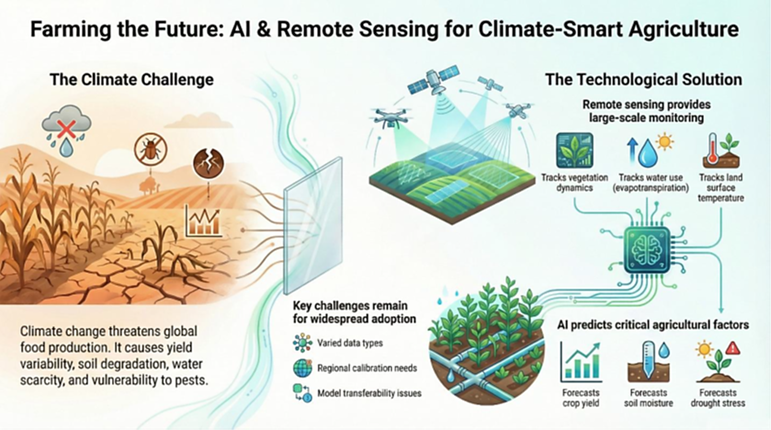
Climate change poses a profound threat to global agriculture, leading to yield variability, soil degradation, water scarcity, and increased vulnerability to pests and diseases. Over the past decade, Remote Sensing (RS) has emerged as a transformative tool in understanding, detecting, and mitigating these impacts. A wide body of research demonstrates that AI-driven models, particularly machine learning and deep learning techniques, are effective in predicting crop yield, drought stress, and soil moisture variability, while remote sensing provides large-scale, high-resolution monitoring of vegetation dynamics, evapotranspiration, and land surface temperature. Recent studies highlight advances in multi-sensor data fusion, cloud-based platforms, and AI enhanced climate models that enable more precise and timely assessments. Despite these advances, challenges remain in terms of data heterogeneity, the need for regional calibration, and the limited transferability of models across agro-climatic zones. This review synthesizes recent progress in AI- and RS-based agricultural monitoring under climate change, critically evaluates their applications and limitations, and identifies future research directions such as explainable AI, integration with socio-economic data, and the development of localized climate-smart decision-support systems.
Graphical Abstract
Novelty statement
This review synthesizes recent progress in AI- and RS-based agricultural monitoring under climate change, critically evaluates their applications and limitations, and identifies future research directions such as explainable AI, integration with socio-economic data, and development of localized climate-smart decision-support systems.
