

 Open Access||Research Article
Effects of Greenhouse Gas Emissions on Climate Change and Animal Productivity and the Use of Radioisotopes to Measure it: A Review
Alsaied Alnaimy Mostafa Habeeb
Egyptian Atomic Energy Authority, Nuclear Research Center, Radioisotopes Application Davison, Biological Applications Department, Cairo, P.O. 13759, Egypt.
Abstract
Atmospheric concentrations of greenhouse gases (GHGs) are increasing, and the average global temperature is increasing. Consequently, nations are striving to make evidence-based decisions to achieve the emission reduction targets set by international agreements such as the Kyoto Protocol and the Paris Agreement. The principal GHGs are carbon dioxide (CO₂), methane (CH₄) and nitrous oxide (N₂O), together with fluorinated gases. GHG emissions play a crucial role in climate change because they absorb infrared radiation from the Earth's surface, thereby increasing the amount of energy reaching the lower atmosphere and contributing to global climate change. Isotopic techniques are widely used to attribute GHG emissions to their sources. Stable isotope ratios (e.g., ¹³C/¹²C, ¹⁵N/¹⁴N) provide an isotopic “fingerprint” of the origin of CH₄ and N₂O, whereas radiocarbon (¹⁴C), which is absent from fossil fuels, distinguishes fossil-derived CO₂ from biogenic CO₂; when combined with atmospheric concentration data, these ratios allow the contribution of each source to be estimated. The World Meteorological Organization and the International Atomic Energy Agency support GHG monitoring as part of global technical cooperation initiatives. Many nations cannot employ isotope tracking to monitor and analyze greenhouse gas emissions; international and regional collaboration is crucial for reducing the negative effects of climate change on environmental livestock production and animal health.
Keywords
Graphical Abstract
Novelty Statement
While stable isotopes and radiocarbon (14C) are established tools for fingerprinting greenhouse gas sources, their deployment has remained highly unequal globally. This study uniquely shifts the focus from localized technical applications to the critical architecture of international and regional technical cooperation (supported by the WMO and IAEA). By analyzing the systemic barriers that prevent developing nations from utilizing isotope tracking, this work offers a novel framework connecting high-level atmospheric science directly to regional environmental livestock production and animal health. It establishes a necessary roadmap for bridging the global data divide to achieve true evidence-based compliance with the Paris Agreement.
1. Introduction
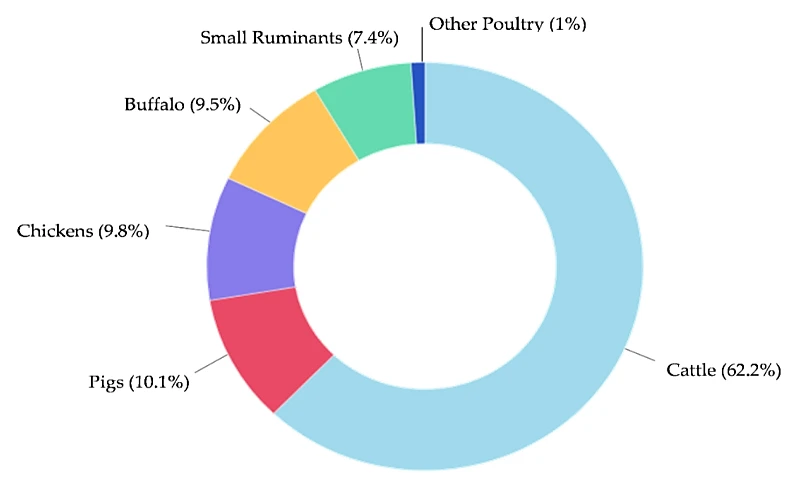
Human activities and natural sources emit greenhouse gases (GHGs) into the atmosphere. Atmospheric greenhouse gas (GHG) emission concentrations have increased by approximately 39%, and the concentration of CH4 has more than doubled since the industrial revolution.[1] Agriculture, forestry, and other land use sectors account for approximately 20% to 24% of the total global anthropogenic greenhouse gas emissions.[2] However, within the agricultural sector specifically, activities account for more than 60% of global anthropogenic non-CO2 GHG emissions, driven primarily by methane (CH4) and nitrous oxide (N2O).[3] The animals are responsible for 18% of GHG emissions. The three main GHGs that cause climate change and global warming are 6% N2O, 16% CH4, 76% CO2 and 2% fluorinated gases. Nitrous oxide (N2O) emissions are released via agricultural fertilizers, industrial processes, and fossil fuel burning; CH4 emissions from enteric fermentation and manure management systems; and CO2 emissions from changes in land use caused by the need for feed grains, grazing land, and agricultural activities. Fluorinate gas emissions from synthetic, highly potent industrial chemicals used in refrigeration and cooling systems (Fig. 1).[4]
The primary sources of GHG emissions are the manufacturing, agricultural, and energy sectors; agricultural emissions make up more than 24% of total emissions.[2] The first two GHG components are carbon dioxide (CO₂) and CH₄, with CH₄ having a 25-fold greater short-term warming potential than CO₂ does.[5] One significant human-induced source of methane (CH₄) emissions in the agricultural sector is livestock, which accounts for 18% of total global GHG emissions. Ruminant livestock account for 93% of all livestock GHG emissions worldwide, with dairy cows producing the highest amount of GHG emissions.[6] This study analyzed the GHG emission characteristics of lactating Holstein dairy cows to provide a basis for developing strategies to reduce GHG emissions. Jia et al. (2022) reported that CH₄ and CO₂ emissions from the respiration of cows were measured using a green feed system.[7] The green feed system indicated that the total CO₂ production, which includes both CH₄ and CO₂ emissions, was 19,201 g/d. Additionally, total CO₂ per dry matter intake was measured at 831 g/kg, while total CO₂ per energy-corrected milk was 531 g/kg. CH₄ production, expressed in CO₂ equivalents, was 8,304 g/d. Furthermore, the CO₂ equivalent per DMI was 359 g/kg, and the CO₂ equivalent per energy-corrected milk was 229.5 g/kg. One powerful GHG that significantly affects the global climate is atmospheric CH₄. Among the most prevalent trace gases in the atmosphere, CO₂ is the main cause of global climate change. Rising GHG concentrations in the atmosphere caused an increase in environmental temperatures and, consequently, climate change. The rising average temperature of the atmosphere, or global warming, is the most evident sign of climate change. Every year, the global temperature increases by 0.40 to 0.70°C. According to the Intergovernmental Panel on Climate Change, by the year 2100, the average global surface temperature could increase by 1.88 to 4.00 degrees Celsius. An increase in the global average surface temperature strongly affects food security in developing nations.[5,8] As projected by climate models, temperatures are expected to increase by 0.3 to 4.8°C over the next century, with significant consequences for agriculture and livestock production.[9]
Fig. 1: Global distribution of livestock-sector greenhouse gas emissions by major domestic animal categories.
2. Impact of GHG emissions on climate change and animal productivity
GHG emissions into the atmosphere drive climate change, which in turn adversely affects animal production and reproduction.[10] Climate change-related high-temperature stress is among the main factors affecting livestock productivity worldwide, and its severity is determined by several interacting factors.[11] The outcomes are erratic rainfall, flooding, frequent droughts, glacier melting, a danger to biodiversity, a rise in plant and animal illnesses, and an endless array of public health issues.[12] The summer temperatures in most of the world’s nations exceed 45°C, which is 18°C higher than the highest essential temperature for dairy cattle. Even with moderate humidity, high-yielding dairy cows become uncomfortable when temperatures exceed 27°C. The availability of grain and fodder, animal stress, particularly heat-related stress, and animal physiological and reproductive activity are the four ways in which climate change may affect the animal production system.[13] When temperatures increase, animals expend energy by panting and perspiring; this is how nature facilitates their cooling through the process of evaporation.[14] Milk yield can decline by up to 50% during summer, and exotic or crossbred cattle are more susceptible to heat stress losses than native cattle are.[15] When temperatures exceed 27 degrees Celsius and the relative humidity reaches 80%, cows suffer from heat-induced depression, as reflected by reduced food intake and decreased production.[13]
In many developing countries, ambient temperatures can exceed 40°C for a period of up to six months.[16] Approximately one-third of the world’s cow population resides in tropical and subtropical regions. This highlights the importance of reducing the instances of feed consumption, milk production, and reproductive rates. This decline in these crucial metrics can severely affect food security and jeopardize the livelihoods of farmers in these regions. When the heat generated by metabolism, combined with heat from the environment, surpasses the heat that the cattle expel from their bodies, heat stress occurs. Heat stress can arise from an unfavorable combination of environmental factors, such as precipitation, wind speed, solar radiation, relative humidity, and ambient temperature. According to Habeeb et al. these external conditions tend to shift the physiological variables of an animal away from their equilibrium levels.[14] Heat stress has become a major focus of cattle research. Mammals use both sensible and insensible methods to remove heat from their body, maintaining thermal equilibrium. In addition to emitting significant amounts of heat into the environment, cattle also attempt to mitigate the severity of heat stress by lowering the generation of metabolic heat. The primary reason for a decline in feed efficiency is either a decrease in metabolic heat production or an increase in energy expenditure for thermoregulatory processes.[17] Numerous detrimental effects on physiology, behavior, productivity, reproduction, health, and well-being are examples of general reactions to temperature stress. These consequences, therefore, must impact the quantity and quality of livestock products that may be produced.[13,18] Furthermore, 20–30% of plant and animal species are likely to face an increased risk of extinction as warming continues, with serious consequences for food security in developing countries.[8]
Heat stress, particularly during the summer months, poses a significant challenge for the dairy sector. Rising temperature and humidity have adverse effects on various aspects, including milk production, feed intake, feed efficiency, reproduction, health, and even the growth rate of farm animals.[19] A significant challenge facing dairy production is the instability of weather conditions attributed to global climate change. For cattle farmers worldwide, heat stress is a significant concern. In 2015, a herd of 100 cows in the European Union was associated with a loss of between 70 and 550 kg of milk daily compared with previous years. On the basis of current milk prices, projected losses are expected to increase from an estimated US$670 million in 2014 to US$2.2 billion annually by the end of the century.[20] The USA ranks among the top producers of cow's milk globally, accounting for 14.2% of total production in 2014, according to statistical information from the FAO. Following the USA are India, China, Germany, and Brazil. One factor contributing to the decline in milk production is environmental variance.[20] Predicting heat stress is crucial for sustaining global milk production levels, particularly in light of the geographical distribution of the largest producers of milk worldwide and the increasing heat stress challenges encountered by dairy cows. However, a more significant concern for breeders may be reproductive issues. Fertility, much like milk output, is also influenced by heat stress; however, issues related to fertility are more difficult to identify and tend to become evident over time. Heat stress impairs fertility, diminishes the effectiveness of insemination, and complicates the identification of estrus in cows. Furthermore, heat stress increases the incidence of stillbirth, postpartum paralysis, calving problems, and irritation of the uterine mucous membrane.[21] A negative energy balance can lead to decreased sperm production in stud bulls, the formation of ovarian cysts, interference with germinal vesicle maturation, and fluctuations in steroid concentrations, which may ultimately result in embryonic death.[22] Oxidative stress negatively affects animal production when an animal is exposed to heat stress conditions. Additionally, hyperthermia and other physiological abnormalities are among the detrimental consequences of heat stress in dairy cows.[23] Therefore, it may be possible to prevent large financial losses caused by heat stress by identifying specific genomes or gene markers related to heat tolerance and genetically selecting animals containing those genes.[24] Heat stress has a detrimental effect on the health and biological functions of dairy cows, resulting in decreased milk production.[25] Insulin resistance and mammary epithelial apoptosis, which are induced by oxidative stress under heat stress conditions, are responsible for the reduced milk protein and casein contents.[26] Therefore, identifying genes or genetic markers associated with heat tolerance and selecting animals that carry them may help prevent large economic losses caused by heat stress.[24]
3. Estimation of GHG using Isotopic and Nuclear techniques
Extreme weather events are becoming more frequent as a result of rapid global climate change in response to rising anthropogenic GHG emissions. The average global temperature is increasing because GHGs are trapped in the atmosphere; thus, the average global temperature of GHGs is increasing. Many nations struggle to accurately identify the sources of GHG emissions and trace them back to their origins. This constraint makes it difficult for countries to make evidence-based decisions to achieve the reduced emission objectives set by international agreements such as the Kyoto Protocol and the Paris Agreement. By identifying the sources of GHG emissions and quantifying their amounts, countries can strategically target the most significant sources of pollution, thereby aiding in the achievement of climate change goals. Measurement and analysis of greenhouse gas emissions are crucial for tracking progress toward global climate objectives and for minimizing carbon footprints.[27] Capturing, using, lowering, and storing greenhouse gases, which are critical in problems such as global warming and climate change, requires an understanding of their sources, emissions, measurements, and management.[28] GHGs include various gases, but CO₂, CH₄ and N₂O emissions from agricultural sources play a significant role in the overall increase in the GHG effect. Emissions of greenhouse gases, especially changes in atmospheric concentrations, significantly impact global climate change. These GHGs are important because they absorb infrared radiation from the Earth's surface, increasing the amount of energy that reaches the lower atmosphere's surface, even though they make up a lesser portion of the atmosphere than nitrogen and oxygen.[29] To determine the components and drivers of GHGs, stable isotopes such as 12C and 13C, 14N and 15N, and 16O and 18O may be used.[30] These stable isotopes do not undergo radioactive decay and are primarily measured using stable isotope ratio mass spectrometry (IRMS) to track mass-dependent fractionation processes. The highest priority on scientific agendas worldwide is the measurement of GHGs released into the atmosphere. The need to study hesitation when developing GHG emission inventories has increased alongside increasing global concern and cooperation regarding climate change. The IPCC emphasizes the need to perform uncertainty analyses and provides recommendations for how to carry them out.[31] In contrast, nuclear techniques utilize radioisotopes to estimate GHG emissions using techniques such as isotopic fingerprinting, which examine the ratios of isotopes found in the atmosphere to identify the sources and concentrations of these gases. Radioisotopes demonstrate changes in global atmospheric circulation, possibly caused by global warming.[32] Vital radioisotopes, particularly radiocarbon (¹⁴C), are analyzed via accelerated mass spectrometry or beta counting to track radioactive decay. This is instrumental in distinguishing between contemporary biological sources of carbon and ancient fossil fuel sources. This distinction arises because fossil fuels have undergone decay to the point where measurable levels of ¹⁴C are no longer present. Nuclear methods offer a precise approach for measuring GHG emissions originating from industrial and agricultural activities, thereby facilitating the identification of their sources. To guarantee the consistency of the data used in climate change monitoring, the International Atomic Energy Agency (IAEA) has also set criteria for calibrating carbon isotope ratios. Scientists may analyze isotopes in GHG emissions in the air and determine their origin and concentration by using the nuclear method known as “isotopic fingerprinting”. As part of an international technical cooperation effort, the IAEA and the World Meteorological Organization are assisting with the tracking of GHG emissions. International and regional collaboration is needed since many nations cannot monitor and analyze GHG emissions via isotopic tracing. Other isotopes, such as stable isotopes and cosmogenic radionuclides, offer important insights into atmospheric circulation and gas transport. This information significantly contributes to our understanding of the global carbon cycle and the budgets of greenhouse gases.[33] Carbonaceous components in the atmosphere are directly linked to climate change, which poses a significant threat to our planet. To improve our understanding of the global carbon cycle and diminish the negative effects of climate change on the environment and human and animal health, Zhang et al. contend that a deeper understanding of the emission sources and environmental fate of carbonaceous components is crucial.[34] To measure the flow of carbon in different carbon reservoirs, such as CH₄ and CO₂ reservoirs, radiocarbon (¹⁴C), which is fully destroyed in fossil fuels, is a perfect instrument. Nuclear power stations also have a pronounced effect on the total amount of CO₂ in the atmosphere through sea-air gas exchange. According to Zhang et al. nuclear power facilities also emit CO₂, which must impact the surrounding air concentrations of ¹⁴CO₂.[34] Nitrous oxide depletes the ozone layer in addition to being a significant greenhouse gas. Natural processes in terrestrial ecosystems and seas release N₂O. Anthropogenic N₂O emissions, which are caused mainly by agricultural and other land use activities, are linked to the intensification of cultivation and other human activities, such as increased use of synthetic fertilizers, inefficient use of irrigation water, deposition of excreta grazing animals, excessive and ineffective application of farm effluents and animal manure to croplands and pastures, and management practices that promote soil organic nitrogen mineralization and carbon decomposition.[35]
4. Conclusion
Rising GHG concentrations in the atmosphere have caused increases in environmental temperatures and, consequently, climate change. The rising average temperature of the atmosphere is the most evident sign of climate change. The production of dairy products is encountering significant challenges because of the increasing variability in climatic conditions resulting from global climate change. For cattle farmers worldwide, heat stress is crucial. To mitigate greenhouse gas emissions from livestock systems, innovations in animal gastrointestinal feeding are becoming increasingly crucial. Advancements in understanding the role of microbial ecology in food metabolism are opening up new avenues for reducing emissions and enhancing productivity. These developments support the adoption of climate-smart farming practices designed to address the impacts of climate change. Emphasis is placed on microbial ecology, particularly its influence on food metabolism. Radioisotopes may be used to estimate GHG emissions using isotopic fingerprinting, which examines the ratios of isotopes found in the atmosphere to identify the sources and concentrations of GHGs.
Acknowledgment
This work was supported by the Biological Application Department, Radioisotopes Applications Division, Nuclear Research Centre, Egyptian Atomic Energy Authority.
Funding
This research did not receive any specific grant from funding agencies in the public, commercial, or not-for-profit sectors.
Data Availability Statement
No data were generated or analyzed during the current study. Therefore, data sharing is not applicable to this article.
Conflict of Interest
There is no conflict of interest.
Artificial Intelligence (AI) Use Disclosure
The author declares that no artificial intelligence was used. All technical content, experimental implementation, results, and interpretations were independently developed and verified by the author.
Supporting Information
Not applicable.
References
- [1] World Health Organization (WHO), Health statistics and health information systems, 2009, https://cir.nii.ac.jp/crid/1570572701019916160, Accessed 23 July 2026.
- [2] IPCC, Climate Change 2023: Synthesis Report, Contribution of Working Groups I, II and III to the Sixth Assessment Report of the Intergovernmental Panel on Climate Change, IPCC, Geneva, Switzerland, 35-115, doi: 10.59327/IPCC/AR6-9789291691647.
- [3] F. N. Tubiello, M. Salvatore, A. F. Ferrara, J. House, S. Federici, S. Rossi, R. Biancalani, R. D. Condor Golec, H. Jacobs, A. Flammini, P. Prosperi, The contribution of agriculture, forestry and other land use activities to global warming, 1990–2012, Global change biology, 2015, 21, 2655-2660, doi: 10.1111/gcb.12865.
- [4] FAO, Emissions totals, 2022, https://www.fao.org/faostat/en/#data/GT, Accessed 01 August 2026.
- [5] IPCC (Intergovernmental Panel on Climate Change), Climate change, Synthesis report. Summary for policymakers. Fifth assessment report on consistent treatment of uncertainties, intergovernmental panel on climate change (IPCC), Geneva, Switzerland, 2016, https://www.ipcc.ch/site/assets/uploads /2018/02/AR5_SYR_FINAL_SPM.pdf, Accessed 25 July 2026.
- [6] S Thakuri, P. Baskota, S. B. Khatri, A. Dhakal, P. Chaudhary, K. Rijal, R. M. Byanju, Methane emission factors and carbon fluxes from enteric fermentation in cattle of Nepal Himalaya, Science of The Total Environment, 2020, 746, 141184, doi: 10.1016/j. scitotenv.2020.141184.
- [7] X Jia, W Yan, J Yang, W Chen, H Ma, X Chen, J Liu, Y Zhong, Z Shangguan, Global patterns and controls of soil greenhouse gas fluxes and crop yield under biochar application, Land Degradation & Development, 2023, 34, 5622-5634, doi: 10.1002/ldr.4868.
- [8] FAO, Climate related Trans boundary pests and diseases. technical background document from expert consultation, 2008, https://openknowledge.fao.org/server/api/core/bitstreams/9f31b468-7bfe-4fdf-8d2d-d61013176ef1/content, Accessed 01 August 2026.
- [9] A. K. Wankar, S. N. Rindhe, N. S. Doijad, Heat stress in dairy animals and current milk production trends, economics, and future perspectives: the global scenario, Tropical Animal Health and Production, 2021, 53, 70, doi: 10.1007/s11250-020-02541-x.
- [10] D. S. Chauhan, N. Ghosh, Impact of climate change on livestock production: A review, Journal of Animal Research, 2014, 4, 223-39, doi: 10.5958/2277-940X.2014.00009.6.
- [11] P. Herbut, S. Angrecka, D. Godyń, Effect of the duration of high air temperature on cow’s milking performance in moderate climate conditions, Annals of Animal Science, 2018, 18, 195-207, doi: 10.1515/aoas-2017-0017.
- [12] S. Sarkar, R. N. Padaria, Farmers’ awareness and risk perception about climate change in coastal ecosystem of West Bengal, Indian research journal of extension education, 2010, 10, 32-38.
- [13] A. Chakrabarti, A. Suklabaidya, V. Singh, D. Daschaudhuri, P. K. Sarkar, K. Nath, Effect of climate change and heat related stress in dairy cattle, Indian Farming Digest, 2022, 1, 202209.
- [14] A. A. Habeeb, S. F. Osman, F. E. Teama, A. E. Gad, The detrimental impact of high environmental temperature on physiological response, growth, milk production, and reproductive efficiency of ruminants, Tropical animal health and production, 2023, 55, 388, doi: 10.1007/s11250-023-03805-y.
- [15] A. A. Habeeb, A. E. Gad , M. A. Atta, Temperature-Humidity Indices as indicators to heat stress of climatic conditions with relation to production and reproduction of farm animals, International Journal of Biotechnology and Recent Advances, 2018, 1, 35-50, doi: 10.18689/ijbr-1000107.
- [16] A. A. Habeeb, The adverse effects of climate change on the productive and reproductive performance of livestock, Eliva Press, Moldova, Europe, 2026, 1-63.
- [17] J. T. Howard, S. D. Kachman, M. K. Nielsen, T. L. Mader, M. L. Spangler, The effect of myostatin genotype on body temperature during extreme temperature events, Journal of Animal Science, 2013, 91, 3051-3058, doi: 10.2527/jas.2012-6180.
- [18] P. J. Hansen, Exploitation of genetic and physiological determinants of embryonic resistance to elevated temperature to improve embryonic survival in dairy cattle during heat stress, Theriogenology, 2007, 68, S242-249, doi: 10.1016/j.theriogenology.2007.04.008.
- [19] D. Hossain, S. Rahman, U. Kulsum, S. Z. Bristi, M. R. Karim, A. J. Masroure, M. Begum, M. M. Ali, Effect of heat stress on the health and performance of dairy cattle: A comprehensive review, Vietnam Journal of Agricultural Sciences, 2025, 8, 2575-2592, doi: 10.31817/vjas.2025.8.2.13.
- [20] G. Mauger, Y. Bauman, T. Nennich, E. Salathé, Impacts of climate change on milk production in the United States, The Professional Geographer, 2015, 67, 121-131, doi: 10.1080/00330124.2014.921017.
- [21] Z. Roth, Effect of heat stress on reproduction in dairy cows: insights into the cellular and molecular responses of the oocyte, Annual Review of Animal Biosciences, 2017, 5, 151–170, doi: 10.1146/annurev-animal-022516-022849.
- [22] P. Herbut, S. Angrecka, J. Walczak, Environmental parameters to assessing of heat stress in dairy cattle—a review, International journal of biometeorology, 2018, 62, 2089-2097, doi: 10.1007/s00484-018-1629-9.
- [23] A. A Habeeb, A. E. Gad, F. E. I. Teama, S. F. Osman, Global Climate Change effects on milk yield and composition of dairy cattle, Agricultural Extension Journal, 2025, 9, 202-211.
- [24] A. R. Sesay, Effect of heat stress on dairy cow production, reproduction, health, and potential mitigation strategies, Journal of Applied and Advanced Research, 2023, 8, 13-25, doi: 10.21839/jaar.2023.v8.8371.
- [25] C. P. Oliveira, F. C. Sousa, A. L. Silva, É. B Schultz, R. I. Valderrama Londoño, P. A. Souza, Heat stress in dairy cows: Impacts, identification, and mitigation strategies—A review, Animals, 2025, 15, 249, doi: 10.3390/ani15020249.
- [26] H. Delower, R. Sabrina, K. Umme, B. Tasnim, M. K. Robiul, M. Jamai, B. Maksuda, A. Mahabbat, Effect of Heat Stress on the Health and Performance of Dairy Cattle: A Comprehensive Review, Vietnam Journal of Agricultural Sciences, 2025, 8, 2575–2592, doi: 10.31817/vjas.2025.8.2.13.
- [27] L. A. Harper, O. T. Denmead, T. K. Flesch, Micrometeorological techniques for measurement of enteric greenhouse gas emissions, Animal Feed Science and Technology, 2011, 166, 227-239, doi: 10.1016/j.anifeedsci.2011.04.013.
- [28] G. Liu, Greenhouse Gases: Emission, Measurement and Management, BoD–Books on Demand, 2012.
- [29] Z. Zhiqiang, Q. Jiansheng, Z. Jingjing, A quantitative comparison and analysis on the assessment indicators of greenhouse gases emission, Journal of Geographical Sciences, 2008, 18, 387-399.
- [30] X. Zhu, D. Di, M. Ma, W. Shi, Stable Isotopes in Greenhouse Gases from Soil: A Review of Theory and Application, Atmosphere, 2019, 10, 1-14, doi: 10.3390/atmos10070377.
- [31] M. Jonas, R. Bun, Z. Nahorski, G. Marland, M. Gusti, O. Danylo, Quantifying greenhouse gas emissions, Mitigation and Adaptation Strategies for Global Change, 2019, 24, 839-852, doi: 10.1007/s11027-019-09867-4.
- [32] L. Terzi, G. Wotawa, M. Schoeppner, M. Kalinowski, P. R. Saey, P. Steinmann, L. Luan, P. W. Staten, Radioisotopes demonstrate changes in global atmospheric circulation possibly caused by global warming, Scientific reports, 2020, 10, 10695, doi: 10.1038/s41598-020-66541-5.
- [33] IAEA (International Atomic Energy Agency), Isotope aided studies of atmospheric carbon dioxide and other greenhouse gases Phase II, Vienna, Austria, 2002, IAEA-TECDOC-1269:1-129, https://www-pub.iaea.org/MTCD/Publications/PDF/te_1269_web.pdf, Accessed 28 July 2026.
- [34] G. Zhang, L. Junwen, J. Li, P. Li, N. Wei, B. Xu, Radiocarbon isotope technique as a powerful tool in tracking anthropogenic emissions of carbonaceous air pollutants and greenhouse gases: A review, Fundamental Research, 2021, 1, 306-316, doi: 10.1016/j.fmre.2021.03.007.
- [35] M. Zaman, L. Heng, C. Müller, Measuring emission of agricultural greenhouse gases and developing mitigation options using nuclear and related techniques, Applications of nuclear techniques for GHGs, Springer Nature, 2021, doi: 10.1007/978-3-030-55396-8.
Publisher Note
The views, statements, and data in all publications solely belong to the author. GR Scholastic is not responsible for any injury resulting from the ideas, methods, or products mentioned. GR Scholastic remains neutral regarding jurisdictional claims in published maps and institutional affiliations.
Open Access
This article is licensed under a Creative Commons Attribution-Non Commercial 4.0 International License, which permits the non-commercial use, sharing, adaptation, distribution and reproduction in any medium or format, as long as appropriate credit to the original author(s) and the source is given by providing a link to the Creative Commons License and changes need to be indicated if there are any. The images or other third-party material in this article are included in the article's Creative Commons License, unless indicated otherwise in a credit line to the material. If material is not included in the article's Creative Commons License and your intended use is not permitted by statutory regulation or exceeds the permitted use, you will need to obtain permission directly from the copyright holder. To view a copy of this License, visit: https://creativecommons.org/licenses/by-nc/4.0/
© The Author(s) 2026