

 Open Access||Editorial
Journal Editorial: The Role of Science, Technology and Innovations Towards Sustainable Development
1 Data Analytics and Collaborative Computing Laboratory, Faculty of Science and Technology, University of Macau, Macau
2 Editor-in-Chief, Journal of Collective Sciences and Sustainability, GR Scholastic, Ahmedabad, Gujarat, 382424, India
3 GR Scholastic, Ahmedabad, Gujarat, 382424, India
4 Managing Editor, Journal of Collective Sciences and Sustainability, GR Scholastic, Ahmedabad, Gujarat, 382424, India
Graphical Abstract
Editorial
Science, Technology and Innovation (STI) are essential drivers of sustainable and inclusive development.[1,2] Science, technology, and innovation must address all aspects of sustainable development-economic, social, and environmental considerations and their interrelations, as technological advancements can negatively impact both social and environmental well-being. Science helps to understand environmental systems and human impact. It informs policy decisions and helps predict long-term outcomes of unsustainable practices. Technology offers practical tools and solutions by translating scientific understanding in to practical solutions. Innovation ties them together to have creative and efficient ways to meet human needs without compromising future generations.
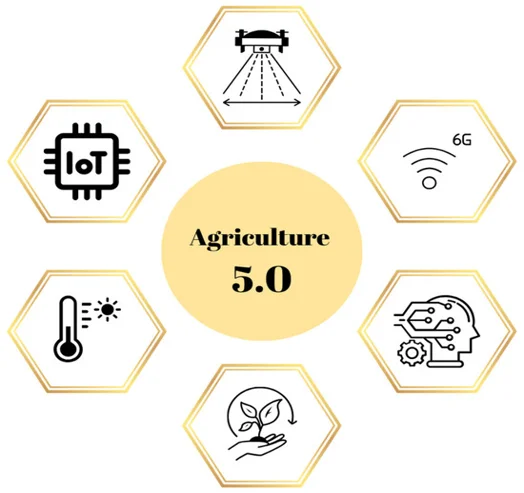
In the recent years, STI contributing to sustainability in clean energy by advancing solar, wind and batteries and enables shift away from the fossil fuels by making low carbon energy more accessible and affordable.[3] In agriculture, precision farming as shown in Fig. 1 and biotechnology are improving crop yields while reducing environmental impact.[4] Similarly, digital innovations like artificial intelligence, Internet of Things (IoT), and big data are helping monitor ecosystems, reduce waste, and enhance urban planning.[5-7]
Journal of Collective Sciences and Sustainability (https://gr-journals.com/journals/css) (accessed 25 June 2025) is an open-access, quarterly, multidisciplinary, peer-reviewed journal that publishes high-quality articles on the technical, environmental, cultural, economic, and social aspects of sustainability. It emphasizes the role of science and technology to a sustainable future through innovation, technological advancements, and smart solutions. The journal offers a dynamic space for advancing scholarly work on sustainability and sustainable development, engaging with critical global challenges that affect the long-term well-being of humanity. With a focus on innovative and interdisciplinary approaches, this journal promotes research that supports balanced, inclusive, and resilient solutions for a sustainable world. This journal welcomes a variety of article types, including original research papers, comprehensive reviews, and impactful case studies, offering a dynamic space for scholarly exchange and professional insights.
This first issue (June 2025) brings together a diverse collection of high-quality research articles. Pathan and Patare explored how profit-centric AI development concentrates control in the hands of a few, risking widespread job displacement, ethical oversights, and socioeconomic instability. Narendra Yadav and Pallavi Yadav discussed the role of blockchain in cryptocurrency and information technology. Goar et. al. reported Valence Aware Dictionary and sentiment Reasoner (VADER) based an analysis of public sentiments expressed in the Twitter database regarding the Coronavirus disease (COVID-19) vaccine. Soni and Poonia investigates the potential for an enhancement in digital forensics based on an integration with Artificial Intelligence (AI) and Open-Source Intelligence (OSINT) sources. Shaik et al. proposed a system that offers a mechanically simple, scalable and modular solution without moving parts, making it ideal for applications requiring silent operation and precise thrust control.
As a newly launched journal, we are dedicated to providing a leading multidisciplinary platform to emphasizes the role of science and technology to a sustainable future through innovation, technological advancements, and smart solutions. We are committed to uphold the rigorous and efficient peer review process ensuring that every published work meets the highest standards. On behalf of the editorial office, we extend a heartfelt welcome to all our readers, authors, and reviewers. Your participation and engagement are critical to the success of this journal. We encourage you to contribute your work, share your insights, and help us to shape this journal into a leading forum for innovation and discovery.
Conflict of Interest
There is no conflict of interest.
Artificial Intelligence (AI) Use Disclosure
The authors declare that artificial intelligence (AI)-assisted tools were used only for language refinement, grammar improvement, and manuscript structuring purposes during the preparation of this work. All technical content, experimental implementation, results, and interpretations were independently developed and verified by the authors.
References
- Y. Huang, Technology innovation and sustainability: Challenges and research needs, Clean Technologies and Environmental Policy, 2021, 23, 1663-1664, doi: 10.1007/s10098-021-02152-6.
- Z. Sossa, J. Wilder, J. Fernando. G. Suárez, N. María López Suárez, J. L. Solleiro Rebolledo, G. L. Orozco Mendoza, V. Vélez Suárez, Innovation systems and sustainability. development of a methodology on innovation systems for the measurement of sustainability indicators in regions based on a Colombian case study, Sustainability, 2022, 14, 15955, doi: 10.3390/su142315955.
- V. J. Reddy, N. P. Hariram, M. F. Ghazali, S. Kumarasamy, Pathway to sustainability: an overview of renewable energy integration in building systems, Sustainability, 2024, 16, 638, doi: doi: 10.3390/su16020638.
- S. Getahun, H. Kefale, Y. Gelaye, Application of precision agriculture technologies for sustainable crop production and environmental sustainability: a systematic review, The Scientific World Journal, 2024, 2126734, doi: 10.1155/2024/2126734.
- R. Vinuesa, H. Azizpour, I. Leite, M. Balaam, V. Dignum, S. Domisch, A. Felländer, S. D. Langhans, M. Tegmark, F. F. Nerini, The role of artificial intelligence in achieving the sustainable development goals, Nature Communications, 2020, 11, 233, doi: 10.1038/s41467-019-14108-y.
- C. Li, W. Lao, Internet of Things sustainability effects: quantile and temporal insights, Humanities and Social Sciences Communications, 2025, 12, 396, doi: 10.1057/s41599-025-04665-7.
- S. J. Barnes, Y. Guo, J. Chan, Big Data analytics for sustainability: Insight through technological innovation, Information & Management, 2022, 59, 103627, doi: 10.1016/j.im.2022.103627.
- A. Barrios-Ulloa, A. Solano-Barliza, W. Arrubla-Hoyos, A. Ojeda-Beltrán, D. Cama-Pinto, Francisco M. Arrabal-Campos, Alejandro Cama-Pinto, Agriculture 5.0 in colombia: opportunities through the emerging 6g network, Sustainability, 2025, 17, 6664, doi: 10.3390/su17156664.
Publisher Note
The views, statements, and data in all publications solely belong to the authors and contributors. GR Scholastic is not responsible for any injury resulting from the ideas, methods, or products mentioned. GR Scholastic remains neutral regarding jurisdictional claims in published maps and institutional affiliations.
Open Access
This article is licensed under a Creative Commons Attribution-NonCommercial 4.0 International License, which permits the non-commercial use, sharing, adaptation, distribution and reproduction in any medium or format, as long as appropriate credit to the original author(s) and the source is given by providing a link to the Creative Commons License and changes need to be indicated if there are any. The images or other third-party material in this article are included in the article's Creative Commons License, unless indicated otherwise in a credit line to the material. If material is not included in the article's Creative Commons License and your intended use is not permitted by statutory regulation or exceeds the permitted use, you will need to obtain permission directly from the copyright holder. To view a copy of this License, visit: https://creativecommons.org/licenses/by-nc/4.0/
© The Author(s) 2026