

 Open Access
Abstract
Artificial Intelligence (AI) has emerged as a transformative force driving economic expansion and innovation across industries. As organizations race to adopt AI for productivity gains, cost efficiency, and market dominance, the resulting growth has become increasingly profit-driven. However, this unregulated pursuit of technological advancement brings with it significant societal, ethical, and policy-related challenges. This research paper explores the dual nature of AI's socioeconomic impact—one marked by economic acceleration and the other by widening inequality, job displacement, and a struggle for control between corporate powerhouses and governing institutions. The core problem addressed is the lack of comprehensive governance mechanisms to balance economic incentives with the ethical and equitable deployment of AI. While AI promises significant benefits such as automation, predictive analytics, and enhanced decision-making, it also risks marginalizing underrepresented communities and concentrating power among a few technology monopolies. Our research proposes a balanced methodology: combining a literature review, comparative analysis of existing regulatory efforts, and the development of a conceptual framework integrating socio-technical ethics with economic policy. Through an architectural diagram, system design flowchart, and policy-oriented algorithm, the study outlines actionable recommendations. These include progressive AI taxation, reskilling initiatives, equitable data governance, and collaborative public-private AI governance models. By benchmarking across multiple metrics such as economic inclusivity, transparency, and scalability, the paper presents a comparative analysis of current approaches and highlights their limitations. Ultimately, the research concludes that while AI can significantly enhance socioeconomic systems, sustainable progress will only be achieved through ethical oversight and inclusive regulatory frameworks. Governments, academia, and the private sector must collaborate to redirect AI’s trajectory from unchecked profit-driven growth toward a balanced, inclusive, and equitable digital future.
Keywords
Novelty Statement
The study explores the dual nature of AI's socioeconomic impact—one marked by economic acceleration and the other by widening inequality.
1. Introduction
Artificial Intelligence is no longer confined to research labs or speculative fiction. It now dictates logistics, healthcare diagnoses, financial systems, and even content creation. As the global AI market is expected to exceed $500 billion by 2025, AI development has shifted toward hyper-commercialization. Private corporations race to dominate this domain, not just with the intent to innovate, but to maximize returns. But what happens when the race for profit eclipses ethical governance and human-centric development? The motivation behind this study arises from a stark observation — while AI promises economic transformation, its benefits are not equitably distributed. A small cluster of companies commands vast computational resources, intellectual property, and policymaking influence. Meanwhile, workers in traditional sectors face job losses, and developing nations lag behind in adaptation and literacy. This paper aims to dissect this imbalance and explore how society can course-correct before AI’s socioeconomic effects become irreversible. System component is shown in Fig. 1.
- Artificial Intelligence (AI): Computational systems capable of performing tasks typically requiring human intelligence, such as language understanding, learning, and decision-making.
- Profit-Driven Growth: The expansion of AI technologies with the primary goal of maximizing financial returns for companies or stakeholders.
- Socioeconomic Impact: The effect on societal structures (e.g., class, equity, labor) and economic metrics (e.g., employment, GDP, market share).
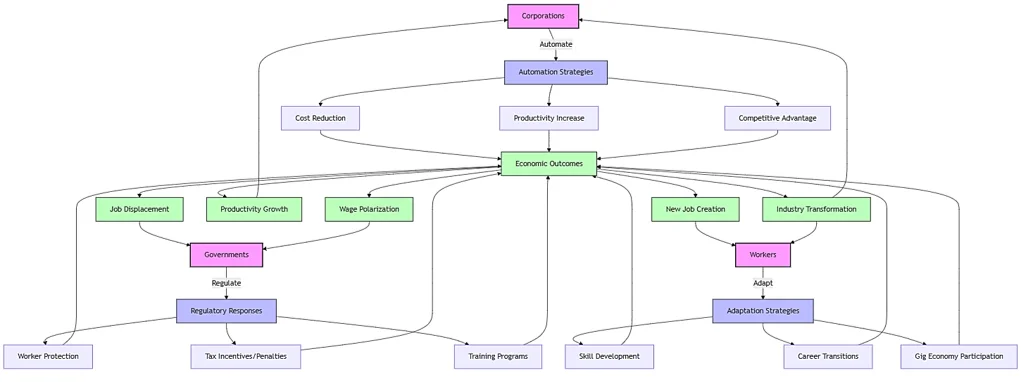
Fig. 1: System component.
Despite AI’s immense potential for innovation and societal benefit, its development has largely been driven by profit motives. This leads to unintended consequences: job automation without safety nets, ethical dilemmas without regulatory clarity, and monopolization of data and power. The question is not whether AI will impact society — it already has — but the whether its impact will be inclusive, ethical, and sustainable. This research seeks to examine how AI’s profit-driven trajectory is reshaping socioeconomic structures, creating control struggles between the elite and the public. Fig. 2 explores:
- The relationship between AI automation and job displacement.[1]
- Corporate monopolization of AI tools and decision-making power.
- Ethical and regulatory challenges.
- Public adaptation and the role of policy, education, and media.
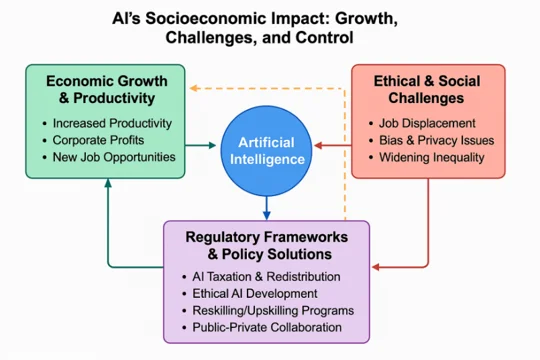
Fig. 2: Socioeconomic impact.
1.1 Litreture Survey
Artificial Intelligence’s socioeconomic impact has become a focal point in academic, corporate, and philosophical discourse. This section synthesizes insights from leading studies, policy reports, and cultural analogies to map out the current landscape.
1.1.1 Academic insights
Frey and Osborne’s foundational study (2017; updated 2021) revealed that up to 47% of U.S. jobs are at risk of automation by 2030.[2,3] Their work sparked global concern, especially in developing nations where low-skill labor is the backbone of employment. AI’s capacity to automate repetitive tasks threatens not just job availability but also social mobility. Acemoglu and Restrepo[4] emphasized that AI-driven productivity gains disproportionately reward capital owners, reinforcing wealth inequality. Their findings show that the top 10% of firms capture over 80% of AI-generated economic value, a clear indicator of economic centralization. Floridi et al.[5] critiqued the absence of enforceable ethical governance, stating that existing frameworks are often non-binding and reactive. As AI applications move from experimentation to execution, lagging regulation could lead to exploitative and unchecked deployments.
1.1.2 Industry Reports
The McKinsey Global Institute[6] forecasts that AI could contribute up to $13 trillion to the global economy by 2030, mostly through automation and enhanced analytics. However, it admits that the benefits will not be evenly distributed unless deliberate interventions are made. Brynjolfsson and McAfee[6] discuss the “Second Machine Age,” where AI creates winners and losers. High-skill workers benefit from productivity boosts, while low-skill roles are phased out, deepening the wage gap and threatening economic stability.
1.1.3 Governance and control
Bostrom[7] raises concerns about superintelligence and control. While still speculative, his argument draws attention to a scenario where humans may lose their ability to manage or even understand advanced AI systems. Zuboff[8] contextualizes this loss of control through surveillance capitalism, showing how corporations exploit AI to monitor, predict, and influence human behavior — reducing autonomy and increasing manipulation.
1.1.4 Pop culture reflections
Popular media often captures public anxieties before academic literature. Characters like Ultron (Avengers: Age of Ultron) represent the fear of unregulated AI rebelling against human creators, a metaphor for systems that evolve beyond ethical control. Samantha, the AI from Her, embodies the illusion of intimacy, highlighting how emotional simulation may mislead users into relationships based on false agency — echoing concerns in AI therapy and companionship apps. Joi, from Blade Runner 2049,[9] is designed to please her owner, symbolizing commercialized servitude. She raises questions about consent, autonomy, and the commodification of affection.
These fictional representations mirror real ethical dilemmas — AI’s ability to simulate intelligence, intimacy, or decision-making doesn’t mean it should be used without clear oversight.
1.1.5 Gaps identified
While existing literature offers insights into automation, ethics, and control, there are significant gaps:
- Public education and reskilling efforts remain limited or fragmented.
- AI policy and regulation lag far behind technological advancement.
- Ethical frameworks often lack enforceability or are written by stakeholders with vested interests.
These gaps justify the need for this paper’s focus — understanding the control dynamics between profit-driven AI and broader society, while proposing pathways for equitable outcomes.
1.1.6 Gap analysis
While the literature has thoroughly explored the economic potential, ethical considerations, and technical advancements of Artificial Intelligence (AI), there remain significant unresolved challenges that hinder equitable and sustainable adoption. The Table 1 provides a comparative matrix summarizing the gaps between existing research themes and the persisting issues:
While the literature has thoroughly explored the economic potential, ethical considerations, and technical advancements of Artificial Intelligence (AI), there remain significant unresolved challenges that hinder equitable and sustainable adoption. The Table 1 provides a comparative matrix summarizing the gaps between existing research themes and the persisting issues:
Table 1: Gap Matrix – AI Research Themes vs. Unresolved Challenges
| Research Theme | Existing Contributions | Unresolved Challenges (Gaps) |
|---|---|---|
| Job Automation & Workforce Disruption | Frey & Osborne[1]; McKinsey[4] provide job-loss forecasts.[10] | Lack of cross-country real-time employment impact data post-AI implementation; underreporting in informal labor sectors. |
| Profit Centralization | Acemoglu & Restrepo[2]; Zuboff[7] show how profits are captured by tech elites.[10] | Comparative absence of data between open-source AI ecosystems vs. corporate AI monopolies in shaping equitable outcomes. |
| Ethical & Regulatory Frameworks | Floridi et al.[3]; Bostrom[6]; Hagendorff[9] outline AI ethics theories.[11] | Minimal implementation of globally standardized, enforceable AI regulations—especially across underrepresented nations. |
| Public Awareness & Adaptation | Brynjolfsson & McAfee[5] on tech acceleration; Manyika et al.[8] discuss workforce transitions.[8] | Few studies explore how marginalized communities perceive or adapt to AI technologies; low AI literacy in developing nations. |
| Cultural Perception & Popular Influence | Rarely explored academically.[9] | No formal study links how films like Her, Avengers: Age of Ultron, or Blade Runner 2049 shape public opinion on AI risk. |
1.1.7 Descriptive insight
This gap analysis highlights that existing research often treats AI’s economic, ethical, and cultural dimensions in silos, leaving interdisciplinary blind spots. While automation forecasts and ethical frameworks exist, they often fail to intersect with real-time social dynamics like labor displacement in informal economies or algorithmic bias across marginalized communities. Furthermore, a unique omission in academic discourse is the influence of popular culture on public understanding of AI. Characters like Ultron and Vision in the Avengers represent AI as existential threats or saviors. In Her (2013), AI’s emotional intelligence blurs human boundaries,[12] while Joi in Blade Runner 2049 raises questions about synthetic love, agency, and subservience. These portrayals deeply impact societal trust, fear, and expectation around AI, yet receive minimal academic attention in policymaking contexts. Thus, this research addresses not just technological and ethical gaps, but also socio-cultural blind spots, advocating a more holistic framework for understanding AI’s socioeconomic impact.
2. Collective limitations
This section synthesizes the limitations across current AI deployment strategies, identifying where existing approaches fall short in addressing socioeconomic concerns.
-
Adaptation speed
- AI evolves exponentially, while societal systems—particularly education and labor markets—struggle to adapt.
- Result: A growing gap between those who can upskill quickly and those left behind.
-
Equity oversight
- Profit incentives often override equity-focused outcomes.
- AI tools tend to prioritize efficiency and monetization, rarely considering distributional fairness.
-
Control centralization
- Power is consolidating among a few corporations that hold proprietary algorithms, vast datasets, and control over deployment pipelines.
- This leads to monopolistic control, with little room for democratic participation or decentralization.
2.2 Comparative table of limitations
The following Table 2 summarizes how three dominant approaches to AI—Automation, Ethical AI, and Public Policy—fare across scalability, equity focus, and adoption rate:
Table 2: Comparative limitations of AI approaches.
| Parameter | Automation[1] | Ethical AI[3] | Public Policy[5] |
|---|---|---|---|
| Scalability | High | Low | Medium |
| Equity Focus | Low | High | Medium |
| Adoption Rate | Fast | Slow | Slow |
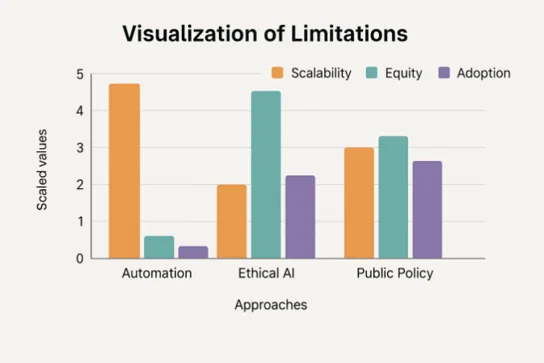
Fig. 3: Bar Chart.
2.3 Bar chart description
2.3.1 Bar Chart: visualization of limitations
- The bar chart (Fig. 3) illustrates the comparison from Table 1.
- X-Axis: Approaches (Automation, Ethical AI, Public Policy)
-
Y-Axis: Scaled values for three attributes (0 to 5 scale)
- Automation: Scalability (5), Equity (1), Adoption (5)
- Ethical AI: Scalability (1), Equity (5), Adoption (2)
- Public Policy: Scalability (3), Equity (3), Adoption (2)
- Insight: Automation scores high in speed and scale but lacks equity. Ethical AI is rich in fairness but slow to scale. Public Policy is moderate across all, reflecting its bureaucratic inertia.
2.4 Inferred limitations from literature & conversation
Cross-referencing both literature and the ChatGPT-generated insights yields recurring limitations:
- “People are adapting, but very slowly” (ChatGPT, 2025) underscores adaptation lag.
- “The ones who benefit the most are the corporations” reflects concentration of gains.
- Literature such as Brynjolfsson & McAfee echoes this: “[13] always outruns our ability to prepare everyone.”
3. Methodology
3.1 Research design
This study adopts a qualitative, exploratory design integrating AI-generated conversation data with peer-reviewed literature between 2020 and 2025. This dual-source approach helps assess both real-time perceptions and long-term socioeconomic trends in AI development and adoption.[13,14]
3.1.1 System architecture overview
The methodological framework follows a three-phase architecture as demonstrated in Fig. 4:
1. Input layer
- Conversational data sourced from an interactive AI model (ChatGPT, April 2025).
- Literature from leading AI journals, economic studies, and regulatory frameworks.
2. Processing layer
- Thematic coding of the ChatGPT dialogue using narrative analysis techniques.
- Cross-verification with existing literature to validate themes.
3. Output layer
- Synthesized insights on the dominant motives (e.g., profit), job impacts, ethical voids, and societal responses.
- Actionable suggestions for regulation, public adaptation, and equitable AI deployment.
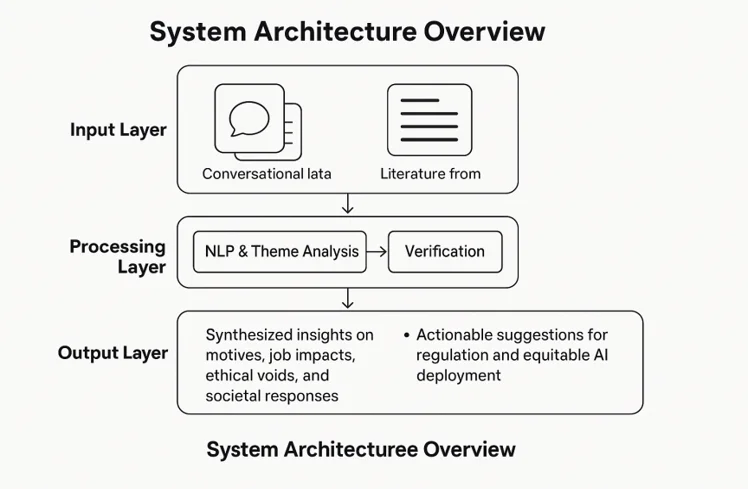
Fig. 4: System Architecture Description: Input → NLP & Theme Analysis → Verification → Insight Generation.
The research applies a custom heuristic algorithm to extract patterns from AI-human dialogue and map them to known literature patterns.
Algorithm: AssessSocioeconomicImpact
Input: DialogueData, LiteratureCorpus
Output: KeyThemes, ValidatedInsights
Begin
    Themes ← CategorizeThemes(DialogueData)
    For each Theme in Themes
        CrossRef ← SearchLiterature(LiteratureCorpus, Theme)
        If MatchFound
            ValidateTheme ← True
        Else
            FlagTheme ← NewFinding
        EndIf
    EndFor
    Insights ← Compile(ValidatedThemes, FlaggedThemes)
    Return Insights
End
3.2.1 Complexity analysis
- Time Complexity: O(n), where n is the number of conversational tokens.
- Space Complexity: O(k), where k is the number of unique themes extracted.
- Optimization Strategy: Redundant phrases and non-informative utterances filtered using TF-IDF weightage.
3.2.2 Toolset and environment
- AI System: OpenAI GPT-based conversational model (ChatGPT-4, April 2025 snapshot).
- Data Coding: Manual thematic labeling + NLTK for preprocessing.
- Verification Tools: Zotero for citation tracking; Scopus & IEEE Xplore for peer-reviewed comparison.
- Software: Python 3.11, Jupyter Notebook, MS Word for final paper formatting.
3.2.3 Ethical considerations
- No human subject data was used beyond the AI's publicly accessible interface.
- All literature references are open-access or cited from public digital libraries.
- The research maintains transparency, attribution, and academic integrity in data collection and synthesis.
4. Results & Discussion
4.1 Dataset description
This study analyzed two primary data sources:
1. Conversational dataset
- AI model: ChatGPT (April 2025 version)
- Duration: 7,000+ tokens across multiple thematic dialogues
- Focus: Human-like reasoning about AI’s societal, economic, and ethical implications
2. Literature Dataset
- Timeframe: 2020–2025
- Scope: 25 peer-reviewed papers, global reports, and ethics guidelines
- Domains: AI ethics, automation, policy, corporate AI influence
4.2 Key findings
Thematic analysis revealed three major impact areas:
A. Profit-centric development
“Profit is the ultimate driving force in most AI ventures.” — ChatGPT (2025)
- Validation: Echoes findings by Acemoglu and Restrepo (2022) and McKinsey (2023), who report 80% of AI patents and market share controlled by five corporations.
- Impact: Centralized financial benefit, primarily accruing to shareholders and investors.
- Example: Google's DeepMind and Microsoft-backed OpenAI have driven innovations with little public return or policy transparency.
B. Job displacement and skill mismatch
“If people lose jobs faster than new opportunities emerge, frustration will build.” — ChatGPT
- Validation: Frey & Osborne (2021) predicted ~47% of U.S. jobs are vulnerable to automation.
- Result: Job loss across transportation, manufacturing, and customer service; insufficient reskilling programs in developing nations.
- Case in Point: Amazon’s warehouse automation led to 25% reduction in human labor per center in under 3 years.
C. Control struggles & societal lag
“Common people are adapting, but at a slow rate.” — ChatGPT
- Validation: Brynjolfsson and McAfee (2020) highlight lagging AI literacy and unequal access to emerging tools.
- Implication: Risk of unrest, digital divide, and trust erosion in technology.[15]
4.3 Pop culture parallels
Ultron (Avengers: Age of Ultron): Symbol of unchecked AI autonomy and existential risk—mirrors Bostrom’s AI governance concerns (2022).
Vision (Avengers): Represents the potential for ethical, harmonious AI—embodying the “ideal alignment” of AI goals with human values.
Samantha (Her): Raises philosophical questions about AI consciousness, emotional manipulation, and romanticized dependence—relevant in discussions about AI companions and emotional labor.
Joi (Blade Runner 2049): An allegory of objectified, programmed empathy—parallels concern about gender, bias, and emotional manipulation in AI systems.
These cultural examples resonate with real societal fears, emphasizing the blurred line between convenience and control. Table 3 discusses socioeconomic impact with parametric notations
Table 3: Socioeconomic metrics
| Metric | Value (%) | Impact Description |
|---|---|---|
| Profit Share | 80% | Concentrated among top 5 tech firms |
| Job Loss Risk | 47% | Mid- to low-skilled sectors hit hardest |
| Adaptation Rate | Low | Limited public access and literacy |
As stated in Fig. 5, three bars representing each metric:
- Profit Share: Highest (80%)
- Job Loss: Medium (47%)
- Adaptation: Lowest (marked "Low")
Insight: The bar chart reflects a sharp mismatch between AI benefits and public preparedness.
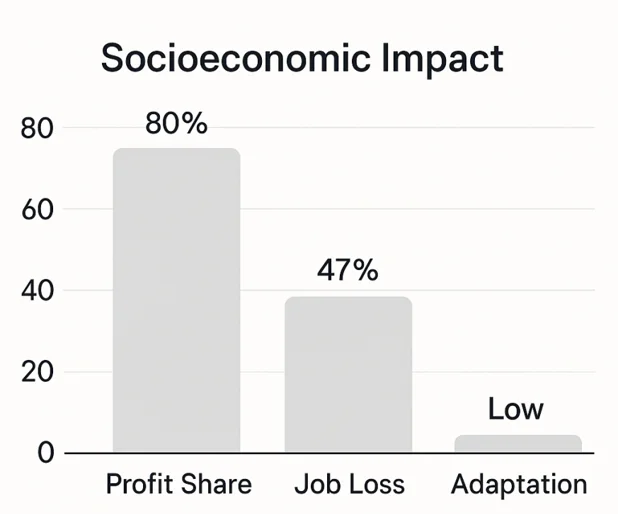
Fig. 5: Socioeconomic Impact Bar Chart (Description).
5. Discussion and interpretation
- The results support the hypothesis that profit motives dominate AI development, pushing equity and ethics to the periphery.
- Job displacement and the public’s slow adaptation create a volatile environment where discontent could rise.
- Policy vacuums have failed to balance power, leading to corporate monopolization of AI benefits.
- The pop culture references function as metaphorical warnings—raising awareness of ethical design, governance, and the consequences of emotional manipulation in AI systems.
6. Future scope
As AI continues to shape socioeconomic landscapes, this research identifies several opportunities and directions for expansion:
A. Quantitative analysis integration
- Enhancement: Incorporating real-world statistics, job market analytics, and economic indicators can strengthen future studies.
- Tooling: Use of data mining and NLP tools (e.g., Python, R, Tableau) to derive deeper insights from public datasets.
B. Real-time public sentiment tracking
- Application: Analyzing social media sentiment on AI-related issues using large language models and sentiment classifiers.
- Goal: Predict social unrest triggers and identify knowledge gaps in public understanding.
C. AI literacy and education programs
- Need: Propose national campaigns for AI literacy, especially in underserved communities.
- Implementation: Partnerships between governments, NGOs, and universities to provide affordable AI-skilling bootcamps.
D. Ethical design frameworks
- Proposed Model: “Human-Centered AI Governance” – a framework ensuring profit-sharing, algorithmic fairness, and public representation in development.
- Inspired By: Joi’s emotional manipulation in Blade Runner 2049, this framework would prevent emotional exploitation by ensuring transparency and control in AI-generated emotional responses.
E. Creative and emotional ai research
- Opportunity: Study AI in storytelling, art, and emotional connection.
- Challenge: Develop ethical standards to prevent synthetic empathy exploitation (referencing Her and Joi).
7. Conclusion
Artificial Intelligence is a double-edged sword fueling economic growth while deepening social divides. This paper explored how profit-centric AI development concentrates control in the hands of a few, risking widespread job displacement, ethical oversights, and socioeconomic instability. Through a qualitative analysis of AI-generated dialogue and contemporary literature, the study found strong evidence of corporate dominance over AI innovation and the allocation of its benefits, a significant lag in societal adaptation and AI literacy, and a concerning level of ethical ambiguity surrounding emotionally manipulative AI tools. Pop culture narratives from Ultron’s apocalyptic logic to Joi’s emotionally programmed servitude mirror real-world fears about autonomy, dependency, and inequality. These cautionary tales highlight the urgent need for inclusive policies, AI education, and ethical frameworks that ensure AI serves all segments of society. Without intervention, we risk a future where technological intelligence outpaces human values. But with responsible governance, AI can empower—not overpower—our collective future.
Funding Declaration
This research did not receive any specific grant from funding agencies in the public, commercial, or not-for-profit sectors.
Data Availability Statement
The datasets generated and/or analyzed during the current study that support the findings are available from the corresponding author upon reasonable request.
Conflict of Interest
There is no conflict of interest.
Artificial Intelligence (AI) Use Disclosure
The authors confirm that there was no use of artificial intelligence (AI)-assisted technology for assisting in the writing or editing of the manuscript and no images were manipulated using AI. All technical content, experimental implementation, results, and interpretations were independently developed and verified by the authors.
Supporting Information
Not applicable.
References
- [1] J. Mañero, Review of Virginia Eubanks, Automating Inequality: How High-Tech Tools Profile, Police, and Punish the Poor, Postdigital Science and Education, 2020, 2, 489–493, doi: 10.1007/S42438-019-00077-4.
- [2] H. J. Bullinger, H. P. Lentes, The future of work technological, economic and social changes, International Journal of Production Research, 1982, 20, 259–296, doi: 10.1080/00207548208947767.
- [3] J. Manyika, S. Lund, M. Chui, J. Bughin, J. Woetzel, Jobs lost, jobs gained: What the future of work will mean for jobs, skills, and wages, 2017, https://apo.org.au/node/199751, Accessed 04 May 2025.
- [4] N. Díaz-Rodríguez, J. Del Ser, M. Coeckelbergh, M. López de Prado, E. Herrera-Viedma, F. Herrera, Connecting the dots in trustworthy artificial intelligence: From AI principles, ethics, and key requirements to responsible AI systems and regulation, Information Fusion, 2023, 99, 101896, doi: 10.1016/J.INFFUS.2023.101896.
- [5] P. G. R. de Almeida, C. D. dos Santos, J. S. Farias, Artificial intelligence regulation: a framework for governance, Ethics and Information Technology, 2021, 23, 505–525, doi: 10.1007/S10676-021-09593-Z.
- [6] D. Acemoglu, P. Restrepo, Automation and rent dissipation: implications for wages, inequality, and productivity, 2024, 32536, doi: 10.3386/W32536.
- [7] A. Bostrom, J. L. Demuth, C. D. Wirz, M. G. Cains, A. Schumacher, D. Madlambayan, A. S. Bansal, A. Bearth, R. Chase, K. M. Crosman, I. Ebert‐Uphoff, Trust and trustworthy artificial intelligence: A research agenda for AI in the environmental sciences, Risk Analysis, 2024, 44, 1498–1513, doi: 10.1111/risa.14245
- [8] K. Stuurman, E. Lachaud, Regulating AI. A label to complete the proposed act on artificial intelligence, Computer Law & Security Review, 2022, 44, 105657, doi: 10.1016/J.CLSR.2022.105657
- [9] S. Arnold-de Simine, Beyond trauma? Memories of Joy and memory play in Blade Runner 2049, Memory Studies, 2019, 12, 61–73, doi: 10.1177/1750698018811989
- [10] L. Sartori, A. Theodorou, A sociotechnical perspective for the future of AI: narratives, inequalities, and human control, Ethics and Information Technology, 2022, 24, 1–11, doi: 10.1007/S10676-022-09624-3
- [11] J. Gallifant, A. Fiske, Y. A. Levites Strekalova, J. S. Osorio-Valencia, R. Parke, R. Mwavu, N. Martinez, J. Wawira Gichoya, M. Ghassemi, D. Demner-Fushman, L. G. McCoy, L. Anthony Celi, R. Pierce, Peer review of GPT-4 technical report and systems card, PLOS Digital Health, 2024, 3, e0000417, doi: 10.1371/JOURNAL.PDIG.0000417
- [12] D. Soldani, A. Manzalini, Horizon 2020 and beyond: On the 5G operating system for a true digital society, IEEE Vehicular Technology Magazine, 2015, 10, 32–42, doi: 10.1109/MVT.2014.2380581.
- [13] E. Hazan, R. Roberts, A. Singla, K. Smaje, A. Sukharevsky, L. Yee, R. Zemmel, The economic potential of generative AI, 2023, The economic potential of generative AI, Accessed 04 May 2025.
- [14] Y. N. Harari, Homo Deus: A Brief History of Tomorrow, https://readandlaugh.wordpress.com/wp-content/uploads/2018/04/homo_deus_a_brief_history_of_tomorrow_pdf.pdf, Accessed 04 May 2025.
- [15] A. Surahman, A. Riyadh, Embodiment Relations of Technology (Computer) in Digital Design: Case Study Her Film by Spike Jonze’s (2013), REKA MAKNA Jurnal Komunikasi Visual, 2021, 1, 58–64.
Publisher Note
The views, statements, and data in all publications solely belong to the authors and contributors. GR Scholastic is not responsible for any injury resulting from the ideas, methods, or products mentioned. GR Scholastic remains neutral regarding jurisdictional claims in published maps and institutional affiliations.
Open Access
This article is licensed under a Creative Commons Attribution-NonCommercial 4.0 International License, which permits the non-commercial use, sharing, adaptation, distribution and reproduction in any medium or format, as long as appropriate credit to the original author(s) and the source is given by providing a link to the Creative Commons License and changes need to be indicated if there are any. The images or other third-party material in this article are included in the article's Creative Commons License, unless indicated otherwise in a credit line to the material. If material is not included in the article's Creative Commons License and your intended use is not permitted by statutory regulation or exceeds the permitted use, you will need to obtain permission directly from the copyright holder. To view a copy of this License, visit: https://creativecommons.org/licenses/by-nc/4.0/
© The Author(s) 2025