

 Open Access||Research Article
Development of Electric Field-Controlled Open-System Ionic Thruster
School of Technology, GITAM University, GITAM Deemed to be University, Hyderabad, Telangana, 502329, India
Abstract
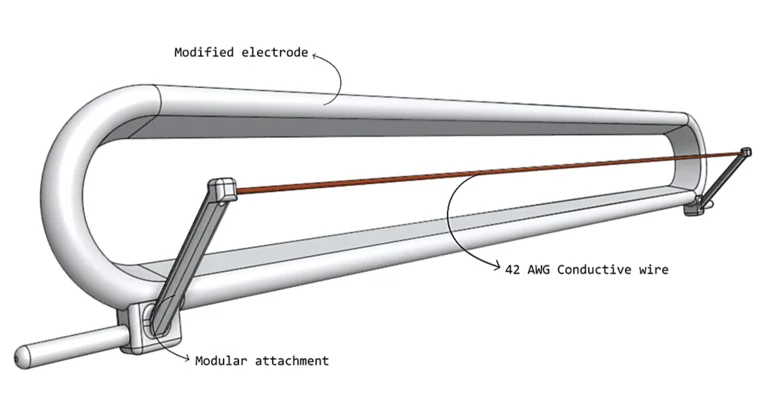
This study presents the development of an open-system ionic thruster designed for silent and efficient propulsion under atmospheric conditions. The thruster operates by generating a high-voltage corona discharge that ionizes a working medium, either ambient air or a noble gas such as argon, and accelerates the resulting ions using a controlled electrostatic field. The thrust is produced by the momentum transfer of these ions as they are expelled from the system. A key focus of the design is the geometry of the negative (collector) electrode, which is shaped to manipulate the local electric field and maximize ion acceleration while minimizing energy loss and ion recombination. The proposed system offers a mechanically simple, scalable and modular solution without moving parts, making it ideal for applications requiring silent operation and precise thrust control, such as unmanned aerial vehicles, near-space platforms, and experimental aerospace propulsion systems.
Graphical Abstract
Novelty Statement
The proposed system offers a mechanically simple, scalable and modular solution without moving parts, making it ideal for applications requiring silent operation and precise thrust control.