

 Open Access||Research Article
Directional Stability and Optimized Radar Cross-Section in Tailless Unmanned Aerial Vehicles
School of Technology, GITAM University, GITAM Deemed to be University, Hyderabad, Telangana, 502329, India
Abstract
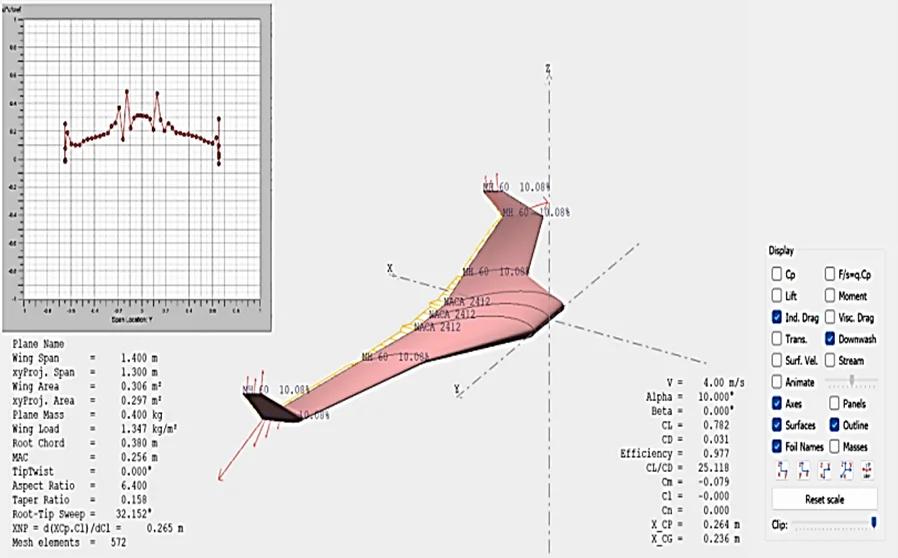
This study presents the development of a tailless flying wing unmanned aerial vehicle (UAV) optimized for low radar cross-section (RCS) and enhanced aerodynamic stability. The design is based on Ludwig Prandtl's 1933 theory of induced drag minimization using a bell-shaped lift distribution, implemented through geometric and/or aerodynamic wing twist. By eliminating traditional vertical stabilizers and redistributing lift along the span, the configuration naturally counters adverse yaw and reduces dependency on active yaw control systems. The result is a structurally efficient UAV capable of stable flight, high payload capacity, and minimal radar signature. This makes it highly suitable for defense applications such as intelligence, surveillance, and reconnaissance (ISR), as well as strategic missions requiring endurance and stealth. Simulation results confirm that the proposed configuration achieves improved lift distribution, reduced induced drag, and enhanced directional stability compared to conventional tailless designs.
Graphical Abstract
Novelty Statement
The study successfully demonstrates the feasibility of a tailless flying wing UAV optimized for low radar cross-section and aerodynamic stability using Prandtl's bell-shaped lift distribution.