
 Open Access||Research Article
An AI-Driven Adaptive Training Platform with Digital Twin-Based Skill Gap Analysis and Future Readiness Insights
Department of Computer Engineering, Thakur College of Engineering and Technology, Mumbai, Maharashtra, 400056, India
Abstract
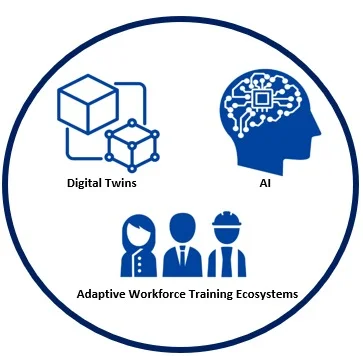
The rapid digital transformation of industries has intensified the demand for adaptive, data-driven learning ecosystems capable of continuously aligning workforce skills with evolving technological trends. Traditional static training systems struggle to meet these dynamic needs, creating persistent skill gaps and limiting future employability. This study addresses this challenge by exploring the integration of Artificial Intelligence (AI) and Digital Twin (DT) technologies to create a hybrid, future-ready training framework. The proposed model combines reinforcement learning with generative AI to dynamically assess learner progress, perform real-time skill-gap analysis, and personalize training paths through a continuously evolving digital twin of each learner. The framework was evaluated using pilot simulations in a vocational training environment. Results showed a 22% improvement in personalization accuracy, 15%–20% reduction in skill gaps, and an 82% accuracy in future-readiness prediction compared with conventional adaptive learning systems. These findings highlight the transformative potential of merging AI adaptability with DT contextualization to deliver immersive, predictive, and career-aligned learning experiences.
Graphical Abstract
Novelty Statement
The convergence of AI and digital twin technologies offers a transformative pathway toward future-ready, personalized, and adaptive workforce training ecosystems.