

 Open Access||Research Article
Responsible AI in the Age of Generative Media: A Comparative Study of Ethical and Transparent AI Frameworks in India and the USA
1 Department of Artificial Intelligence and Data Science, Vasantdada Patil Pratishthan's College of Engineering & Visual Arts, Mumbai, Maharashtra, 400022, India
2 Department of Electronics and Computer Science, Vasantdada Patil Pratishthan's College of Engineering & Visual Arts, Mumbai, Maharashtra, 400022, India
Abstract
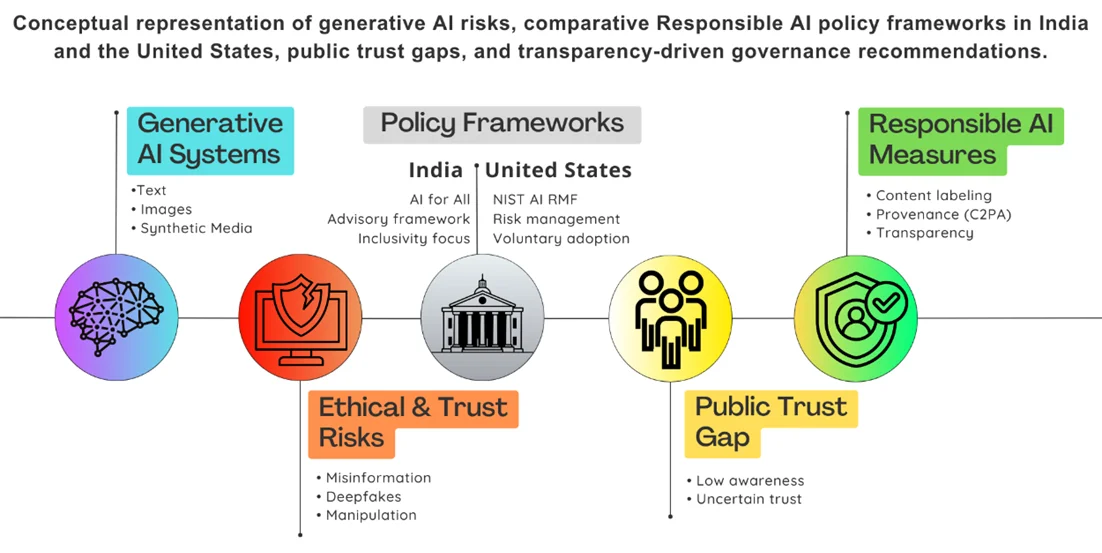
Advances in generative artificial intelligence, such as Google Gemini, ChatGPT and DALL·E, are opening new possibilities for creativity on digital media but also raising pressing concerns about misinformation, deepfakes and declining trust in media outlets. This paper explores Responsible Artificial Intelligence (RAI) efforts at the policy level in India and the United States, comparing their unique and shared approaches to addressing generative media. India's official AI for All strategy speaks to inclusivity and social development, though concrete enforcement mechanisms and safeguards against generative media misuse are currently lacking. The US relies on the NIST AI Risk Management Framework, emphasizing risk assessment, technical robustness and accountability but lacks a robust regulatory mechanism that aligns its varying state and sector-specific initiatives. Alongside policy analysis, we designed and ran a pilot survey of college students and working professionals through September 2025 to capture awareness, trust and concerns related to Responsible AI. Our findings showed low relative exposure to national policy frameworks on RAI but high expressed concern related to potential misuse of generative AI around deepfakes, manipulated images and the lack of checks on content authenticity. We conclude that India and the USA display parallel and diverging paths on RAI for generative media, and both experiences are marked by a gap between policy aspirations and public understanding.
Graphical Abstract
Novelty Statement
This study uniquely integrates India–USA AI policy comparison with empirical survey evidence highlighting public trust and awareness gaps.