

 Open Access||Review Article
A Comprehensive Review of Smart and Sustainable Waste Management Using AI, IoT, and Robotics
Department of Computer Engineering, Samarth College of Engineering & Management, Pune, Maharashtra, 412410, India
Abstract
Urbanization and population growth have made waste management more challenging in urban areas such as parks, streets, and public transport. Traditional waste collection requires significant manual labor and is inefficient, expensive, and poses health hazards to sanitation workers. Recent advances in robots, Artificial Intelligence (AI), and the Internet of Things (IoT) have enabled autonomous and intelligent waste management systems that can detect, collect, and separate waste. This paper reviews intelligent robotic solutions for automated waste collection and separation. Key subsystems are discussed, including perception, navigation, manipulation, sorting, and IoT for waste management data generation. Sensor technologies such as ultrasonic, inductive, and moisture sensors, along with machine vision and deep learning algorithms for waste classification, are examined. Communication architectures using GSM, GPS, and mobile applications for real-time tracking and operation are also discussed. Despite significant progress, long-term challenges remain related to energy efficiency, outdoor operation, and large-scale deployment. The review further identifies critical research gaps in system-level integration, autonomy, and scalability, and highlights future directions toward unified AI–IoT–robotic frameworks, energy-aware designs, and adaptive navigation strategies for sustainable and smart urban waste management.
Graphical Abstract
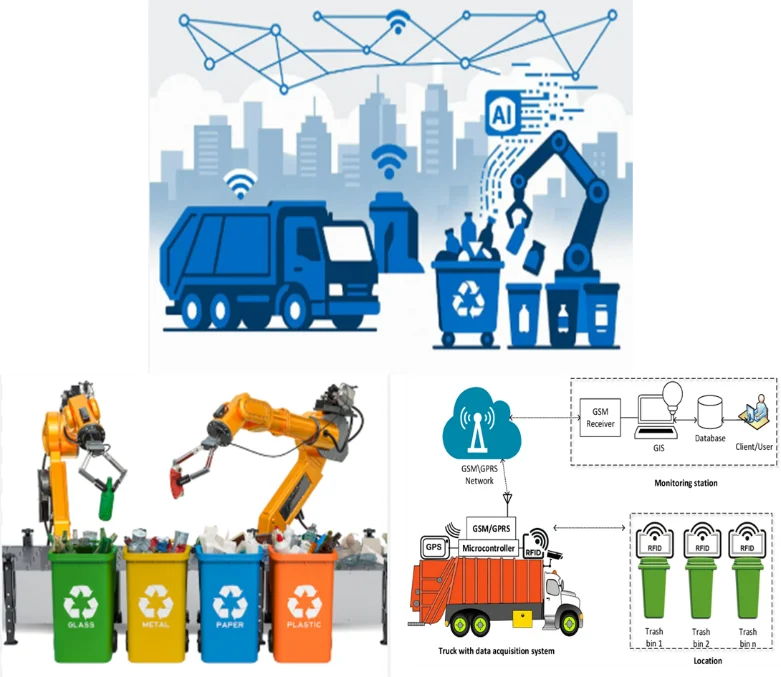
Novelty Statement
This review consolidates robotics, AI, and IoT into a unified perspective for autonomous waste collection in urban environments.