

 Open Access||Review Article
IoT-Based Health Risk Prediction Systems Using Artificial Intelligence and Biomedical Sensors: A Review
Department of Electronics and Telecommunications Engineering, Sinhgad Institute of Technology, Lonavala, Maharashtra, 410401, India
Abstract
This article presents a comprehensive review of Internet of Things (IoT)-based health risk forecasting systems that integrate Artificial Intelligence (AI) with biomedical sensors. The convergence of these technologies is transforming healthcare by enabling proactive and personalized care, particularly in chronic disease management. The review examines the architecture of the Internet of Medical Things (IoMT), highlighting the continuous collection of physiological and biochemical data through wearable and implantable devices. It further explores the role of AI, including Machine Learning and Deep Learning, in converting large-scale health data into actionable insights for disease detection, classification, and prediction, with a focus on conditions such as diabetes and cardiovascular diseases. Key challenges, including data privacy, interoperability, and security, are also discussed, along with emerging solutions such as Federated Learning and blockchain. Finally, the paper outlines future research directions, emphasizing the need for energy-efficient sensors, explainable AI, and scalable global digital health systems.
Graphical Abstract
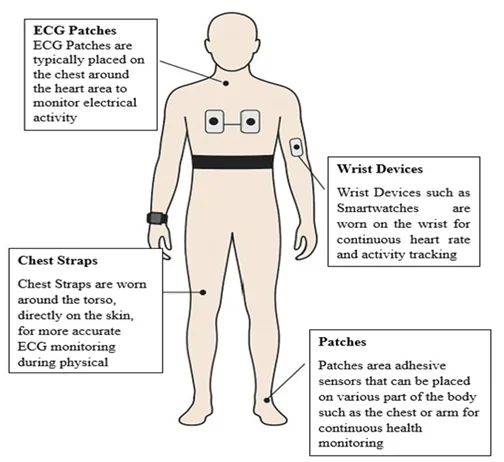
Novelty Statement
This review integrates IoT, AI, and biomedical sensors for health risk prediction, highlighting privacy, scalability, and emerging technologies advancements.