

 Open Access||Research Article
Spell Checker for Low-resource Konkani Language
1 Department of Computer Science, DCT's Dhempe College of Arts and Science, Panaji, Goa, 403001, India
2 Independent Researcher, Navi Mumbai, Maharashtra, India
3 Department of Computer Science, University of Mumbai, Mumbai, Maharashtra, 400098, India
Abstract
A spell checker is an application that identifies misspelled words by analyzing the sequence of characters in each word. Spell checking applications exist for many of the Indian languages in the Eighth Schedule of the Indian Constitution. However, there are not as many spell checkers for languages that were added later, some of which are low-resource languages. Konkani is one such language. This is the first time a spell checker has been developed for Konkani, in Devanagari script. Konkani is a macrolanguage, and developing a spell checker is challenging. We have presented the design and implementation of the spell checker. The proposed approach makes use of dictionary lookup to identify correct words and minimum edit distance to suggest correct words for misspelled words. This spell checker also achieved a high F-score after being tested with a set of Konkani words. It has 1,510,514 unique words in the dictionary.
Keywords
Graphical Abstract
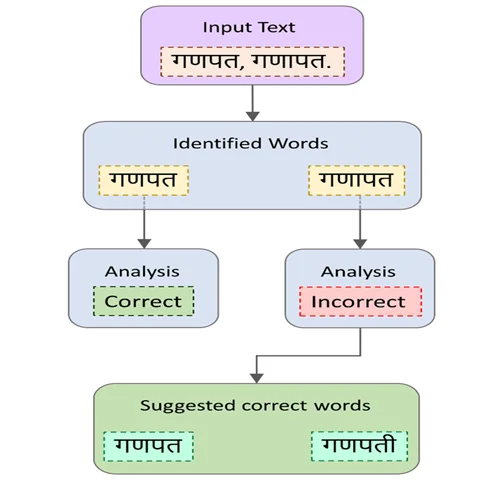
Novelty Statement
This is the first time a spelling checker has been developed for a low-resource Indian language, Konkani, in Devanagari script.
1. Introduction
India is a country with 22 languages in its Eighth Schedule language list[1] to the constitution and 38 languages that are not on the list. A developing country like India needs the digital footprint of these languages as various Natural Language Processing (NLP) tools. Building NLP tools like Part-of-Speech (PoS) tagger,[2] Named Entity Recognizer (NER),[3] morphological analyzer,[4] etc. is a challenging task since to build these tools there is a need for an annotated corpus in the language in which the tool is built. Information processing in low-resource languages involves technologies and methods to understand corpora and linguistic databases. By processing this information, the resources of low-resource languages can be preserved, helping to bridge communication gaps.
A spell checker is an application that flags words in a document that may not be spelled correctly.[5,6] A spell checker is a basic need of a word processor in any language. The spell checker analyzes the written text in order to identify any misspellings and gives the best correct suggestions for those misspellings. Spell checking applications present valid suggestions to the user based on each misspelled word encountered in the user's document. The user then selects from a list of suggestions or chooses to ignore the suggestions and accept the current word as valid. Regardless of how often this is done, the spell-checking application will perform its task independent of the types of misspelled words most commonly made by the user. The spell checkers are crucial in making quality content without any mistakes or ambiguity. A misspelled word can change the meaning, focus, and intention of a word and therefore its content, and also can lead to reading and attention discomfort.
The essence of digital applications is exponentially increasing day by day. It is difficult to imagine a regular day without search engines, social media, online news, emails, and word processing. Further, there are other NLP applications like speech-to-text and text-to-speech engines, Optical Character Recognition (OCR) systems, speech synthesizers, and Machine Translation (MT) systems that are evolving. Spell checkers and correctors play a crucial role in the development of all these applications, and they are deeply coupled with the NLP ecosystem. Extensive work is reported for English spelling detection and a limited number of Indian languages, whereas no work has been reported for Konkani, the state language of Goa, India. Konkani is a low-resource macrolanguage that has multiple scripts and is classified in the linguistic database ISO 639-3.[7] The Konkani language has 36 consonants and 12 vowels. The methods available for other languages cannot be directly applied to Konkani. One such example is phonetic based spell checking which cannot be directly implemented in a generalized Konkani spell checker. This is because the pronunciation differs among different variants of Konkani, like Mangalorean Konkani differs Goan Konkani. In this paper, we have tried to develop a spell checker for Konkani with 1,510,514 unique words.[8]
1.1 Literature survey
Spelling checkers are the basic tools needed for word processing and document preparation. It is a tool that enables users to check the spellings of the words in a text file, validates them, i.e., checks whether they are right or wrongly spelled, and, in case the spell checker has doubts about the spelling of the word, suggests possible alternatives. As mentioned in Ref. 12, spell checkers look for four types of possible errors: a wrong letter ('byll'), an inserted letter ('buall'), an omitted letter ('bul'), or a pair of adjacent transposed letters ('blul') (considering the correct word to be 'bull'). These types of errors can be resolved by a dictionary lookup.
Languages like Hindi,[9-13] Tamil,[14-18] Punjabi,[19-21] Kashmiri,[22] Sanskrit,[23] Bengali,[24-28] Marathi,[29,30] Gujarati,[31,32] Sindhi,[33-35] Telugu,[13,36] Kannada,[37,38] Malayalam,[39-44] Urdu,[45-48] Assamese,[49-51] Manipuri,[52] Nepali,[53-55] Oriya,[56,57] and Bodo,[58] have papers in spell checker. In Table 1, the methods used in papers on spell checking for Indian languages have been listed.
Table 1: Methods used in papers of spell checking and suggestion.
| Sr. No. | Language | Methods | Train data size in words | Test data size in words | Overall accuracy | Ref. |
|---|---|---|---|---|---|---|
| 1 | Hindi | Minimum edit distance, Statistical machine translation | * | 870 | 83.2% | [9] |
| 2 | Hindi | Character n-gram, Dictionary lookup | * | * | * | [10] |
| 3 | Hindi | Dictionary lookup, Minimum edit distance | ~117,000 | 291 | * | [11] |
| 4 | Hindi | Minimum edit distance | * | * | * | [12] |
| 5 | Hindi | Statistical machine translation, Convolutional neural network and Gated recurrent unit | 108,587 | * | 85.4% | [13] |
| 6 | Tamil | Character bi-gram, Minimum edit distance, Word frequency, Hashing | 4,000,000 | 2,105 | 98.4% | [14] |
| 7 | Tamil | Bloom filter, Minimum edit distance, Long short-term memory | 249,056 | * | * | [15] |
| 8 | Tamil | Dictionary lookup, Character bi-gram, Minimum edit distance | * | * | 89.13% | [16] |
| 9 | Tamil | Minimum edit distance, Distance matrix | * | * | * | [17] |
| 10 | Tamil | Minimum edit distance, Rule-based, Soundex, Long short-term memory | * | * | 95.67% | [18] |
| 11 | Punjabi | Lexicon lookup | ~150,000 | 225 | 95.61% | [19] |
| 12 | Punjabi | Lexicon lookup | * | * | 83.5% | [20] |
| 13 | Punjabi | Dictionary lookup, Minimum edit distance | ~1,000,000 | * | 87.2% | [21] |
| 14 | Kashmiri | Dictionary lookup, Hashing, Binary search tree | ~1,000,000 | * | ~80% | [22] |
| 15 | Sanskrit | Morphological rules | 13,000 | 1,500 | 99% | [23] |
| 16 | Bangla | Partition around medoids clustering | * | 2,450 | 99.8% | [24] |
| 17 | Bangla | Dictionary lookup, Minimum edit distance | 15,162,317 | 250,000 | ~95% | [17] |
| 18 | Bangla | Double metaphone encoding | * | 1,607 | 91.67% | [26] |
| 19 | Bangla | Finite state automation | * | * | ~70% | [27] |
| 20 | Bangla | Convolutional neural network, Bidirectional encoder representations from transformers model | 513,000 | 52,400 | 87.8% | [28] |
| 21 | Marathi | Morphological rules | 13,000 | 10,648 | 99.57% | [29] |
| 22 | Marathi | Minimum edit distance, Cosine similarity algorithm | * | 929,663 | 85.88%; 86.76% | [30] |
| 23 | Gujarati | Minimum edit distance | 192,000 | 79,024 | 83.14% | [31] |
| 24 | Gujarati | Mel frequency cepstral coefficients, Gammatone frequency cepstral coefficients, Bidirectional encoder representations from transformers model | * | * | * | [32] |
| 25 | Sindhi | Minimum edit distance, SoundEx algorithm, ShapeEx algorithm | 100,000+ | * | * | [33] |
| 26 | Sindhi | Minimum edit distance, SoundEx algorithm, ShapeEx algorithm | 250,000 | 1,744 | * | [34] |
| 27 | Sindhi | Dictionary lookup | 70,576 | 2,052 | * | [35] |
| 28 | Telugu | Statistical machine translation, Convolutional neural network and Gated recurrent unit | 92,716 | * | 89.3% | [13] |
| 29 | Telugu | Markov Models | 3,300,000+ | * | * | [36] |
| 30 | Kannada | Morphological rules, Dictionary lookup | * | 112,000 | 97.83% | [37] |
| 31 | Kannada | Morphological rules, Dictionary lookup | 3,000,000 | 43,209 | 90% noun; 80% verb | [38] |
| 32 | Malayalam | Long short-term memory | 1,505,279 | 500 | 55.2% | [39] |
| 33 | Malayalam | Character n-gram, Minimum edit distance | ~80,000 | 10,000 | 91% | [15] |
| 34 | Malayalam | Finite state machine | * | * | * | [41] |
| 35 | Malayalam | Dictionary lookup, Character n-gram | ~10,000 | 10,000 | * | [42] |
| 36 | Malayalam | Sequence-2-sequence, Lexicon lookup, Hashing, Character n-gram | 10,000 | 6,000 | 91.26% | [43] |
| 37 | Malayalam | Word length difference, Minimum edit distance, Character n-gram, Phoneme similarity, Random forest classifier | * | * | 71% | [44] |
| 38 | Urdu | SoundEx algorithm, Single edit distance | 1,700,000 | 724 | 96.27% | [45] |
| 39 | Urdu | SoundEx algorithm, ShapeEx algorithm | 1,700,000 | 280 | 93.5% | [46] |
| 40 | Urdu | Reverse edit distance | 110,582 | * | * | [47] |
| 41 | Urdu | Character n-gram, Minimum edit distance | 593,738 | 510,547 | 83.67% | [48] |
| 42 | Assamese | Dictionary lookup, SoundEx algorithm, Hashing, Minimum edit distance | * | 5,000+ | * | [49] |
| 43 | Assamese | Minimum edit distance, Morphological rules, Dictionary lookup | 16,000 | 1,000; 5,000; 10,000 | 0.58; 0.63; 0.69 recall | [50] |
| 44 | Assamese | Character tri-gram | 220,743 | 500 | 76.6% | [51] |
| 45 | Manipuri | Dictionary lookup, Reverse dictionary lookup, Minimum edit distance, Phonetic encoding | ~10,000 | * | * | [52] |
| 46 | Nepali | Character bi-gram, Bidirectional encoder representations from transformers model, Probabilistic spelling correction | ~350,000 | ~125,000 | 69.1% | [53] |
| 47 | Nepali | Dictionary lookup, Minimum edit distance, Decision Tree | * | * | 78% | [54] |
| 48 | Nepali | Gated recurrent unit | 120,000 | * | 73% | [55] |
| 49 | Odia | Confusion matrix, Character n-gram | * | 685 | 88% | [56] |
| 50 | Odia | Dictionary lookup, Minimum edit distance | 36,000 | * | * | [57] |
| 51 | Bodo | Morphological rules, Dictionary lookup | ~15,000 | ~1,500,000 | * | [58] |
* Values not listed
Currently, there are no papers available on spell checking for the Konkani language. The proposed spell-checking approach discussed in this study is mainly based on dictionary lookups and minimum edit distance.[59]
2. Methodology
The Konkani language has 15 diacritics.[60] A diacritic is a mark added to a letter to show a change in pronunciation, tone, or emphasis. In Konkani, diacritics in the Devanagari script help distinguish sounds. For example, in the word कां (kā̃), the nasal diacritic ं (anusvara) above आ (ā) creates a nasalized 'a' sound, setting it apart from का (kā), which lacks this nasal quality. In this spell checker, the character count of these diacritics is set to 0.5, and the count of other alphabets is set to 1. Fig. 1 shows the workflow of the proposed approach.
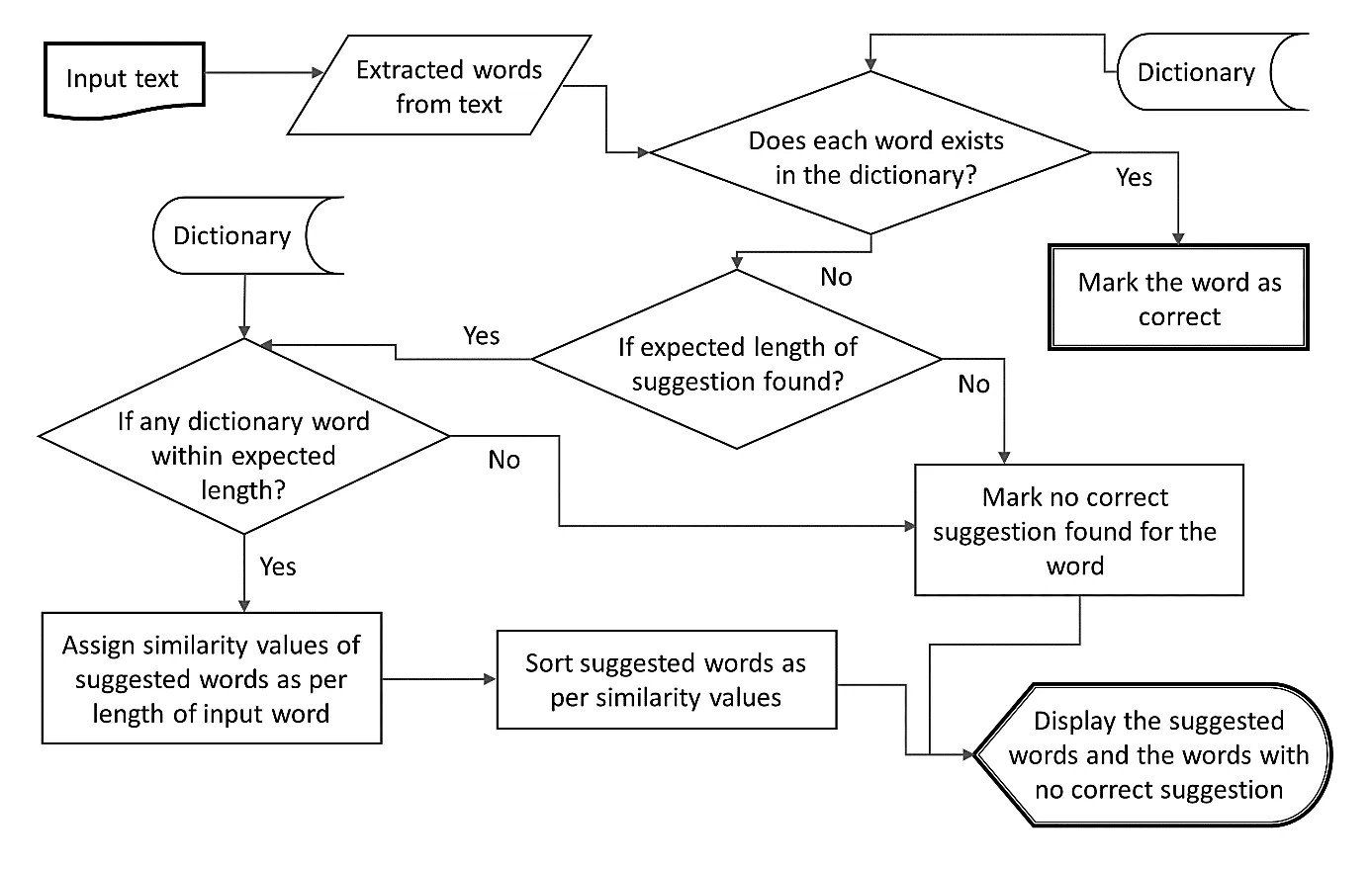
Fig. 1: Flowchart of the Konkani spell checker.
2.1 Dataset
The data used to generate our dictionary originated from the author of Ref. 3, supplemented by a collection of ~4,000 additional words, totaling 1,510,514 words.
2.2 Dictionary creation
The dictionary developed for the spell checker has the words arranged in sequential order based on their first character, words having the same first character are further arranged in ascending order of length. Three comma separated valued files were created and were used as reference for executing the proposed approach.
The first file, File-1, is the dictionary, where each row consists of the Konkani words and their respective character count in the aforementioned order. A sample demonstration is shown in Table 2. In the second file, File-2, each row consists of unique alphabets, the beginning and ending row numbers in File-1 starting with the current alphabet, and the minimum and maximum character count of the words starting with the alphabet. A sample demonstration is shown in Table 3. The third file, File-3, contains the range of rows in File-1 covered by words beginning with each alphabet, where the range is further subdivided as per character count. A sample demonstration is shown in Table 4, where columns like '4.0 start' and '4.0 end' denotes the beginning and ending rows in File-1, that has words with the specified character count. The value -1 for the Konkani alphabet, ङ means that there are no words with lengths 4.0, 4,5 and 5.0 that begins with this alphabet.
Table 2: Sample rows from File-1.
| Row no. | Word | Character count |
|---|---|---|
| 0 | अब्ज | 2.0 |
| 1 | अर्द | 2.0 |
| 295189 | खा | 1.5 |
| 334068 | खामसुत्रांलें | 8.0 |
| 334069 | गो | 1.5 |
Table 3: Sample range of rows in File-2.
| Alphabet | Start row no. | End row no. | Min. character count | Max. character count |
|---|---|---|---|---|
| अ | 0 | 60449 | 2.0 | 8.0 |
| ख | 295189 | 334068 | 1.5 | 8.0 |
Table 4: Sample range of rows in File-3.
| Alphabet | 4.0 start row no. | 4.0 end row no. | 4.5 start row no. | 4.5 end row no. | 5.0 start row no. | 5.0 end row no. |
|---|---|---|---|---|---|---|
| क | 189436 | 191986 | 191987 | 197007 | 197008 | 204162 |
| ख | 296000 | 297169 | 297170 | 299281 | 299282 | 302316 |
| ङ | -1 | -1 | -1 | -1 | -1 | -1 |
Although File-2 contains less information than File-3, this file reduces computation time to identify whether an input word is incorrect based on its stored list of character count range for each alphabet. If an input word has character count beyond the specified range in File-2, then it is declared incorrect. Whereas if the character count is within the range, then File-3 is referred for further analysis of correctness.
2.3 Pipeline of code
Table 5 shows the various abbreviations used while explaining the pipeline of code. The workings of our code are briefly explained with the help of the five steps mentioned below.
(1) Check if wi can be traced in File-1 by iterating through the range of words having the same α as wi. If it is traceable, then further steps should not be continued.
(2) Identify ws_l based on wi_l.
If wi_l is 1.5 or 2.0, then ws_l can be within range → (1.0, 2.0); if wi_l is 3.0, then ws_l can be within range → (2.0, 4.0); if wi_l is 3.0, then ws_l can be within range → (2.0, 4.0); if wi_l is 3.5, then ws_l can be within range → (2.5, 4.5); if wi_l is 4.0, then ws_l can be within range → (3.0, 5.0); if wi_l is > 4.0, then ws_l can be within range → ( ((ceiling value of wi_l) * 0.8), (wi_l / 0.8) ).
(3) Compare wi with words from File-1 whose length is within the range of ws_l.
If wi_l is > 4.0, then sp is 80; if wi_l is 4.0, then sp is 75; if wi_l is 3.0, then sp is 66.66; if wi_l is 1.5 or 2.0, then sp is 50 (if sc is 1.0) or 75 (if sc > 1.0).
(4) Sort ws as per sp in descending order.
(5) Display the sorted ws.
Table 5: List of abbreviations.
| Sr. No. | Abbreviations | Full form |
|---|---|---|
| 1 | wi | input word |
| 2 | α | first alphabet of a word |
| 3 | wi_l | length of input word |
| 4 | ws | suggested words |
| 5 | ws_l | expected length of suggested words |
| 6 | wd | word from dictionary as per ws_l |
| 7 | sp | final minimum similarity value of wi and ws in percentage |
| 8 | sc | initial count of similar characters between wi and wd in sequence |
| 9 | wln | the longer word among wi and wd |
| 10 | wst | the shorter word among wi and wd |
If the list of ws contains sp values > 80, then display the first ten ws as most preferred suggestions and the remaining as other probable suggestions.
In step (3), the calculation of similarity in terms of the comparison is done in two steps.
The first step is to determine sc. There are two methods, and these are demonstrated below with the help of pseudocode.
Method A:
sc1 = 0 // sc value by method A cln = 0 // counter for wln cst = 0 // counter for wst while (cln < length of wln) { if (cst < length of wst) and (wst[cst] == wln[cln]) { update sc1 as per conditions increment cst by 1 increment cln by 1 } else { increment cln by 1 } }
Method B:
sc2 = 0 // sc value by method B cln = 0 // counter for wln cst = 0 // counter for wst while (cln < length of wln) { if (cst < length of wst) and (wst[cst] == wln[cln]) { update sc2 as per conditions } increment cst by 1 increment cln by 1 }
In method A, the counter for wst is not updated if the current character of wst is not equal to the current character of wln. This method is useful for a wrong input word like 'friiend', and a correct word to be suggested is 'friend'. Since 'friiend' is the longer word and the character 'i' is repeated, the counter of this word can be incremented, whereas the counter for the correct and shorter word 'friend' can remain unchanged when iterating through the second 'i'.
In method B, the counters for both wst and wln are incremented in every iteration, regardless of the equality of characters. This method is useful for a wrong input word like 'friendey', and a correct word to be suggested is 'friendly'. Only the characters in position 7 ('e' and 'l') of both the words do not match, but the succeeding characters in position 8 ('y') do. Detecting suggestions for this wrong word through method A would lead to a lesser value of sc as only the first six characters would be identified as similar. So, the larger value among sc1 and sc2 is considered the value of sc.
The second step of the calculation of similarity is to determine sp. For this, the formula (sc / length of wln) * 100 is used, and the value obtained is compared with different conditions of percentage values depending on wi_l. If conditions are satisfied, then that value is considered the value of sp.
2.4 Spell checker tool
The Konkani Spell Check (https://konkanispellcheck.pythonanywhere.com/) tool has been designed using a Python (version 3.5) based web framework, Django (version 2.2). The Konkani dictionary is parsed using the 'csv' library. The tool did not rely on any database management system. Its user interface incorporates responsive web design, so it changes based on the screen resolution. Fig. 2 shows the output of words getting analyzed by the application. When a user enters a misspelled word, the tool flags it with '/W' in the user-input text box and tries to suggest some correct alternatives in the suggested-words text box.
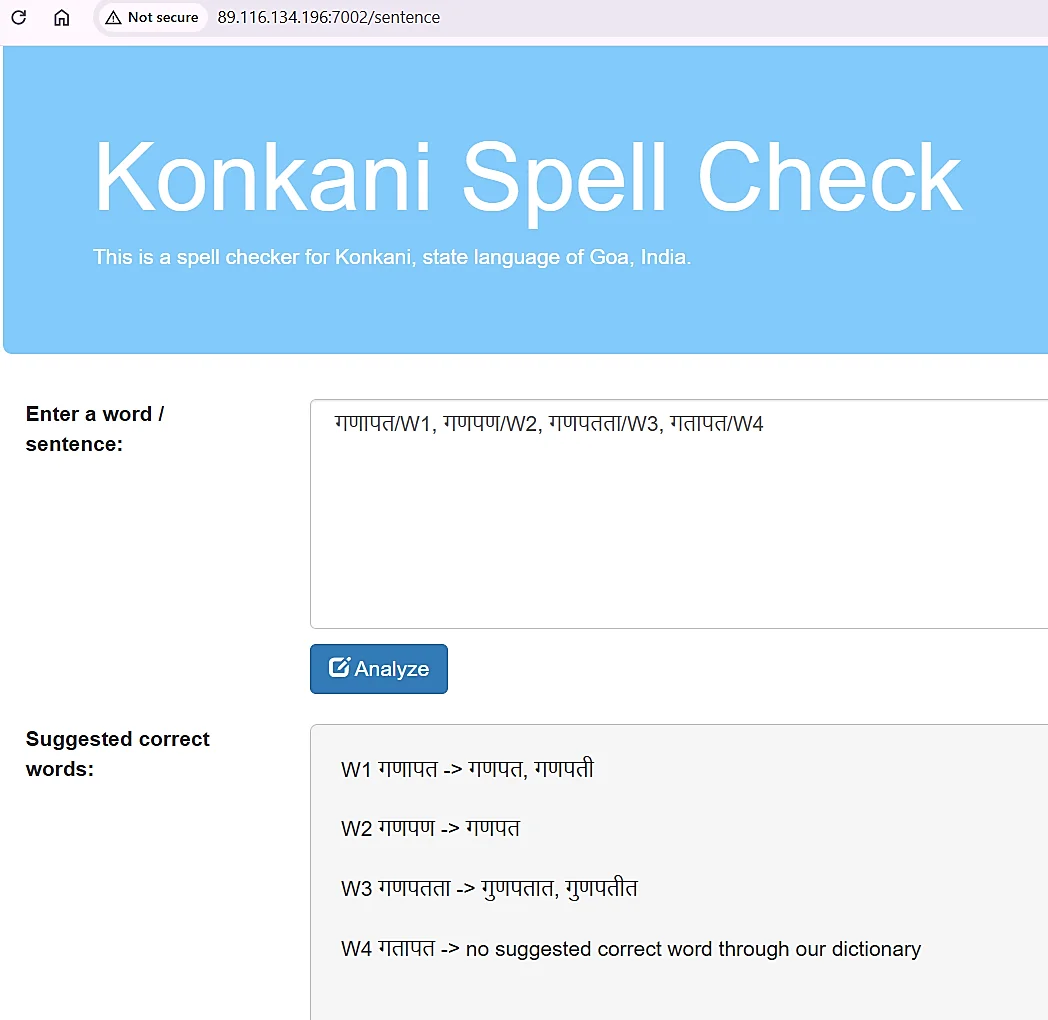
Fig. 2: Analysis through Konkani spell check tool.
3. Results and discussion
A test dataset of 4,853 unique Konkani words from books of Standards 1, 2, and 3 by SCERT-Goa[61] was analysed, out of which 4,041 words were identified as correct by our dictionary. Out of 812 unidentified words, 522 words were assigned suggestions by our system. The F-score value in Table 7 is calculated as per the confusion matrix outcomes shown in Table 6. The analysis of this dataset took 4,600.15 seconds on a local machine with an Intel Core i7-3770 CPU and 1600 MHz RAM. The analysis of only the 4,041 identified words was significantly faster, taking 605.77 seconds. The algorithm analyzes correct words faster because it doesn't need to perform word identification for suggestion.
Table 6: Confusion matrix.
| Outcome | Value |
|---|---|
| True Positive (TP) | 4,041 |
| False Positive (FP) | 0 |
| True Negative (TN) | 0 |
| False Negative (FN) | 812 |
Table 7: Classification metrics.
| Metric | Formula | Value |
|---|---|---|
| Precision (P) | TP / (TP + FP) | 1 |
| Recall (R) | TP / (TP + FN) | 0.833 |
| F-score | 2 * (P * R) / (P + R) | 0.909 |
Table 8 presents a comparison of different incorrect word inputs for a proper noun, गणपत (gəɳəpət̪ə). Since this noun is of length 4.0 units, the expected sp is 75%. Hence, in Fig. 2, it is shown as a suggestion for 1st and 2nd input words by the application.
Table 8: Comparison of incorrect inputs.
| Sr. no. | Input | Length | Similarity (in %) |
|---|---|---|---|
| 1 | गणापत (gəɳɑːpət̪ə) | 4.5 | 88.88 |
| 2 | गणपण (gəɳəpəɳə) | 4.0 | 75 |
| 3 | गणपतता (gəɳəpət̪ət̪ɑː) | 5.5 | 72.72 |
| 4 | गतापत (gət̪ɑːpət̪ə) | 4.5 | 66.66 |
4. Conclusion
The results demonstrate that our spell checker achieved an F-score of 0.909 on a dataset consisting of words from school books of Standards 1, 2 and 3. This makes our spell checker a reliable source for checking basic Konkani words. The implementation of an alphabet and word length-based arrangement of the dictionary makes this spell checker much faster in giving suggestions to wrong words than a conventional spell checker where no such arrangements are implemented in its dictionary. Future experiments can emphasize on implementing a much faster algorithm for correct word suggestions and increasing the size of the corpus. A bigger corpus can help a spell checker reliable in checking advanced Konkani words, the ones that are used in school books of higher standards.
Funding Declaration
This research did not receive any specific grant from funding agencies in the public, commercial, or not-for-profit sectors.
Data Availability Statement
The test data is available in a Harvard Dataverse repository (https://doi.org/10.7910/DVN/ECWMBB).
Conflict of Interest
There is no conflict of interest.
Artificial Intelligence (AI) Use Disclosure
The authors declare that artificial intelligence (AI)-assisted tools were used only for language refinement, grammar improvement, and manuscript structuring purposes during the preparation of this work. All technical content, experimental implementation, results, and interpretations were independently developed and verified by the authors.
Supporting Information
Not applicable.
References
- [01] Ministry of Home Affairs Government of India, 2017, accessed 08 August 2024, https://www.mha.gov.in/sites/default/files/EighthSchedule_19052017.pdf,
- [02] H. Li, H. Mao, J. Wang, Part-of-speech tagging with rule-based data preprocessing and transformer, Electronics, 2022, 11, 56, doi: 10.3390/electronics11010056.
- [03] W. L. Seow, I. Chaturvedi, A. Hogarth, R. Mao, E. Cambria, A review of named entity recognition: from learning methods to modelling paradigms and tasks, Artificial Intelligence Review, 2025, 58, 315 https://doi.org/10.1007/s10462-025-11321-8
- [04] E. B. Boltayevich, H. S. Mirdjonovna, A. X. Ilxomovna, Methods for Creating a Morphological Analyzer. In: Zaynidinov, H., Singh, M., Tiwary, U.S., Singh, D. (eds) Intelligent Human Computer Interaction. IHCI 2022. Lecture Notes in Computer Science, vol 13741. Springer, Cham, doi: 10.1007/978-3-031-27199-1_4.
- [05] A. Toleu, G. Tolegen, R. Mussabayev, A. Krassovitskiy, I. Ualiyeva, Data-driven approach for spellchecking and autocorrection, Symmetry, 2022, 14, 2261, doi: 10.3390/sym14112261.
- [06] N. Hossain, S. Islam, M. N. Huda, Development of bangla spell and grammar checkers: resource creation and evaluation, IEEE Access, 2021, 9, 141079-141097, doi: 10.1109/ACCESS.2021.3119627.
- [07] ISO 639-2, Library of Congress, 2017, https://www.loc.gov/standards/iso639-2/php/code_list.php, accessed 10 April 2024
- [08] S. N. Desai, Design and implementation of algorithms for morphology learning and its applications, Doctoral dissertation, Goa University, 2017.
- [09] B. Kaur, H. Singh, Design and implementation of HINSPELL- Hindi spell checker using hybrid approach, International Journal of Scientific Research and Management, 2015, 3, 2058–2061.
- [10] A. Jain, M. Jain, Detection and correction of non-word spelling errors in Hindi language, 2014 International Conference on Data Mining and Intelligent Computing (ICDMIC), Delhi, India, 2014, 1-5, doi: 10.1109/ICDMIC.2014.6954235.
- [11] A. Sharma, P. Jain, A. Mukerjee: Hindi spell checker Project, Indian Institute of Technology Kanpur, 2013.
- [12] S. Rachel, S. Vasudha, T. Shriya, K. Rhutuja, L. Gadhikar, Vyakranly: Hindi grammar & spelling errors detection and correction system, 2023 5th Biennial International Conference on Nascent Technologies in Engineering (ICNTE), Navi Mumbai, India, 2023, 1-6, doi: 10.1109/ICNTE56631.2023.10146610.
- [13] P. Etoori, M. Chinnakotla, R. Mamidi, Automatic spelling correction for resource-scarce languages using deep learning, Proceedings of ACL 2018- Student Research Workshop, ACL, Melbourne 2018, 1, 146–152.
- [14] K. Uthayamoorthy, K. Kanthasamy, T. Senthaalan, K. Sarveswaran, G. Dias, DDSpell-A data driven spell checker and suggestion generator for the Tamil language, 2019 19th International Conference on Advances in ICT for Emerging Regions (ICTer), Colombo, Sri Lanka, 2019, 1-6, doi: 10.1109/ICTer48817.2019.9023698.
- [15] S. Murugan, T. A. Bakthavatchalam, M. Sankarasubbu, SymSpell and LSTM based spell-checkers for Tamil, Tamil Internet Conference, 2020.
- [16] J. Segar, K. Sarveswaran, Contextual spell checking for Tamil language, 14th Tamil Internet Conference, 1-5, 2015.
- [17] P. Kumar, A. Kannan, N. Goel, Design and implementation of NLP-based spell checker for the Tamil language., 1st International Electronic Conference on Applied Sciences, Noida, 2020, 1–6.
- [18] A. Sampath, V. Shanmugavel, Hybrid Tamil spell checker with combined character splitting, Concurrency and Computation Practice and Experience, 2022, 35, e7440, doi: 10.1002/cpe.7440.
- [19] G. S. Lehal, Design and implementation of Punjabi spell checker, International Journal of Systemics, Cybernetics and Informatics, 2007, 3, 70–75.
- [20] J. Kaur, K. Garg, Hybrid approach for spell checker and grammar checker for Punjabi, International Journal of Computer Science and Software Engineering, 2014, 4, 62–67.
- [21] R. Kaur, P. Bhatia, Spell checker for Gurmukhi script, Master’s thesis, Thapar Institute of Engineering and Technology, 2010.
- [22] A. Lawaye, B. S. Purkayastha, Design and implementation of spell checker for Kashmiri, International Journal of Scientific Research, 2016, 5, 199–200.
- [23] N. Tapaswi, Morphological-based spellchecker for Sanskrit sentences, International Journal of Scientific & Technology Research, 2012, 1, 1–4.
- [24] P. Mandal, B. M. M. Hossain, Clustering-based Bangla spell checker, 2017 IEEE International Conference on Imaging, Vision & Pattern Recognition (icIVPR), Dhaka, Bangladesh, 2017, 1-6, doi: 10.1109/ICIVPR.2017.7890878.
- [25] B. B. Chaudhuri, Reversed word dictionary and phonetically similar word grouping based spell-checker to Bangla text, Proc. LESAL Workshop – Mumbai, 2001.
- [26] N. UzZaman, M. Khan, A double metaphone encoding for Bangla and its application in spelling checker, 2005 International Conference on Natural Language Processing and Knowledge Engineering, Wuhan, China, 2005, 705-710, doi: 10.1109/NLPKE.2005.1598827.
- [27] M. M. Abdullah, M. Z. Islam, M. Khan, Error-tolerant finite-state recognizer and string pattern similarity-based spelling-checker for Bangla, Proceeding of 5th international conference on natural language processing, ICON, 2007.
- [28] C. R. Rahman, M. H. Rahman, S. Zakir, M. Rafsan, M. E. Ali, Spell- A CNN-blended BERT based Bangla spell checker, Proceedings of the First Workshop on Bangla Language Processing, Singapore, 2023, 1, 7–17.
- [29] V. Dixit, S. Dethe, R. K. Joshi, Design and implementation of a morphology-based spellchecker for Marathi, and Indian language, Archives of Control Science, 2005, 15, 251–258.
- [30] K.T. Patil, R. P. Bhavsar, B. V. Pawar, Contrastive study of minimum edit distance and cosine similarity measures in the context of word suggestions for misspelled Marathi words, Multimedia Tools and Applications, 2022, 82, 15573–15591, doi: 10.1007/s11042-022-13948-z.
- [31] H. Patel, B. Patel, K. Lad, Jodani- A spell checking and suggesting tool for Gujarati language, 2021 11th International Conference on Cloud Computing, Data Science & Engineering (Confluence), Noida, India, 2021, 94-99, doi: 10.1109/Confluence51648.2021.9377072.
- [32] M. Dua, B. Bhagat, S. Dua, An amalgamation of integrated features with Deep-Speech2 architecture and improved spell corrector for improving Gujarati language ASR system, International Journal of Speech Technology, 2024, 27, 87-99.
- [33] Z. Bhatti, I. A. Ismaili, D. N. Hakro, W. J. Soomro, Phonetic-based Sindhi spellchecker system using a hybrid model, Digital Scholarship in the Humanities, 2016, 31, 264–282, doi: 10.1093/llc/fqv005.
- [34] I. A. Dahar, F. Abbas, U. Rajput, A. Hussain, F. Azhar, An efficient Sindhi spelling checker for microsoft word. International Journal of Computer Science and Network Security, 2018, 18, 144–150.
- [35] M. Umair, M. U. Rahman, Analysis of Sindhi spelling error patterns for spelling error detection and correction, International Conference on Computer & Emerging Technologies, 2013.
- [36] K. N. Murthy, Technology for Telugu, Bhasha, 2008, 1, 70–95
- [37] S. R. Murthy, V. Madi, D. Sachin, P. R. Kumar, A non-word Kannada spell checker using morphological analyzer and dictionary lookup method, International Journal of Engineering Sciences & Emerging Technologies, 2012, 2, 43–52, doi: 10.18653/v1/P18-3021.
- [38] S. R. Murthy, A. N. Akshatha, C. G. Upadhyaya, P. R. Kumar, Kannada spell checker with sandhi splitter. 2017 International Conference on Advances in Computing, Communications and Informatics (ICACCI), Udupi, India, 2017, 950-956, doi: 10.1109/ICACCI.2017.8125964.
- [39] S. Sooraj, K. Manjusha, M. A. Kumar, K. P. Soman, Deep learning-based spell checker for Malayalam language, Journal of Intelligent & Fuzzy Systems, 2028, 34, 1427-1434.
- [40] P. H. Hema, C. Sunitha, Malayalam spell checker using n-gram method, Computational Intelligence in Data Mining, Advances in Intelligent Systems and Computing, 2016, 1, 217–225, doi: 10.1007/978-81-322-2734-2_23.
- [41] N. Manohar, P. T. Lekshmipriya, V. Jayan, V. K. Bhadran, Spellchecker for Malayalam using finite state transition models, 2015 IEEE Recent Advances in Intelligent Computational Systems (RAICS), Trivandrum, India, 2015, 157-161, doi: 10.1109/RAICS.2015.7488406.
- [42] T. Ambili, S. K. Panchamim, N. Subash, Automatic error detection and correction in Malayalam, International Journal for Science Technology and Engineering, 2016, 3, 92–96.
- [43] D. J. Ratman, A. K. Karthika, K. Praveena, R. Tania, S. Thara, N. Prema, Phonogram-based automatic typo correction in Malayalam social media comments, Procedia Computer Science, 2024, 233, 391–400, doi: 10.1016/j.procs.2024.03.229.
- [44] S. Dhanya, M. R. Kaimal, P. Nedungadi, Automatic spelling error classification in Malayalam, ICT-Cyber Security and Applications, In: Joshi, A., Mahmud, M., Ragel, R.G., Kartik, S. (eds) ICT: Cyber Security and Applications. ICTCS 2022, Lecture Notes in Networks and Systems, 2024, 916, 301–313, Springer Nature, LNNS 2024, Springer, Singapore, doi: 10.1007/978-981-97-0744-7_25.
- [45] T. Naseem, A hybrid approach for Urdu spell checking, Master’s thesis, National University of Computer & Emerging Sciences, 2004.
- [46] T. Naseem, S. Hussain, A novel approach for ranking spelling error corrections for Urdu, Language Resources and Evaluation, 2007, 41, 117–128, doi: 10.1007/s10579-007-9028-6.
- [47] S. Iqbal, W. Anwar, U. I. Bajwa, Z. Rehman, Urdu spell checking: Reverse edit distance approach, Proceedings of the 4th workshop on South and Southeast Asian natural language processing, 2013, 4, 58–65.
- [48] R. Aziz, M. W. Anwar, M. H. Jamal, U. I. Bajwa, A. K. Castilla, C. U. Rios, E. B. Thompson, I. Ashraf, Real word spelling error detection and correction for Urdu language, IEEE Access, 2023, 11, 100948–100962, doi: 10.1109/ACCESS.2023.3312730.
- [49] M. Das, S. Borgohain, J. Gogoi, S. B. Nair, Design and implementation of a spell checker for Assamese, In: Language Engineering Conference, Language Engineering Conference, 2002. Proceedings, Hyderabad, India, 2002, 156-162, doi: 10.1109/LEC.2002.1182303.
- [50] K. Kashyap, Luitspell- development of an Assamese language spell checker for open office writer, European Journal of Advances in Engineering and Technology, 2015, 2, 135–138.
- [51] R. Choudhury, N. Deb, K. Kashyap, Context-sensitive spelling checker for Assamese language, Recent developments in machine learning and data analytics, In: J. Kalita, V. Balas, S. Borah, R. Pradhan, R. (eds) Recent Developments in Machine Learning and Data Analytics. Advances in Intelligent Systems and Computing, Springer, Singapore, 2019, 740, 177188, doi: 10.1007/978-981-13-1280-9_18.
- [52] H. M. Devi, T. Keat, B. B. Chaudhuri, Spelling Correction in Manipuri text. Advanced Computing Applications Databases and Networks, Narosa, Silchar, 2011, 21–29.
- [53] N. Luitel, N. Bekoju, A. K.Sah, S. Shakya, Contextual spelling correction with language model for low-resource setting, International Conference on Inventive Computation Technologies, IEEE, Lalitpur, 2024, 7, 582–589.
- [54] B. Devkota, B. Adhikar, D. Shrestha, Integrating romanized Nepali spellchecker with SMS based decision support system for Nepalese farmers, 9th International Conference on Software, Knowledge, Information Management and Applications, IEEE, Kathmandu, 2016, 3, 1–6.
- [55] B. Prasain, N. Lamichhane, N. Pandey, P. Adhikari, P. Mudbhari, Nepali spelling checker, Journal of Engineering and Sciences, 2022, 1, 128–130.
- [56] Y. Mohapatra, A. K. Mishra, Spell Checker for OCR, International Journal of Computer Science and Information Technologies, 2013, 4, 91–97.
- [57] A. Pradhan, S. S. Dalai, Design of Odia spell checker with word prediction, International Journal of Engineering Research and Technology, 2020, 8, 1–4.
- [58] B. Bhatima, C. S. Prabha, Linguistic foundations for Bodo spell checker, Doctoral dissertation, Gauhati University (2016).
- [59] E. S. Ristad, P. N. Yianilos, Learning string-edit distance, IEEE Transactions on Pattern Analysis and Machine Intelligence, 1998, 20, 522–532, doi: 10.1109/34.682181.
- [60] Diacritics, 1997, University of Sussex, https://www.sussex.ac.uk/informatics/punctuation/misc/diacritics, accessed 16 June 2025.
- [61] S.C.E.R.T. Government of Goa, https://scert.goa.gov.in/, accessed 16 June 2025.
Publisher Note: The views, statements, and data in all publications solely belong to the authors and contributors. GR Scholastic is not responsible for any injury resulting from the ideas, methods, or products mentioned. GR Scholastic remains neutral regarding jurisdictional claims in published maps and institutional affiliations.
Open Access
This article is licensed under a Creative Commons Attribution-NonCommercial 4.0 International License, which permits the non-commercial use, sharing, adaptation, distribution and reproduction in any medium or format, as long as appropriate credit to the original author(s) and the source is given by providing a link to the Creative Commons License and changes need to be indicated if there are any. The images or other third-party material in this article are included in the article's Creative Commons License, unless indicated otherwise in a credit line to the material. If material is not included in the article's Creative Commons License and your intended use is not permitted by statutory regulation or exceeds the permitted use, you will need to obtain permission directly from the copyright holder. To view a copy of this License, visit: https://creativecommons.org/licenses/by-nc/4.0/
© The Author(s) 2025