

 Open Access||Research Article
The Digital Divide: Challenges in Artificial Intelligence Adoption across Higher Education Institutions
Shubham Kishor Kadam , Gaurav Mishra, Pankajkumar Anawade, Chhitij Raj, Deepak Sharma, Anurag Luharia
Datta Meghe Institute of Higher Education and Research, Wardha, 442001, Maharashtra, India
Abstract
Higher education is being increasingly transformed by Artificial Intelligence (AI), particularly through the emergence of Large Language Models (LLMs) that enable personalized learning, support research activities, and automate various administrative processes. However, the adoption of AI in higher education institutions is uneven, contributing to a widening digital divide between resource-rich Tier-1 urban universities and under-resourced Tier-3 rural institutions. This paper examines the structural, technological, pedagogical, and policy-related barriers that influence AI adoption across diverse institutional contexts. Using a qualitative comparative framework supported by global and Indian case studies, the study analyzes infrastructural constraints, faculty preparedness, digital literacy gaps, ethical considerations, and disparities in funding. The findings indicate that infrastructural capacity, institutional readiness, faculty AI literacy, and sustained public–private collaboration are key factors enabling equitable AI integration. This study proposes a multitiered 'AI for All' framework that emphasizes inclusive infrastructure development, curriculum reform, ethical governance, adoption of open-source technologies, and sustainable funding mechanisms.
Keywords
Graphical Abstract
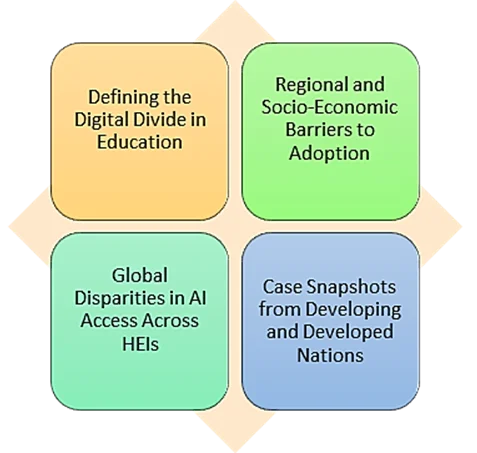
Novelty Statement
This study compares Tier-1 and Tier-3 institutions and proposes an inclusive AI adoption model addressing infrastructure, faculty readiness, funding, and ethics.
1. Introduction
Artificial Intelligence (AI) in higher education institutions represents a transformative shift in how education is delivered, managed, and conceptualized.[1,2] Technologies such as Large Language Models (LLMs) have the potential to significantly enhance personalized learning, democratize research access, and automate several institutional processes.[3] From AI-powered chatbots that assist students with academic queries to advanced adaptive learning systems that tailor educational content to individual learning needs, AI is reshaping the landscape of higher education.[4]
However, this transformation does not occur uniformly. Well-funded, urban Tier-1 institutions, such as many Indian Institutes of Technology (IITs), often have greater access to advanced digital infrastructure than Tier-2 and Tier-3 colleges do, particularly those located in rural or underserved regions. This digital divide reflects underlying systemic inequalities related to infrastructure availability, digital literacy, faculty preparedness, and institutional policy support. While leading institutions are better positioned to drive AI-enabled innovation, many institutions in less developed contexts continue to struggle with limited internet bandwidth, outdated technological infrastructure, and insufficient training opportunities for faculty. If these disparities remain unaddressed, they risk reinforcing existing educational inequalities and excluding large groups of students from the potential benefits of AI-enabled learning.
The digital divide is both a global and a local issue. While many western institutions are rapidly advancing through institutional AI strategies and partnerships with technology industries, institutions in low- and middle-income countries (LMICs) continue to face significant infrastructural and resource constraints.[5] In countries such as India, disparities in access to digital technologies and artificial intelligence in education are further shaped by socioeconomic inequalities and regional differences.[6] Addressing these challenges requires not only improved technological infrastructure but also the ethical and sustainable integration of AI across all levels of education, along with strategies aimed at bridging the digital access gap.[7,8]
This paper examines these challenges across both global and local contexts, including infrastructure limitations, policy gaps, and pedagogical considerations. It identifies several barriers that hinder the adoption of artificial intelligence in higher education institutions and provides targeted recommendations to support more equitable digital transformation. The study also highlights the importance of faculty development in artificial intelligence to ensure effective implementation in teaching and learning practices. Ultimately, the paper envisions a future in which technology supports equity and mobility for all learners, enabling them to move across institutions and geographic boundaries in pursuit of their educational and workforce aspirations.
1.1 Objectives
- To investigate the structural, technological, and socioeconomic barriers impeding AI (LLM) adoption across diverse HEIs.
- To recommend sustainable, inclusive frameworks for integrating AI tools in higher education without reinforcing digital inequality.
1.2 Understanding the digital divide: a global and local perspective
By linking global disparities in AI readiness with local institutional challenges, the multilayered nature of the digital divide in higher education is illustrated in Fig. 1. It highlights how variations in economic development, infrastructure availability, digital literacy, and policy support interact to influence AI adoption across HEIs. The figure provides a conceptual framework for understanding how global-level inequalities translate into institutional-level barriers, particularly affecting Tier-3 and resource-constrained institutions.
Fig. 1: Understanding the digital divide: a global and local perspective.
1.3 Operational definitions
Table 1 presents the operational definitions of key concepts used in this study, including the digital divide, AI adoption, AI literacy, and institutional tiers in higher education. These definitions outline the core dimensions, measurable indicators, and institutional implications that help structure the analysis of AI integration across different categories of Higher Educational Institutions (HEIs).
Table 1: Operational definitions of key concepts used in this study, including the digital divide, AI adoption, AI literacy, and institutional tiers in higher education.
| Concept | Detailed Definition | Core Dimensions | Measurable Indicators | Institutional Implications |
|---|---|---|---|---|
| Digital Divide | The structured and measurable disparity among Higher Educational Institutions (HEIs) in terms of access to digital infrastructure, technological resources, computational power, internet connectivity, digital skills, and institutional AI preparedness. It reflects systemic inequality in technological readiness that affects equitable AI integration. | 1. Infrastructure Gap 2. Connectivity Gap 3. Computational Capacity 4. Digital Skill Gap 5. Policy Readiness | − Bandwidth speed and reliability − Number of functional computer labs − GPU/Cloud access availability − Percentage of digitally trained faculty − AI-related institutional policies | Institutions with higher digital maturity demonstrate greater innovation capability, while digitally deprived institutions experience restricted academic competitiveness and reduced student exposure to AI-based learning tools. |
| AI Adoption | The systematic institutional integration of Artificial Intelligence tools—such as Large Language Models (LLMs), predictive analytics, adaptive learning systems, intelligent tutoring, plagiarism detection tools, and AI-enabled administrative platforms—into academic, research, and governance processes. | 1. Pedagogical Integration 2. Research Utilization 3. Administrative Automation 4. Policy Integration | − AI-enabled course modules − Use of AI in grading and evaluation − AI-supported research tools − AI governance guidelines | Higher adoption levels correlate with improved efficiency, personalized learning, and data-driven decision-making. Limited adoption results in institutional stagnation and competitive disadvantage. |
| AI Literacy | The cognitive, technical, and ethical competency of faculty and students to understand AI systems, critically evaluate AI outputs, responsibly use generative tools, and recognize associated ethical risks such as bias, data privacy, and academic integrity concerns. | 1. Technical Understanding 2. Critical Evaluation Skills 3. Ethical Awareness 4. Responsible Use Practices | − Participation in AI training programs − AI literacy modules in curriculum − Ethical AI awareness workshops − Ability to interpret AI-generated outputs critically | Institutions with higher AI literacy demonstrate safer, more meaningful AI deployment, while low literacy increases misuse, dependency, and academic integrity risks. |
| Tier-1 HEIs | Highly funded, urban, research-intensive institutions characterized by advanced digital ecosystems, strong industry collaborations, high faculty expertise, and institutional AI strategies. Typically, nationally or internationally ranked universities. | 1. Advanced Infrastructure 2. Strong Industry Linkages 3. Research Orientation 4. Dedicated IT Support | − High research funding − Presence of AI labs/centers − High-speed campus-wide connectivity − Dedicated AI faculty positions | These institutions serve as innovation leaders and early adopters of AI technologies, influencing policy and pedagogical trends nationwide. |
| Tier-3 HEIs | Resource-constrained institutions, often located in rural or semiurban regions, characterized by limited funding, outdated infrastructure, inadequate digital support systems, and minimal AI integration within curriculum and administration. | 1. Infrastructure Constraints 2. Limited Connectivity 3. Restricted Budget Allocation 4. Low Digital Readiness | − Limited computer-to-student ratio − Unstable internet access − Absence of AI-specific courses − Limited FDP participation | These institutions face structural disadvantages that restrict AI experimentation, potentially widening socio-educational inequalities without targeted policy intervention. |
Source: Developed by the authors on the basis of an integrative review of the literature on digital divide theory, AI adoption in higher education, AI literacy frameworks, and institutional differentiation models, drawing on studies by Ghobadi & Ghobadi[7], Scherer et al.[10], Reed, Gannon & Dongarra[15], Southworth et al.[19], Roy & Swargiary[18], Gu & Ericson[27], Kamalakar & Kamala[17], and other relevant references cited in this study.
2. Methodology
2.1 Explaining the digital divide in education
The educational digital divide is a continuous gap among regions, institutions, and socioeconomic strata in the field of access to digital technologies, infrastructure, and digital literacy. This gap can increasingly be seen in the usage of AI tools (LLMs) within higher educational institutions. While some institutions may have digital infrastructure, faculty expertise or funds to integrate AI, others in the hinterland or poorer regions are limited by outdated systems, unreliable connectivity and few skilled field professionals. This leads to an inequitable learning environment that stifles innovation and exacerbates school segregation.[7,8]
2.2 AI access inequality around the world between HEIs
A significant correlation is observed globally between AI access inequalities and greater concerns about economic advancements and digital maturity. Affluent countries have well-funded digital ecosystems, strong research infrastructure, and access to state-of-the-art tools and training that support HEIs in those countries. Such institutions are well positioned to lead AI adoption and expand user access since they can effectively integrate LLMs into research, personalized learning, and administration. On the other hand, institutions in low- and middle-income countries face significant structural disadvantages. Many institutions lack the financial capacity to procure licenses or access cloud computing infrastructure, or their area of operation has unreliable internet connectivity. Such international disparity not only limits innovation in education but also hinders global cooperation, therefore strengthening structural differences between the Global North and South.[9]
2.3 Regional and socioeconomic barriers to adoption
Within a country such as India, the digital divide occurs at regional and socioeconomic levels. The significant advantage of urban HEIs (which can be considered Tier-1 institutions) is that they have better access to digital resources, governmental grants, and connections with technological companies. Conversely, Tier-3 institutions, primarily located in semi-urban or rural areas, face financial constraints, limited staffing and infrastructural limitations. The socioeconomic situation (dissimilarities in income, the level of digital literacy among the faculty and students, language barriers, etc.) also limits the use of AI tools. Furthermore, even when technological infrastructure is available, a lack of required training and resistance to change among faculty members usually undermine the effective use of technology.[10]
2.4 Case studies from developing and developed nations
Developed countries such as the United States and the United Kingdom have played a leading role in supporting AI adoption in universities to personalize curricula, make administrative processes less time-consuming, and enhance the production of research. As an example, AI is incorporated into MIT and Stanford universities to help with grading in real time, learning analytics, and AI-based tutoring. Universities in less developed countries, such as Kenya or India, struggle with the digital infrastructural basics. An example would be a rural Indian HEI that would not have access to electricity and good broadband on a regular basis; therefore, using cloud-based LLMs would not be a viable option. However, some developing countries are demonstrating measurable progress.[11,12]
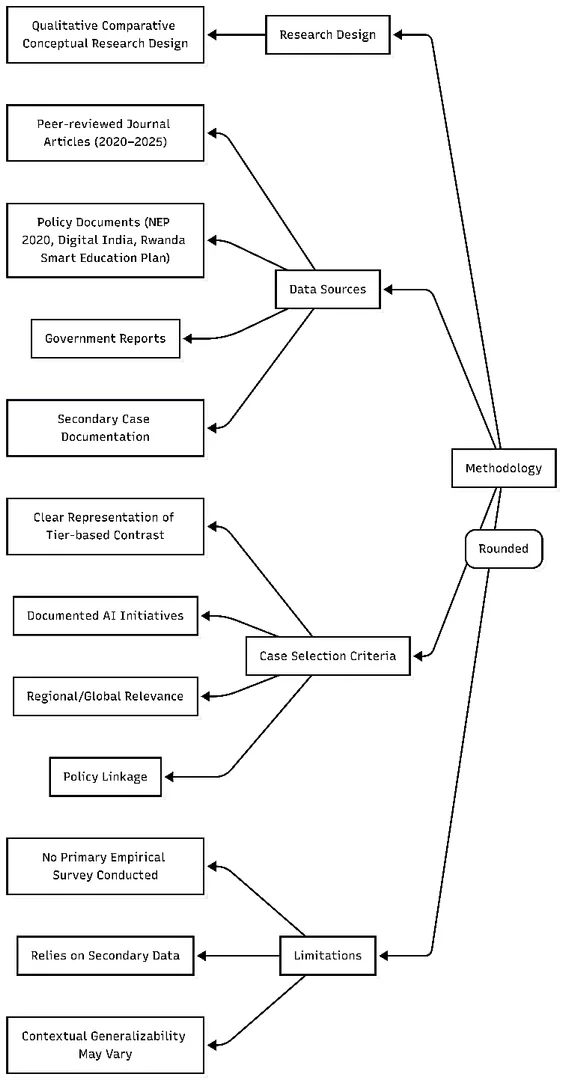
Fig. 2: Methodology framework illustrating the research design, data sources, case selection criteria, and study limitations used in the qualitative comparative analysis.
3. Infrastructure, Connectivity, and Capacity Gaps in HEIs
3.1 Technology infrastructure in tiered institutions
One of the main constituents of the digital divide is the difference in technology infrastructure between Tier-1 and Tier-3 HEIs. Such Tier-1 organizations are often provided with the latest computing infrastructure, state-of-the-art laboratories, cloud-based infrastructure and AI-driven platforms. These facilities enable experimentation, learning, and research on AI and LLMs. Conversely, Tier-3 HEIs, which are frequently located in resource-limited areas, face problems with an aging computer infrastructure, low availability of digital resources, and the absence of a scalable IT design. This infrastructure deficit has serious repercussions for the capacity of lower-level institutions to access the latest technologies, resulting in limited exposure and inadequately prepared graduates.[13,14]
3.2 Limitations on internet access and computational power
The cornerstones of effective AI integration are the presence of reliable internet connectivity and computational capacity. Most Tier-3 HEIs lack stability in their broadband, data bandwidth, and server capacity; therefore, they are unable to implement cloud-based AI solutions. Although institutions with the most funding in urban centers can potentially have access to high-performance computing (HPC) clusters or artificial intelligence cloud providers such as Azure or AWS, underfunded institutions may lack awareness and access due to a lack of investment. This not only impedes learning efficiency but also limits students’ academic progression and constrains administrative functions such as automated grading, plagiarism detection, and data analysis. Additionally, lacking GPUs or greater processors, these institutions may lack the capacity to develop and deploy advanced LLMs, and they will be at a long-term disadvantage.[15]
3.3 Staffing, IT support, and digital readiness
Other significant constraints relate to human capital and institutional readiness. Tier-1 institutions typically have dedicated IT staff, AI experts, and capabilities to support and drive digital transformation initiatives. Regular training programs and workshops keep the faculty up to date about the new tools. Tier-3 institutions, on the contrary, typically have IT personnel who are generalists and do not have expert knowledge of AI. A lack of systematic digital literacy courses among faculty members and students further exacerbates this deficiency. Consequently, the lack of well-trained staff limits effective utilization even when the infrastructure is upgraded. The fact that no specialized change management units exist to facilitate change also hampers the rate of digitalization and hobbles the ability of the institution to be innovative.
4. Case Study: Contrasting AI Adoption in Tier-1 and Tier-3 HEIs in India with a Global Perspective (Rwanda Model)
4.1 Case study: Rwanda’s smart education & Microsoft AI partnership — a Global South success model
Rwanda, through its Smart Education Master Plan, has emerged as a leader in AI and digital inclusion among developing nations. The government collaborated with Microsoft, the Mastercard Foundation, and Smart Africa to digitally transform HEIs.
Key highlights:
- Deployment of AI Labs and digital classrooms in public universities.
- Focus on teacher training, student AI literacy, and multilingual tools.
- Supported through grants and public–private partnerships, ensuring sustainability.
- AI-driven platforms are being used for adaptive learning, administration, and research analytics.
Significance:
Rwanda’s success proves that even low-income countries can overcome traditional barriers through policy alignment, global partnerships, and localized implementation, making it a model for AI adoption in the Global South. This case provides an alternative avenue for the integration of AI, which is supported by coherent policy, public–private partnerships and intentional capacity building. Unlike the Indian HEI case, where AI implementation is limited to a narrow set of discrete applications in the teaching-learning situation, in Rwanda, AI implementation extends beyond teaching and learning to include administrative and research functions. The report revealed that investment in infrastructure and technology-based teaching platforms, including advanced AI platforms that support language capabilities, remains very limited in low-income settings. On the conceptual level, it contributes to the debate regarding how decisions, policies and adherence to adopt AI are shaped not only economically but also by congruence at the governance level. This offers a scalable model that can be scaled to propagate the extensive use of AI in the Global South.
5. The Role of Faculty, Pedagogy, and Curriculum Integration
5.1 Faculty perceptions and resistance
Large language models or other tools of AI can be implemented in HEIs under the influence of faculty members. However, the degree of interest and adoption depends considerably on what happens institutionally. In Tier-1 HEIs, the faculty can be exposed to technological innovations in advance and have an increased propensity to experiment with AI-driven solutions in teaching and research. Conversely, faculty in Tier-3 institutions can be sceptical or reluctant to adopt AI due to unfamiliarity or may perceive AI as a threat to academic autonomy or professional relevance. There is also resistance to workload implications, insufficient training, and a lack of institutional support for AI integration. To the extent that perceptions remain unchanged, they can hinder the process of digital transformation, with or without the existence of an appropriate infrastructure.[16]
5.2 Digital pedagogy and the redesign of learning models
The implementation of AI in education requires the application of a paradigm shift in education pedagogy, i.e., the replacement of static curriculum delivery with interactive and student-centered learning. The ability to generate content in real time, adaptive assessments, and intelligent tutoring are examples of possibilities that LLMs are able to deliver and that have made educators reimagine classroom interaction. The success of digital pedagogy does not solely involve the use of LLMs because they are no longer support systems but are part of the learning platform. Nonetheless, most institutions, particularly Tier-3 colleges, are still working on legacy models that are based on rote learning and summative evaluations. The design of new learning models that embrace inquiry-centered learning and project-based assessment, as well as collaborative digital spaces, has not yet been developed owing to institutional and curricular conservatism.[17]
5.3 Upskilling educators for AI tools
The introduction of LLMs into the educational process requires systematic upskilling programs. The faculty should be trained not only in the technical use of AI tools but also in their pedagogical potential and ethical implications. Tier-1 institutions typically provide internal training and peer-learning courses as well as MOOCs in artificial intelligence-related fields. In contrast, Tier-3 institutions do not have steady upskilling opportunities because of budget and staffing constraints. This gap is further enhanced by the lack of institutional policies requiring faculty to be digitally literate. National-level programs, such as the AI-for-education programs of Digital India, can help fill this gap, but only if they are designed to be localized and inclusive.[18]
5.4 Curriculum gaps in AI literacy
In recent years, with increasing interest in AI, it has been surprising that very few undergraduate or postgraduate-level academic curricula have modules designed entirely for artificial intelligence literacy, especially in non-STEM subjects. The gap is more pronounced in the case of Tier-3 HEIs, where curricula are often outdated and centrally regulated. When colleges offer AI courses, they are often theoretical and provide little practical experience with LLMs or AI platforms. This produces a cohort of AI-unprepared college graduates. A proactive approach would involve integrating AI literacy across disciplines and departments, ranging from transdisciplinary modules to laboratory courses, along with discussions aimed at strengthening ethical understanding in the context of AI. Policy frameworks that support innovation, flexibility, and industry alignment in the development of new classes must accompany curricular reforms.[19]
6. Ethical, Legal, and Policy Challenges
6.1 Data privacy and bias in LLM tools
The architecture of constructed large language models is built on the basis of large-scale data scraping from the internet, which has attracted some serious concerns, such as the problems of data privacy and bias in such models. The tools that will be used by HEIs tend to work with highly sensitive information (research by students or institutional records). Poor security or integration may result in the loss of data, unwanted surveillance or violation of local privacy laws. Moreover, training data biases may result in LLMs reinforcing stereotypes based on gender, race or location. This becomes a major challenge for inclusive education, particularly in multicultural and multilingual learning environments. It is likely that such risks will increase in an organization that does not have tailored data ethics policies, especially in certain lower-level Tier-3 systems in which AI governance is unstable.[20]
6.2 IP and academic integrity concerns
The generative abilities of LLMs raise acute challenges related to Intellectual Property (IP), authorship and scholarly honesty. Students also have the opportunity to compose assignments, write a code, or research paper with the help of LLMs, and it becomes difficult to distinguish between the original work and the one that has been done with the assistance of AI. Similarly, lecturers and publishers employing AI-generated content in their lectures or publications may face challenges in determining authorship and originality. The current plagiarism detection systems are extremely ineffective against paraphrased or AI-generated content, thereby creating a loophole in academic integrity policy. The use of proprietary LLMs also concerns the matter of ownership in regard to the results produced with the assistance of this type of tool. The absence of a specific piece of law concerning IP will put institutes at risk of lawsuits involving ownership, licensing, and copyright infringement.[21]
6.3 Regulatory gaps and institutional risks
Unlike numerous states, India does not yet possess a proper regulatory system aimed at the implementation of AI in education. The absence of national-level guidelines or accreditation-related standards on how AI is used in HEIs makes the topic of acceptable conduct ambiguous. Institutions often interpret ethical boundaries independently, and this causes a variation in the application of the rules, with the possibility of reputational risk. HEIs at the Tier-1 level with legal and policy access may proceed to implement institutional ethics committees or compliance processes. However, Tier-3 colleges may lack awareness of the legal implications associated with deploying commercial AI platforms, thereby increasing their susceptibility to risks related to data misuse, discrimination, and potential regulatory non-compliance in the context of AI.[22]
6.4 Balancing innovation with ethics
However, a balance between the possible power of AI innovation and morality needs to be sought, which should be sought by HEIs. This requires a complicated course of action that includes policy creation, stakeholder training, and continuous monitoring. To analyze new implementations and determine the risks, companies should implement AI Ethics Boards or Digital Policy Committees. Among the above, transparent and open-source LLMs can be favored over opaque commercial models as tools for promoting accountability. Faculty members should be given training on the concepts of ethical use, informed consent, and AI literacy. Finally, ethical frameworks may be considered in the approach to adoption, and this may assist HEIs in innovating in a responsible way, meeting academic integrity, and protecting the rights of students and teachers.[23]
7. Funding Models and Public–Private Partnerships
7.1 Role of government funding in digital transformation
Government financing forms the basis of driving digital transformation and AI usage in higher educational institutions (HEIs), especially in low- and middle-income areas. National Education Policy (NEP 2020), Rashtriya Uchchatar Shiksha Abhiyan (RUSA), and Digital India are some of the initiatives in India that intend to increase the infrastructure and encourage learning through the application of technology. Investment is channeled to make smart classrooms, digital libraries, and virtual laboratories, and some of them can indirectly support the implementation of AI. However, Tier-3 HEIs also tend to lack the ability to access or use these funds efficiently. In most instances, bureaucratic delays, a lack of proposal-writing skills and misalignment with funding requirements hinder these institutions from taking advantage of available grants. It is necessary to develop a focused strategy with set funds dedicated to AI capacity building in underserved HEIs.[24,25]
7.2 Industry collaborations and freemium models
The private sector has been a great contributor to AI integration within HEIs. Major technology corporations such as Microsoft, Google, and Amazon have also introduced educational-related alliances to offer cloud credits, AI toolkits, and training opportunities. Such partnerships, specifically within Tier-1 HEIs, assist in fast-tracking AI-powered curriculum reform and the pedagogical modernization of faculty. For example, the AI-for-education package offered by Microsoft and TensorFlow provided by Google is frequently used in data science curricula. Another emerging trend is the widespread use of so-called freemium models or the distribution of simple AI tools, such as ChatGPT, Grammarly, or Copilot, free of charge to students and educators, with paid extensions. These models may create dependency on proprietary platforms while they increase access at early stages of adoption. In the case of Tier-3 institutions, sustainability and vendor lock-in risks have to be dealt with diligently.[26]
7.3 NGO and international support models
International development agencies and Non-Governmental Organizations (NGOs) play key mediating roles in bridging the gap in AI access. Organizations such as the Wadhwani Foundation, UNESCO and the British Council have conducted pilots and initiatives to increase AI literacy and digital skills among under-resourced Indian HEIs. Such efforts frequently revolve around the creation of the basics of digital skills, the notion of inclusivity by means of tools of regional languages, and the bolstering of local digital learning ecosystems. Exchange of knowledge, fellowships and open-source educational technologies are also facilitated through international collaborations. Nevertheless, these kinds of interventions tend to be small-scale and short-term and accordingly need institutional backup to produce long-term resonance and scale.[27]
8. Strategies for Bridging the Digital Divide
A strategic framework for bridging the digital divide in AI adoption across HEIs is presented in Fig. 3. It integrates key intervention areas such as infrastructure development, faculty capacity building, policy support, ethical governance, and collaborative partnerships. The figure demonstrates how coordinated action across these dimensions can promote inclusive and sustainable AI integration, particularly for under-resourced institutions.
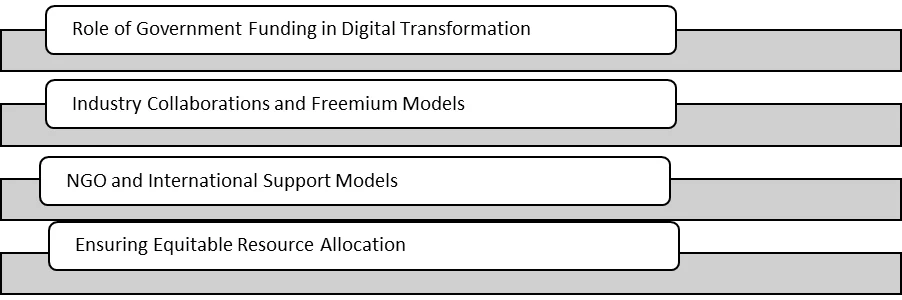
Fig. 3: Strategies for bridging the digital divide.
8.1 Infrastructure development and shared services
The digital divide in HEIs can be reduced by ensuring more equitable distribution of infrastructure. Whereas Tier-1 institutions enjoy world-class facilities, in the case of Tier-3 and rural HEIs, there is hardly any basic digital infrastructure. The development of shared services is a successful technique that includes regional AI resource centers, cloud computing hubs, and remote learning labs to serve a group of under-resourced establishments. This mutual strategy curbs the redundancy of expenses and maximizes scarce resources. Public infrastructure projects should also be accompanied by monitoring systems to ensure the maintenance, upgrading, and pedagogical utilization of installed infrastructure. Hybrid classrooms, mobile labs, and community internet kiosks are other scalable and cost-effective infrastructural interventions.[28]
8.2 National AI education policy initiatives
Government policy is a catalyst for systemic reform. Countries such as India aim to democratize access to emerging technologies through national initiatives such as National Digital Education Architecture (NDEAR) and AI-for-All programs under the Digital India framework. These frameworks demand curriculum change, professional skills, and digital inclusion in schools and higher education. To ensure that HEIs deploy AI tools, such as the resurgence of LLMs, in their standard academic and administrative cycles, policy interventions must be targeted and context-specific. Policy guidelines should also require that AI be taught as part of the curriculum across disciplines, not just the STEM subjects. State governments can augment these arrangements by providing grants, policy toolkits and district-level AI innovation hubs. Policy application should also be local and sensitive to regional settings.[29]
8.3 Faculty development and community-of-practice models
Faculty play a central role in driving digital transformation. Faculty development programs should be provided on a large scale with the aim of updating educators about AI applications and digital ethics, as well as the latest innovative approaches. However, one-time workshops are not enough. Institutions should be able to create CoP models that are collaborative, peer-driven networks that enable faculty to experiment, share, and reflect on AI-supported teaching processes. These community-based groups facilitate the creation of long-term learning opportunities, decrease the isolated nature of the institutions in rural areas, and encourage contextualized innovations. Digital platforms such as SWAYAM, NPTEL, and FDP.ai may be incorporated into proper capacity-building programs. Interchange of the faculty between Tier-1 and Tier-3 HEIs, either through grants or virtual mentorship, will also fill the knowledge and skill gaps.[30]
9. Future Roadmap for Inclusive AI in Education
9.1 Recap of core challenges and takeaways
The implementation of AI, especially LLMs, at higher educational institutions presents immense opportunities in terms of teaching, learning, research, and administration. Nonetheless, this potential is not fulfilled equally because of a current digital gap. The significant implications that arose in the course of the study are infrastructural gaps between Tier-1 and Tier-3 institutions, uneven internet access, insufficient computing facilities, faculty preparedness and the curriculum. In addition, the questions of data privacy, algorithm bias, intellectual property, and a lack of cohesive national regulations pose another problem in terms of AI adoption. Whereas Tier-1 universities have adequate funding, alliances, and digital networks, Tier-3 colleges can be left on the periphery of modern-day innovation. These disparities risk perpetuating existing social inequalities and limit a substantial proportion of students’ access to twenty-first-century learning opportunities.
9.2 Vision for “AI for All” in HEIs
To create an inclusive and future-ready educational ecosystem, the concept of AI, which aims to make it accessible to everyone, should be placed at the core of the policy and practice. This vision involves the democratization of AI accessibility among all of the HEIs; the extent of democratization is not dependent on size, location, or financial power. It does not see AI as a luxury that can be used only by elite institutions but rather as a means of increasing equity in learning opportunities and academic excellence. Realizing this vision requires the ethical design of AI, cross-cultural and multilingual inclusivity, and sustained collaboration between the state and the corporate world. “AI for All” also emphasizes the development of digital citizenship and literacy to understand AI and supports educators in becoming agents of innovation and inclusion.
9.3 Future research and policy recommendations
The existing study needs to be expanded with other studies to investigate localized approaches to AI adoption in various institutional settings, especially in less represented regions and fields. The potential long-term effects of AI-enabled pedagogy on student success, faculty involvement, and employability should also be studied. International comparative studies can provide best practices in the entire world and problem-specific issues. Some of the policy recommendations involve the development of a national framework on AI in higher education, which advocates the use of open-source and multilingual AI systems and the creation of AI ethics and innovation committees at the institutional level. Funding models should be long term.
10. Conclusion
Artificial intelligence (AI) has the potential to transform teaching and learning, research, and administration across higher educational institutions; however, this potential is not evenly distributed. Infrastructure limitations, unreliable connectivity, limited computational resources, gaps in faculty expertise, and unclear policy frameworks continue to widen the disparity between well-funded Tier-1 universities and resource-constrained Tier-3 and rural institutions. Ethical and privacy concerns, including data protection, academic integrity, and algorithmic bias, further complicate AI adoption. Nevertheless, emerging models based on public–private partnerships, national-level digital initiatives, and NGO-led interventions demonstrate that inclusive AI adoption is achievable when strategy, investment, and capacity building are effectively aligned. The vision of “AI for All” must therefore prioritize equitable infrastructure development, continuous faculty reskilling, the use of multilingual and open-source tools, robust governance frameworks, and sustained funding mechanisms. Ultimately, through coordinated national policies, institutional commitment, and community-driven innovation, AI can serve as a catalyst for reducing—rather than reinforcing—educational inequalities while empowering learners and educators across diverse contexts.
References
- [01] J. Garzón, E. Patiño, C. Marulanda, Systematic review of artificial intelligence in education: trends, benefits, and challenges, Multimodal Technologies and Interaction, 2025, 9, 84, doi: 10.3390/mti9080084.
- [02] O. Zawacki-Richter, V. I. Marín, M. Bond, F. Gouverneur, Systematic review of research on artificial intelligence applications in higher education—where are the educators?, International Journal of Educational Technology in Higher Education, 2019, 16, 39, doi: 10.1186/s41239-019-0171-0.
- [03] D. Long, B. Magerko, What is AI literacy? Competencies and design considerations, Proceedings of the 2020 CHI Conference on Human Factors in Computing Systems (CHI ’20), Association for Computing Machinery, New York, NY, USA, 2020, 1–16, doi: 10.1145/3313831.3376727.
- [04] A. Fošner, B. Aver, AI chatbots in higher education: students’ beliefs and concerns, Sustainable Futures, 2025, 9, 100734, doi: 10.1016/j.sftr.2025.100734.
- [05] H. Sharma, T. Soetan, T. Farinloye, E. Mogaji, M. D. F. Noite, AI adoption in universities in emerging economies: prospects, challenges and recommendations, Reimagining Educational Futures in Developing Countries, Palgrave Macmillan, Cham, 2022, doi: 10.1007/978-3-030-88234-1_9.
- [06] A. Goswami, A. Sharma, AI for bridging socio-economic inequities in Indian education space, International Journal of Research and Scientific Innovation, 2024, 11, 890–935, doi: 10.51244/IJRSI.2024.1104066.
- [07] S. Ghobadi, Z. Ghobadi, How access gaps interact and shape digital divide: a cognitive investigation, Behaviour & Information Technology, 2015, 34, 330–340, doi: 10.1080/0144929X.2013.833650.
- [08] P. S. Aithal, S. Aithal, Optimizing the use of artificial intelligence-powered GPTs as teaching and research assistants by professors in higher education institutions: a study on smart utilization, International Journal of Management, Technology, and Social Sciences, 2023, 8, 368–401, doi: 10.47992/IJMTS.2581.6012.0326.
- [09] F. Marcinkowski, K. Kieslich, C. Starke, M. Lünich, Implications of AI (un)fairness in higher education admissions: the effects of perceived AI (un)fairness on exit, voice and organizational reputation, Proceedings of the 2020 Conference on Fairness, Accountability, and Transparency, 2020, 122–130.
- [10] R. Scherer, F. Siddiq, J. Tondeur, The technology acceptance model (TAM): A meta-analytic structural equation modeling approach to explaining teachers’ adoption of digital technology in education, Computers & Education, 2019, 128, 13–35, doi: 10.1016/j.compedu.2018.09.009.
- [11] E. Molina, E. Medina, AI Revolution in Higher Education. What you need to know, Digital Innovations in Education, World Bank, 2025.
- [12] G. Bibakumana, O. Niyibizi, Exploring the integration of ICT in promoting inclusive education: a case study of the College of Business and Economics at the University of Rwanda, Journal of Research Innovation and Implications in Education, 2024, 8, 170–178, doi: 10.59765/nhj8594f.
- [13] G. Kamalakar, K. Kamala, Inclusive education: bridging the gap for diverse learners in India, 2024.
- [14] A. A. Ogwo, Higher education, skills development and students’ preparedness for employability: a case study of the University of Lagos, Nigeria (toward a sustained practice approach with the triple helix model of innovation), Doctoral dissertation, University College London, 2024.
- [15] D. Reed, D. Gannon, J. Dongarra, Reinventing high performance computing: challenges and opportunities, arXiv preprint arXiv:2203.02544, 2022, doi: 10.48550/arXiv.2203.02544.
- [16] J. Buele, L. Llerena-Aguirre, Transformations in academic work and faculty perceptions of artificial intelligence in higher education, Frontiers in Education, 2025, 10, 1603763, doi: 10.3389/feduc.2025.1603763.
- [17] A. Gomathi, Faculty perspectives on the adoption of AI tools in education and research, Humanities and Social Science Studies, 2024, 13, 66–79.
- [18] K. Roy, K. Swargiary, Exploring the impact of AI integration in education: a mixed-methods study, SSRN, 2024, 4857648, doi: 10.2139/ssrn.4857648.
- [19] J. Southworth, K. Migliaccio, J. Glover, J. N. Glover, D. Reed, C. McCarty, A. Thomas, Developing a model for AI across the curriculum: transforming the higher education landscape via innovation in AI literacy, Computers and Education: Artificial Intelligence, 2023, 4, 100127, doi: 10.1016/j.caeai.2023.100127.
- [20] H. Mahapatra, S. B. Ingole, D. Singh, A. Dutt, R. Gupta, B. Chauhan, Artificial intelligence for sustainable education in India: problems and prospects, Library Progress: Library Science, Information Technology & Computer, 2024, 44, doi: 10.48165/bapas.2024.44.2.1.
- [21] S. Pudasaini, L. Miralles-Pechúan, D. Lillis, M. L. Salvador, Survey on plagiarism detection in large language models: the impact of ChatGPT and Gemini on academic integrity, arXiv preprint arXiv:2407.13105, 2024, doi: 10.48550/arXiv.2407.13105.
- [22] A. Mohanty, S. Sahu, India’s advance on AI regulation, Carnegie India, 2024.
- [23] A. Dabis, C. Cski, AI and ethics: investigating the first policy responses of higher education institutions to the challenge of generative AI, Humanities and Social Sciences Communications, 2024, 11, 1–13, doi: 10.1057/s41599-024-03526-z.
- [24] Government of India, Ministry of Education, National Education Policy 2020, https://www.education.gov.in/.../NEP_Final_English_0.pdf, Accessed: December 2025.
- [25] Government of Maharashtra, Rashtriya Uchchatar Shiksha Abhiyan (RUSA), https://htedu.maharashtra.gov.in/Main/RUSA, Accessed: December 2025.
- [26] Microsoft, Microsoft inks strategic partnerships to make India’s core sectors AI-first, https://news.microsoft.com/en-in/..., Accessed: December 2025.
- [27] X. Gu, B. J. Ericson, AI literacy in K-12 and higher education in the wake of generative AI: an integrative review, arXiv preprint, arXiv:2503.00079, 2025, doi: 10.48550/arXiv.2503.00079.
- [28] S. Helmer, C. Pahl, J. Sanin, L. Miori, S. Brocanelli, F. Cardano, T. D. Oyetoyan, Bringing the cloud to rural and remote areas via cloudlets, Proceedings of the 7th Annual Symposium on Computing for Development, 2016, 1–10.
- [29] M. Keerthana, M. S. Shetty, N. Ramkumar, Overview of innovations in AI education in India: school, teachers, and students, doi: 10.13140/RG.2.2.15784.99841.
- [30] J. R. Reilly, C. Vandenhouten, S. Gallagher-Lepak, P. Ralston-Berg, Faculty development for e-learning: A multicampus community of practice approach, Journal of Asynchronous Learning Networks, 2012, 16, 99–110.