

 Open Access||Editorial
Embracing the Future: The New Era of Sensing and Computing
1 Department of Mathematics, Faculty of Science, King Mongkut's University of Technology, Bangkok, 10140, Thailand
2 Editor-in-Chief, Journal of Smart Sensors & Computing, GR Scholastic, Ahmedabad, Gujarat, 382424, India
3 G R Scholastic LLP, Ahmedabad, Gujarat, 382424, India
4 Managing Editor, Journal of Smart Sensors & Computing, GR Scholastic, Ahmedabad, Gujarat, 382424, India
Graphical Abstract
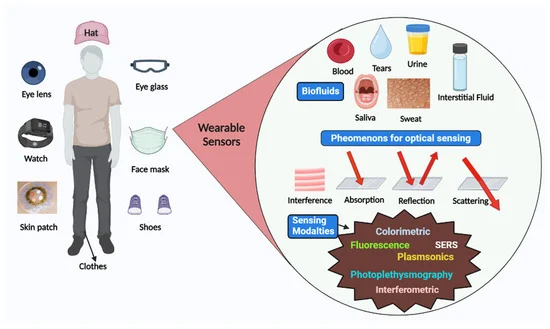
In this transformative era of Artificial Intelligence (AI) and Machine Learning (ML), many technological developments are going on from Internet of things (IoT), sensing technologies, AI applications.[1-4] By combining AI technology, edge computing, and Internet of things (IoT) sensing technologies, will enable the development of next-generation Sensing technology and pave the way for future applications such as AI robots, digital twins, e-healthcare, and digital human.[5-7] Fig. 1 shows schematic representation of novel wearable optical sensors for vital health monitoring system.
Fig. 1: Wearable optical sensors for vital health monitoring system. Reproduced from [8].
Journal of Smart Sensors and Computing (https://gr-journals.com/journals/ssc) (accessed 02 June 2025) is an open-access, quarterly, peer-reviewed journal that publishes high-quality research articles focused on the latest advancing research and innovation in sensor technologies and computational methods. The journal serves as a multidisciplinary platform for studies that contribute to the development, integration, and application of smart sensors and intelligent computing frameworks across a wide range of fields. It provides an advanced forum for researchers, engineers, and scholars focused on modern data acquisition systems, sensor development, and computational techniques used in building intelligent, integrated systems. By emphasizing both theoretical advancements and practical implementations, the journal bridges the gap between cutting-edge research and real-world application.
This journal welcomes a variety of article types, including original research papers, comprehensive reviews, and impactful case studies, offering a dynamic space for scholarly exchange and professional insights.
This first issue (June 2025) brings together a diverse collection of high-quality research articles. Md. Rezaul Hossain and Fizar Ahmed reported fine-tuning loan risk prediction models by comparing the performance of different Artificial Neural Network (ANN) layers (4-layer, 5-layer, and 6-layer) in identifying the risk attributes in loan defaults. This utilizes a comparative research design, using diverse borrower attributes and a range of financial ratios. Specifically, the method like Accuracy, Precision, Recalling is used to assess how well every configuration of ANN works on loan risk prediction. Jaimeet Sarode et al reported Attendie AI provides a comprehensive solution to the challenges faced by modern management. Offering real-time transcription, intelligent summarization, and integration with popular meeting platforms ensures that no critical information is lost, even in overlapping meetings or absences. Mohd Shafi Pathan and Aman Dhyani reported a study with an analysis of the practical implications, limitations of current methodologies, and a roadmap for future research in adaptive, real-time spam filtering systems. Salve et al. proposed a prototype using machine learning and deep learning algorithms that harnesses computer vision technology for accurate classification of weeds and crops without any involvement of human labour or assistance. Mohd Shafi Pathan and Kashish Rajankumar Reshamwala explored a conceptual study a digital examination seating allocation system with the architectural design, expected outcomes, and practical implications of adopting such a digital framework, laying the foundation for future development and real-world deployment.
As a newly launched journal in this transformative era of Artificial Intelligence (AI) and Machine Learning (ML), we are dedicated to providing a dynamic platform for sharing groundbreaking ideas and developments. We are committed to uphold the rigorous and efficient peer review process ensuring that every published work meets the highest standards.
On behalf of the Editorial Office, we extend a heartfelt welcome to all our readers, authors, and reviewers. Your participation and engagement are critical to the success of this journal. We encourage you to contribute your work, share your insights, and help us to shape this journal into a leading forum for innovation and discovery.
Conflict of Interest
There is no conflict of interest.
Supporting Information
Not applicable
Artificial Intelligence (AI) Use Disclosure
The authors confirm that there was no use of artificial intelligence (AI)-assisted technology for assisting in the writing or editing of the manuscript and no images were manipulated using AI.
References
- [1] S. D. Datta, M. Islam, Md. H. R. Sobuz, S. Ahmed, M. Kar, Artificial intelligence and machine learning applications in the project lifecycle of the construction industry: A comprehensive review, Heliyon, 2024, 10, e26888, doi: 10.1016/j.heliyon.2024.e26888.
- [2] S. Leleko, R. Chupryna, AI and IoT: A New Era of Technological Integration, accessed 02 June 2025.
- [3] S.B. Far, A. I. Rad, Internet of Artificial Intelligence (IoAI): the emergence of an autonomous, generative, and fully human-disconnected community, Discover Applied Sciences, 2024, 6, 91, doi: 10.1007/s42452-024-05726-3.
- [4] U. Khadam, P. Davidsson, R. Spalazzese, Exploring the role of artificial intelligence in internet of things systems: a systematic mapping study, Sensors, 2024, 24, 6511, doi: 10.3390/s24206511.
- [5] X. Liu, Z. Zhang, J. Zhou, W. Liu, G. Zhou, C. Lee, Development of photonic in-sensor computing based on a mid-infrared silicon waveguide platform, ACS Nano, 2024, 18, 22938–22948, doi: 10.1021/acsnano.4c04052.
- [6] M. H. da Fonseca, F. Kovaleski, C. T. Picinin, B. Pedroso, P. Rubbo, E-Health practices and technologies: A systematic review from 2014 to 2019, Healthcare 2021, 9, 1192, doi: 10.3390/healthcare9091192.
- [7] Z. Xiao, Z. Ren, Y. Zhuge, Z. Zhang, J. Zhou, S. Xu, X. Xu, B. Dong, C. Lee, Multimodal in-sensor computing system using integrated silicon photonic convolutional processor, Advanced Science, 2024, 11, 2408597, doi: 10.1002/advs.202408597.
- [8] B. Kaur, S. Kumar, B. K. Kaushik, Novel wearable optical sensors for vital health monitoring systems-a review, Biosensors, 2023, 13, 181, doi: 10.3390/bios13020181.
Publisher Note: The views, statements, and data in all publications solely belong to the authors and contributors. GR Scholastic is not responsible for any injury resulting from the ideas, methods, or products mentioned. GR Scholastic remains neutral regarding jurisdictional claims in published maps and institutional affiliations.
Open Access
This article is licensed under a Creative Commons Attribution-NonCommercial 4.0 International License, which permits the non-commercial use, sharing, adaptation, distribution and reproduction in any medium or format, as long as appropriate credit to the original author(s) and the source is given by providing a link to the Creative Commons License and changes need to be indicated if there are any. The images or other third-party material in this article are included in the article's Creative Commons License, unless indicated otherwise in a credit line to the material. If material is not included in the article's Creative Commons License and your intended use is not permitted by statutory regulation or exceeds the permitted use, you will need to obtain permission directly from the copyright holder. To view a copy of this License, visit: https://creativecommons.org/licenses/by-nc/4.0/
© The Author(s) 2025