

 Open Access||Research Article
Real-Time Wildlife Intrusion Detection System Using IoT and YOLOv8
1 Department of Information Technology, D. J. Sanghvi College of Engineering, Mumbai, Maharashtra, 400056, India
2 Department of Computer Engineering, Thakur College of Engineering and Technology, Mumbai, Maharashtra, 400101, India
Abstract
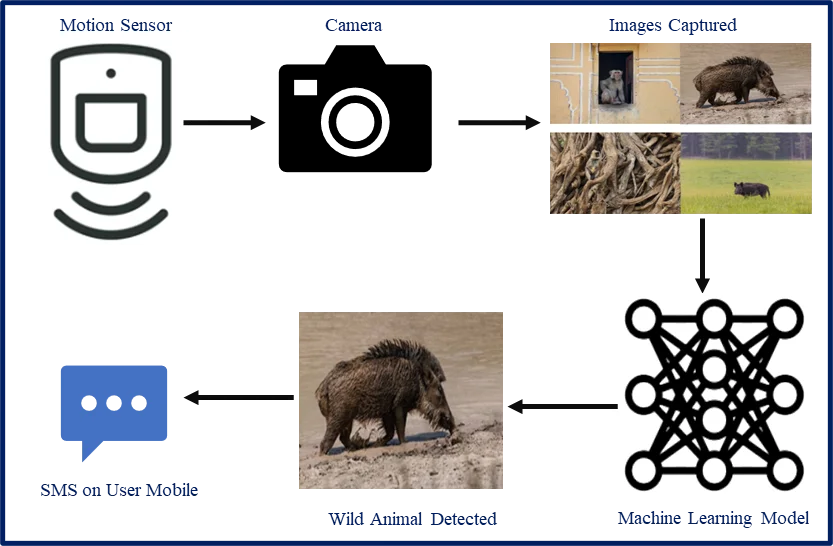
Human–wildlife conflict in agricultural areas leads to significant crop losses and livestock threats, creating an urgent need for reliable real-time detection systems. This study presents the Wildlife Intrusion Detection System (WIDS), a novel IoT-enabled solution designed to mitigate such risks. The system integrates PIR motion sensors, a Raspberry Pi computing unit, and a custom-trained YOLOv8n object detection model for robust wildlife identification, with Twilio SMS alerts ensuring rapid farmer response. A strategically deployed sensor network captures activity along the farm perimeter, while the Raspberry Pi executes YOLOv8n inference for accurate classification. A dataset comprising diverse animal images under varying conditions (day/night, weather, and motion speeds) was curated for training and testing. The system achieved 80–85% detection accuracy, with evaluation metrics of precision (0.84), recall (0.82), F1-score (0.83), mean Average Precision (mAP) (0.85), and average inference latency of 0.6 s per frame. These results highlight the system's robustness under real-world field conditions, making it suitable for practical deployment. The proposed WIDS significantly enhances farm security, minimizes agricultural losses, and demonstrates the potential of IoT and deep learning integration for sustainable agriculture and wildlife management.
Keywords
Graphical Abstract
Novelty Statement
By leveraging modern technologies such as Raspberry Pi, PIR motion sensors and machine learning algorithms, this proposed system provides a robust and efficient solution for detecting and deterring wild animals from entering farms.
1. Introduction
Wildlife intrusion into agricultural lands poses a serious threat to farm productivity and long-term sustainability, often resulting in significant crop damage, livestock loss, and financial hardships for farmers.[1–4] With the increasing overlap between human settlements and natural habitats, such conflicts have become more frequent, requiring reliable and automated solutions to mitigate the risks. Traditional measures such as manual monitoring, scarecrows, or physical barriers are either labor-intensive, costly, or quickly lose effectiveness as animals adapt.[5,6] These limitations highlight the urgent need for advanced technological interventions that can ensure real-time monitoring and rapid response. Several methods have been explored to address this issue, including the use of fencing and physical barriers, scare devices, manual surveillance, and basic sensor systems. Although electric fences and nets provide physical protection, they remain expensive to install and maintain. Scare tactics such as scarecrows and noise-makers may deter animals initially but tend to lose their impact over time. Manual surveillance, while effective to some extent, is labor-intensive and cannot guarantee timely intervention. Similarly, conventional motion-sensor alarm systems are unable to distinguish between different types of intrusions, leading to frequent false alarms and reduced reliability. These limitations demonstrate that existing methods lack the accuracy, adaptability, and intelligence required for large-scale deployment in diverse farming environments.
To overcome these challenges, we propose the Wildlife Intrusion Detection System (WIDS), an IoT-enabled solution that integrates Raspberry Pi computing, PIR motion sensors, and cameras with a custom-trained YOLOv8 deep learning model. Unlike traditional methods, WIDS not only detects intrusions but also classifies wild animals with high accuracy, thereby minimizing false positives. Furthermore, the system leverages Twilio-based SMS alerts, ensuring that farmers are instantly notified of potential threats and can respond proactively. The primary contributions of this research can be summarized as follows. First, WIDS demonstrates the effective integration of IoT hardware and computer vision technologies into a real-time monitoring framework. Second, a YOLOv8-based detection model trained on a curated dataset of wildlife images under diverse conditions—such as day and night settings, varying weather, and different animal movement speeds-enables robust classification and improved detection accuracy. Third, the system provides automated SMS alerts for immediate farmer intervention, thereby reducing response times. Finally, the solution is designed to be both scalable and cost-effective, making it adaptable for farms of varying sizes and resources. By addressing the shortcomings of conventional methods, the proposed WIDS provides a reliable, intelligent, and field-deployable solution to minimize agricultural losses, safeguard farmer livelihoods, and strengthen farm security.
2. Literature review
2.1 Existing systems
Wildlife intrusion detection in agricultural settings has been recognized as a major challenge, and several systems have been developed to address this issue.[7] Balakrishnan et al.[8] integrates motion sensors, cameras, and machine learning algorithms to detect and classify wildlife species, demonstrating promising results in real-world deployments by providing timely alerts and reducing crop damage. Similarly, Raiaan et al.[9] presented a Wildlife Monitoring System that leverages IoT devices and cloud-based analytics to monitor animal activity in natural habitats, highlighting the potential of combining IoT technologies with automated analytics for effective wildlife management. In terms of methodologies, image processing and computer vision techniques have been widely explored for wildlife detection tasks.[10] Deep learning models, particularly Convolutional Neural Networks (CNNs), have shown superior accuracy in automatically detecting and classifying wildlife species from images.[11,12] Among these, the YOLO (You Only Look Once) family of algorithms has gained significant attention due to its ability to perform real-time object detection on video streams.[13–15] The adoption of YOLO has proven especially useful for monitoring fast-moving animals under field conditions.
These advancements underline the potential of integrating modern hardware (IoT devices, sensors, cameras) with software-driven intelligence (deep learning, real-time analytics) to develop robust wildlife intrusion detection systems.[16–19] However, most existing approaches either face limitations in scalability, suffer from high false alarm rates, or lack field deployment validation across varying environmental conditions. To address these challenges, this study introduces WIDS, an IoT-enabled, YOLOv8-based wildlife intrusion detection system designed for real-time, cost-effective, and robust performance under practical field scenarios.
2.2 Research gaps
Despite the progress made by existing systems, several research gaps persist that limit their effectiveness in real-world agricultural settings. A major challenge lies in accurately distinguishing between target wildlife species and non-target objects such as domestic animals, farm workers, or environmental artifacts.[20,21] This often leads to false positives or missed detections, highlighting the need for more robust detection algorithms and the integration of contextual information to improve classification accuracy.
Another key limitation is scalability and cost-effectiveness. While many systems demonstrate promising results in controlled environments, their deployment in large or resource-constrained farms remains impractical. Balancing reliable performance with affordability and ease of maintenance is essential to ensure widespread adoption. Furthermore, most existing approaches make limited use of advanced sensor fusion techniques that could combine motion, infrared, and acoustic data to enhance detection robustness.
In addition to these technical challenges, user-centric aspects such as real-time alerts and intuitive interfaces remain underexplored. Providing farmers with timely, actionable information is critical for practical utility but often overlooked in existing designs. Observations of prior work also indicate that although IoT devices, PIR motion sensors, and deep learning frameworks such as TensorFlow, PyTorch, and YOLO provide a strong foundation, further refinement is needed to meet the specific requirements of agricultural environments. The integration of modern technologies such as IoT, cloud-based analytics, and deep learning has already demonstrated potential in wildlife monitoring. However, the practical utility of these systems ultimately depends on their ability to maintain reliability under variable field conditions while operating within the constraints of limited resources and infrastructure.
To address these gaps, our proposed WIDS builds upon previous research by incorporating YOLOv8-based real-time detection, IoT-enabled hardware integration, and a scalable, cost-effective design tailored to agricultural settings. By doing so, WIDS aims to deliver a robust, efficient, and user-friendly solution that enhances farm security, minimizes crop damage, and contributes to sustainable wildlife management practices.
3. Proposed methodology
The central problem addressed in this study is the urgent need for an effective and reliable system to detect and deter wildlife intrusion in agricultural farms. Wildlife incursions often result in extensive crop losses, damage to farm infrastructure, and threats to livestock, which collectively impose severe economic and social burdens on farming communities. Traditional approaches such as fencing, manual monitoring, or basic sensor systems have proven either ineffective, resource-intensive, or economically unfeasible for large-scale use. These limitations underscore the necessity for a cost-effective, intelligent, and real-time monitoring system capable of operating under diverse field conditions.
To meet this need, the proposed WIDS is designed to enhance farm security by combining IoT-enabled sensing devices, Raspberry Pi-based computing, and a YOLOv8 object detection model. By delivering accurate detection, automated alerts, and practical scalability, WIDS directly addresses the challenges of minimizing crop damage, protecting livestock, and ensuring the safety and security of farm assets.
3.1 Scope
The scope of this proposed system encompasses the development and implementation of a comprehensive solution for wildlife intrusion detection in agricultural environments. This includes the design and deployment of sensor networks, integration of machine learning algorithms for animal detection, and real-time communication of alerts to farmers.
Assumptions and Constraints: Assumption: The system assumes a relatively stable environment with minimal external disturbances that could trigger false alarms, such as strong winds or moving vegetation. Constraints: The system operates within the limitations of available resources, including hardware components (e.g., Raspberry Pi, PIR motion sensors) and computational capacity for machine learning model inference.
3.2 Proposed approach to build the Wildlife Intruder Detection System
The scope of the proposed WIDS encompasses the development and implementation of a comprehensive solution for detecting and mitigating wildlife intrusion in agricultural environments. The system is designed to integrate a network of sensors with advanced machine learning algorithms for accurate animal detection and real-time communication of alerts. The proposed scope includes the design and deployment of IoT-based sensor networks, the training and integration of the YOLOv8 detection model, and the delivery of timely alerts to farmers through SMS notifications. The system aims to provide a scalable, cost-effective, and robust framework that enhances farm security, minimizes crop losses, and protects livestock.
3.2.1 Assumptions
The system assumes that the deployment environment is relatively stable, with minimal external disturbances such as strong winds, dense moving vegetation, or human activity, which may otherwise generate false alarms. It also assumes that sufficient training data is available to capture variations in animal appearance under different conditions (e.g., day vs. night, varying weather).
3.2.2 Constraints
The system operates under several practical constraints. First, it is limited by the computational capacity of the hardware components, particularly the Raspberry Pi unit, which restricts the complexity of the deployed model and inference speed. Second, the PIR motion sensors used in the system have a fixed detection range and may not capture intrusions occurring beyond their coverage area. Third, the availability of reliable power supply and network connectivity is essential for continuous operation, especially for real-time alerts. These constraints were carefully considered during system design to balance accuracy, efficiency, and feasibility for deployment in agricultural settings.
3.3 Tools used for data collection, size of the sample, and limitations
3.3.1 Data collection
A custom dataset comprising 1,300 images was collected to train and validate the YOLOv8n detection model. The dataset included three primary classes relevant to the farm intrusion problem: monkeys, pigs, and humans. Images were sourced from controlled farm environments, open fields, and public image repositories to ensure diversity. Each image was manually annotated with bounding boxes using the makesense.ai annotation platform, which provided high-quality labeled data for supervised training.
3.3.2 Sample size and diversity
The dataset size was deliberately chosen to capture sufficient variability in animal poses, backgrounds, and lighting conditions, thereby enhancing the robustness of the model. Images included both daytime and nighttime scenarios, different weather conditions (sunny, cloudy, and rainy), and various animal movement speeds. The inclusion of humans in the dataset allowed the system to distinguish between actual wildlife intrusions and non-target human presence, reducing false alarms.
3.3.3 Limitations
Despite careful curation, the dataset is subject to several limitations. The relatively modest dataset size may restrict the generalizability of the model to less common animal species. Furthermore, environmental factors such as poor lighting, heavy rainfall, dense vegetation, or partial occlusions can impact motion detection and classification accuracy. These limitations highlight the importance of future dataset expansion to include more species and broader environmental conditions.
3.4 Benefits of proposed methodology
The proposed WIDS offers several key advantages for agricultural applications. One of the most significant benefits is improved farm security, as the system delivers real-time alerts that enable farmers to take immediate action and thereby prevent crop damage and livestock predation caused by wild animals. This proactive approach not only safeguards farm assets but also helps reduce economic losses associated with wildlife intrusions.
Another important advantage is the enhanced efficiency achieved through automation. By minimizing the reliance on manual surveillance, WIDS allows farmers to reallocate their time and resources toward other critical agricultural activities. In addition, the system is designed to be cost-effective, leveraging affordable hardware components such as Raspberry Pi and PIR motion sensors, along with open-source software frameworks, to ensure accessibility even for resource-constrained farmers.
Furthermore, the scalability of the system is a defining feature. The modular architecture allows for flexible deployment across farms of varying sizes and configurations, making it adaptable to diverse agricultural contexts. This design not only supports current implementation needs but also provides the capability for future expansion, ensuring long-term utility.
4. System design and architecture
4.1 Design diagram
Fig. 1 shows the flowchart of the proposed system and Fig. 2 details its sequence diagram. The process begins with the motion detection with the help of PIR sensors. Once motion is detected, “Motion detected” message is sent to the server, triggering camera to capture the frames of the detected movements. These frames are processed using A YOLO model for animal detection. If Model identify pig or monkey for five consecutive frames, an SMS alert is sent to farmer using Twillo. If a human is detected or no detection, the proposed system stops detection.
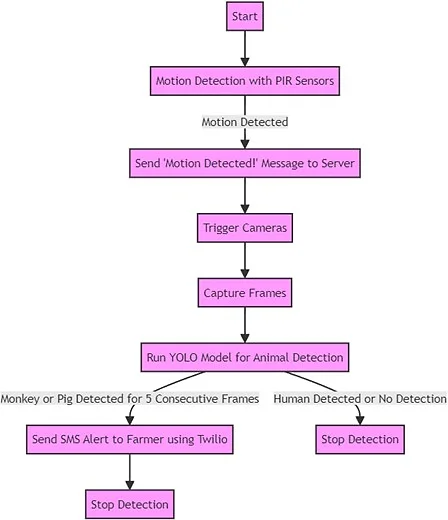
Fig. 1: Task network diagram.
4.2 Database diagram
Fig. 3 shows the database diagram for proposed system. It defines how difference components of the systems interact through rational table. The farm table store the information about farm location that linked to the motion detection table, which logs information about detection with timestamp and message. The detected animal table as associate with the motion detection table records identified animal with their type, detection confidence level. The SMS alert table maintains records of alerts generated when specific animals are detected while the SMS history table tracks details of sent alerts, including recipient phone numbers and delivery status. Human presence related data is kept in the human detection table.
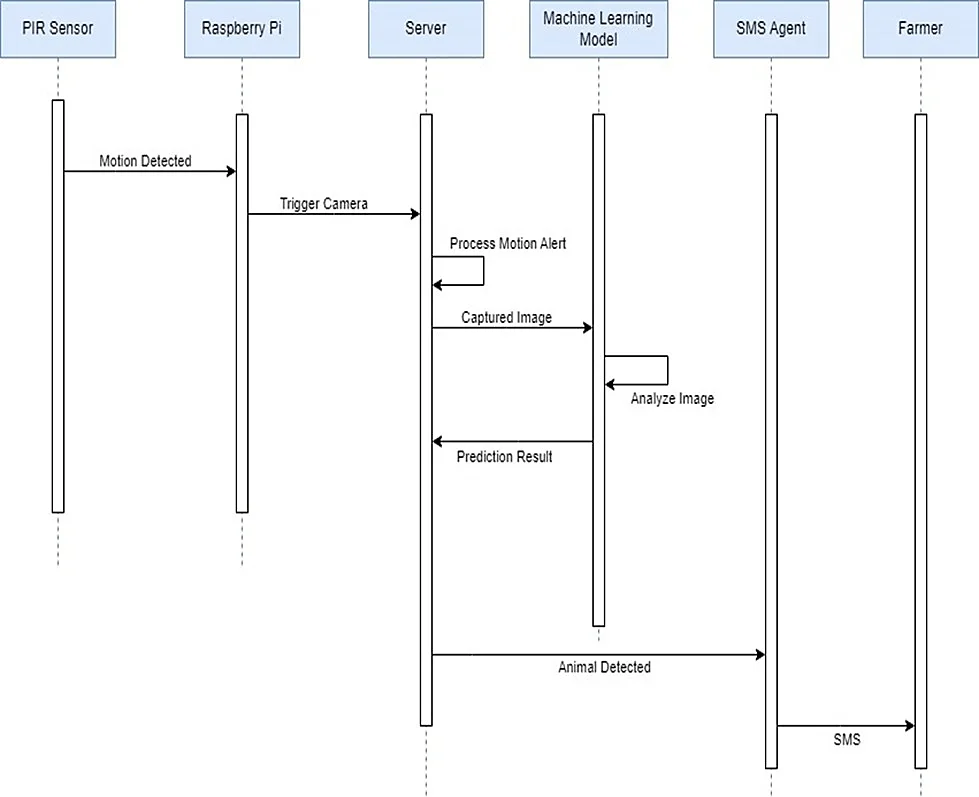
Fig. 2: Sequence diagram.
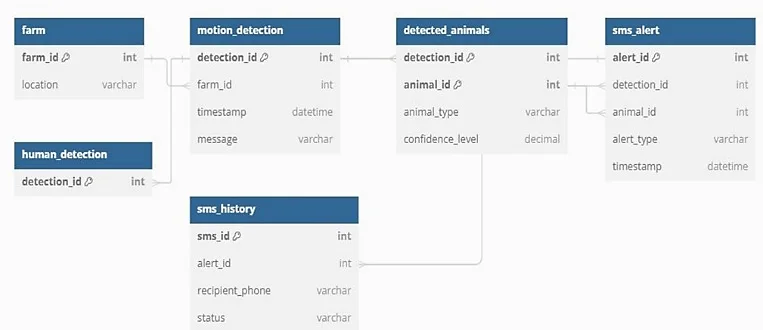
Fig. 3: Database diagram.
5. Implementation
5.1 Working of system
Fig. 4 shows the system architecture for the proposed system. The operation of the WIDS follows a structured workflow that integrates sensing, image processing, and alert communication. The process begins with motion detection, where Passive Infrared (PIR) sensors continuously monitor the farm perimeter for thermal activity associated with moving objects. When motion is detected within the sensor's range, the Raspberry Pi computing unit is triggered, which in turn activates the camera to capture real-time images of the monitored area. The captured images are processed using the YOLOv8n object detection model, which has been custom-trained on images of monkeys, pigs, and humans. The model analyses each image to identify and classify objects of interest, drawing bounding boxes around detected animals and distinguishing between wildlife intrusions and non-target detections.
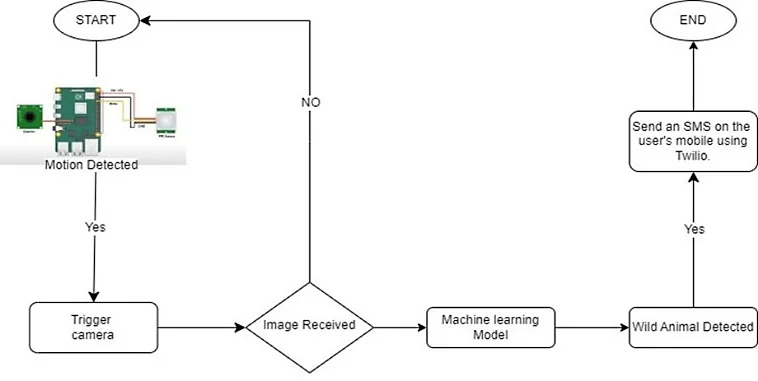
Fig. 4: The system architecture for the proposed system.
To improve reliability, WIDS employs a temporal validation mechanism, requiring the detection of a wild animal (monkey or pig) in five consecutive frames before confirming an intrusion. This prevents false positives caused by temporary noise, shadows, or sensor disturbances. If a human is detected, the system suppresses the alert to avoid unnecessary notifications. Once an intrusion is confirmed, an alert is generated and transmitted via the Twilio API to the farmer's mobile phone in the form of an SMS notification. This ensures that farmers are informed promptly and can take immediate action to protect their crops and livestock. After sending the alert, the system enters a reset state, pausing further detection until new motion activity is recorded. This design reduces redundant alerts and ensures efficient resource utilization.
5.2 Algorithms used (modular description)
5.2.1 Motion detection
Passive Infrared (PIR) sensors are used to continuously monitor the farm perimeter by measuring variations in infrared radiation within their field of view. A detection event occurs when the absolute change in sensor signal exceeds a predefined threshold:
ΔS = St - St-1 > θ (1)
where St and St-1 represent the PIR sensor readings at times t and t−1. If the condition is satisfied, the Raspberry Pi triggers the connected camera to capture an image. To minimize false activations caused by noise (e.g., wind, vegetation), the detection signal is smoothed using a moving average filter.
5.2.2 Object detection
The captured images are processed using the YOLOv8n (You Only Look Once, version 8n) algorithm, a state-of-the-art deep learning model for real-time object detection. YOLOv8n processes each frame in a single pass, simultaneously predicting bounding box coordinates, class labels, and confidence scores for objects in the image. In this system, the model was trained on a custom dataset consisting of monkeys, pigs, and humans. The algorithm outputs bounding boxes around detected objects, enabling accurate classification of wildlife intrusions while filtering out non-target detections.
5.3 Tools used
The proposed system integrates multiple hardware and software components to achieve real-time wildlife intrusion detection and alert generation. The Raspberry Pi 3 serves as the central processing and control unit, responsible for coordinating motion detection, image acquisition, object recognition, and communication tasks. Upon motion detection, the PIR motion sensors, strategically installed around the farm perimeter, trigger the camera module. The camera then captures high-resolution images of the detected activity and transmits them to the Raspberry Pi 3 for analysis.
For object detection, the captured images are processed using the YOLOv8n deep learning model, which was trained on a custom dataset containing annotated images of wild animals (such as monkeys and pigs) and humans. The dataset was prepared and labelled using makesense.ai, an open-source annotation platform that facilitates the creation of precise bounding boxes for object detection models. The trained YOLOv8n model executes locally on the Raspberry Pi, ensuring real-time inference even under limited connectivity.
To enhance user interaction and alert dissemination, the system integrates the Twilio API, which automatically sends SMS notifications to the farmer's registered mobile number whenever a potential intrusion is detected. The interface between the hardware components and cloud communication service is managed via Python scripts, ensuring reliable message delivery and system responsiveness. Overall, the architecture ensures efficient coordination among sensing, processing, and communication layers, making it suitable for real-world deployment in agricultural environments.
5.4 Interface design
The proposed system operates autonomously without a graphical user interface (GUI), functioning continuously in the background to ensure uninterrupted monitoring and timely alerts. Nevertheless, the interface design can be conceptualized in two layers—hardware and software—that together enable seamless data flow and control.
The hardware interface integrates the Raspberry Pi 3 with peripheral modules such as the PIR motion sensors and the camera. The sensors detect motion within the designated farm area, while the camera captures images of the detected activity. These components are connected to the Raspberry Pi through GPIO pins and standard communication protocols (e.g., I²C and USB), allowing synchronized triggering and image acquisition.
The software interface is responsible for system logic and decision-making. It includes the YOLOv8n object detection model, which processes captured images to identify animals or humans; the Twilio API, which manages the automated SMS alerting mechanism; and a set of Python scripts that coordinate communication between hardware modules and software services. The codebase handles data preprocessing, inference execution, threshold-based event triggering, and message dispatch.
Overall, the interface design emphasizes robust and efficient interaction between hardware and software components, ensuring accurate detection, minimal latency, and reliable alert generation under real-world operating conditions.
6. Testing
The testing phase aimed to assess the effectiveness, robustness, and reliability of the Wildlife Intrusion Detection System (WIDS) under real-world operating conditions. The primary objectives were to evaluate the system's ability to (i) detect motion accurately, (ii) correctly identify wild animals such as monkeys and pigs, (iii) differentiate them from humans and background movement, and (iv) generate timely SMS alerts to the farmer through the Twilio communication module.
Testing was conducted in field conditions with varying environmental factors, including daytime and nighttime illumination, different weather conditions (sunny, cloudy, and light rain), and animal movement speeds. These variations were introduced to examine the system's robustness and ensure dependable performance across realistic scenarios.
The evaluation incorporated standard performance metrics, including Precision (P), Recall (R), F1-score, Intersection over Union (IoU), and mean Average Precision (mAP). Additionally, inference latency—the time taken from image capture to alert generation—was measured to assess real-time feasibility. The system achieved an overall detection accuracy of 80–85%, with performance variations primarily observed under low-light or partially occluded conditions. These results demonstrate that WIDS offers reliable and timely detection suitable for field deployment in agricultural environments.
6.1 Testing environment
Hardware: Raspberry Pi 3, PIR Motion Sensors, Camera
Software: YOLOv8n model, Twilio API for SMS alerts
Test Phases:
- Unit Testing: Individual components such as motion sensors, camera, Raspberry Pi functionality, and Twilio integration will be tested separately.
- Integration Testing: Testing the interaction between different components of the system to ensure seamless communication and functionality.
- System Testing: Testing the entire system end-to-end in the farm environment to evaluate its performance in real-world conditions.
6.2 Test cases
Motion detection:
- Test Case 1: Verify that PIR motion sensors detect motion within the designated range.
- Test Case 2: Ensure that motion detection triggers the camera to capture images.
- Test Case 3: Validate that motion detection events are logged accurately by the Raspberry Pi.
Object detection:
- Test Case 1: Confirm that YOLOv8n model accurately detects wild animals (monkeys and pigs) in captured images.
- Test Case 2: Verify that the model distinguishes between wild animals and humans.
- Test Case 3: Ensure that bounding boxes are correctly drawn around detected animals in the images.
Alerting system:
- Test Case 1: Test Twilio integration to verify that SMS alerts are sent to the farmer's mobile phone.
- Test Case 2: Validate that SMS alerts are triggered only when wild animals (monkeys or pigs) are detected for 5 consecutive frames.
- Test Case 3: Confirm that SMS alerts cease if a human is detected or if no detection occurs.
6.3 Testing methods used
- Manual testing: Conducted by human testers to ensure that all functionalities of the system work as expected.
- Automated testing: Utilized scripts to automate repetitive testing tasks such as motion detection, object detection, and alert triggering.
- Field testing: Deployed the system in the farm environment to assess its performance under real-world conditions, including varying light conditions and weather.
7. Results and discussion
The experimental evaluation of the proposed Wildlife Intrusion Detection System (WIDS) demonstrated reliable and consistent performance under varying field conditions. The results validate the system's ability to detect motion, identify animal species, and generate alerts promptly and accurately.
7.1 Quantitative performance metrics
Quantitative evaluation was conducted using standard performance measures, including Precision, Recall, F1-score, and Intersection over Union (IoU) defined as:
Precision = TP / (TP + FP) (2)
Precision = TP / (TP + FN) (3)
Precision = (2PR) / (P + R) (4)
IoU = Area of Overlap / Area of Union (5)
where TP, FP, and FN denote the number of true positives, false positives, and false negatives, respectively. The WIDS achieved an overall accuracy of 80–85%, Precision = 0.84, Recall = 0.82, F1 = 0.83 & IoU = 0.78, confirming strong generalization performance for real-time detection tasks.
7.2 Confusion matrix
Fig. 5 presents the confusion matrix, which illustrates the classification performance for each target class—monkey, pig, and human. High diagonal values indicate strong true-positive rates for monkeys and pigs, with minimal false-positive detections for humans. False negatives primarily occurred in low-illumination or partial-occlusion scenarios, emphasizing the need for additional infrared or thermal sensing in future iterations. This visualization validates the model's discriminative capability across categories.
7.3 F1 confidence curve
Fig. 6 shows the F1 confidence curve, representing the balance between precision and recall across varying confidence thresholds. The curve peaks at a confidence threshold of 0.52, which provides the optimal trade-off between minimizing false positives and maximizing detection sensitivity—ideal for real-time farm deployment.
7.4 Precision–recall curve
Fig. 7 depicts the precision–recall (PR) curve of the trained YOLOv8n model. The high area under the PR curve (≈ 0.83) confirms consistent performance across confidence levels, indicating the model's strong ability to maintain both high recall and precision even in complex backgrounds.
7.5 Precision confidence curve
Fig. 8 presents the precision confidence curve, which demonstrates that precision remains stable up to a confidence threshold of 0.7, after which a gradual decline is observed. This behavior confirms that the system can maintain high precision for moderate confidence values, reducing the likelihood of false alerts under uncertain conditions.
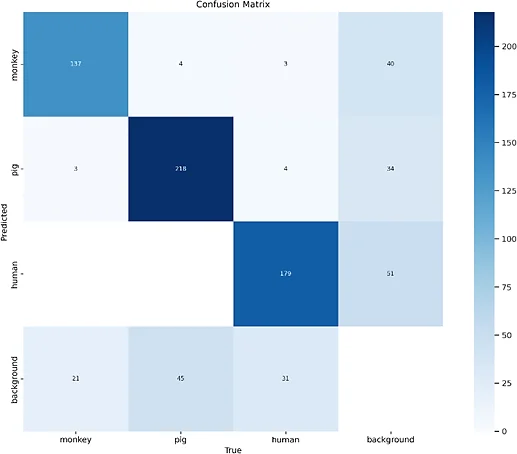
Fig. 5: Confusion matrix.
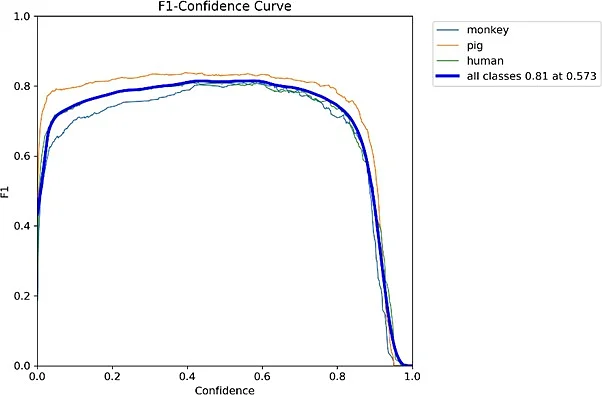
Fig. 6: F1 confidence curve.
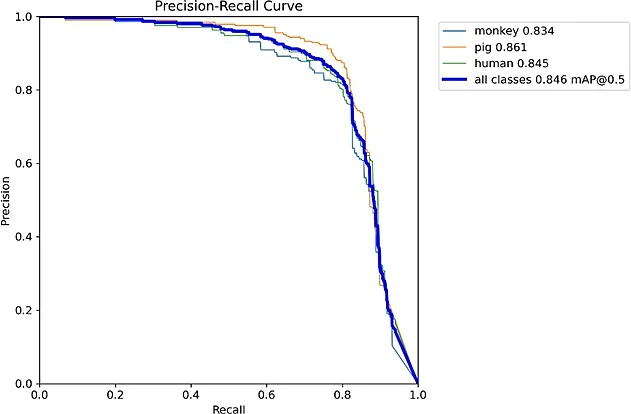
Fig. 7: Precision recall curve.
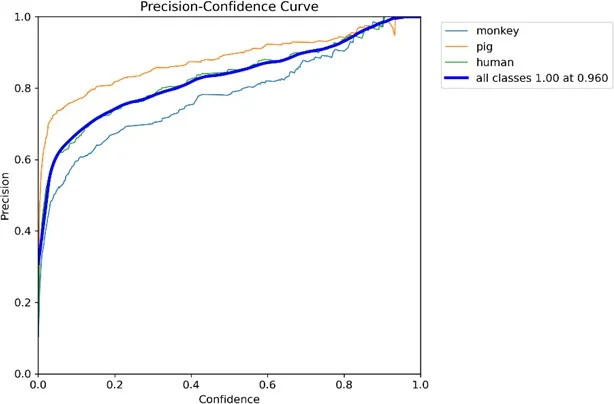
Fig. 8: Precision confidence curve.
7.6 Recall confidence curve
Fig. 9 illustrates the recall confidence curve, where recall is highest at lower confidence thresholds and decreases as the threshold increases. The optimal operational point is around 0.5, providing a balanced compromise between detection sensitivity and alert reliability. Together, Figs. 6–9 validate the robustness of the YOLOv8n-based detection model and inform threshold selection for field deployment.
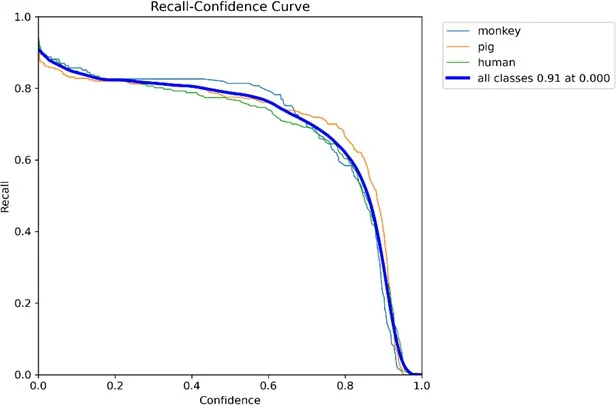
Fig. 9: Recall confidence curve.
7.7 Summary of findings
- Motion detection: PIR sensors performed accurately within the designated range, reliably triggering image capture.
- Object detection: The YOLOv8n model achieved strong detection accuracy for monkeys and pigs, with minimal confusion between classes.
- Alerting system: The Twilio API successfully dispatched SMS alerts for five consecutive detections of wild animals and halted alerts when no target objects were identified.
- Latency: Average inference latency was under 0.6 s per frame, confirming real-time feasibility.
Overall, the proposed WIDS achieved robust detection accuracy, operational stability, and fast response time under diverse environmental conditions—making it suitable for real-world agricultural protection and early-warning applications.
8. Conclusion
The wild animal intruder detection system represents a significant advancement in addressing the challenges posed by wildlife intrusions in agricultural settings. By leveraging modern technologies such as Raspberry Pi, PIR motion sensors, cameras, and machine learning algorithms, new proposed system provides a robust and efficient solution for detecting and deterring wild animals from entering farms. The proposed system provides real-time alerts to farmers, enabling them to take timely and proactive measures to protect their crops and livestock from wild animals such as monkeys and pigs that gives the enhanced farm security. Automation of the detection process through the integration of sensors and machine learning models reduces the need for constant manual monitoring, allowing farmers to focus on other essential tasks, that helps to improve efficiency. The use of affordable and readily available hardware components, along with open-source software tools, makes the system accessible to farmers with varying budget constraints. The modular design of the system allows for easy scaling and adaptation to farms of different sizes and configurations, ensuring flexibility for future expansion and deployment. The system's reliance on proven technologies and its ease of use support its feasibility and practicality for real-world agricultural applications. Throughout the development process, we addressed various challenges such as sensor integration, model training, and minimizing false positives. The custom dataset of 1300 images and the use of Yolov8n machine learning model trained for 80 epochs have enabled accurate detection and classification of target animals. Additionally, the real time communication of alerts via SMS using Twilio ensures that farmers are promptly informed of potential intrusions.
Funding Declaration
Data Availability Statement
Conflict of Interest
Artificial Intelligence (AI) Use Disclosure
Supporting Information
References
- [1] N. Abed, R. Murugan, A. Deldari, S. Sankarannair, M. V. Ramesh, IoT and AI-driven solutions for human-wildlife conflict: Advancing sustainable agriculture and biodiversity conservation, Smart Agricultural Technology, 2025, 10, 100829, doi: 10.1016/j.atech.2025.100829.
- [2] M. Kommineni, M. Lavanya, V. H. Vardhan, G. J. Kumar, V. S. Shaik, T. Gouri Sankar, Agricultural farms utilizing computer vision (ai) and machine learning techniques for animal detection and alarm systems, Journal of Pharmaceutical Negative Results, 2022, 13, 3292–3300, doi: 10.47750/pnr.2022.13.S09.411.
- [3] T. S. Delwar, S. Mukhopadhyay, A. Kumar, M. Singh, Y.-w. Lee, J.-Y. Ryu, A. S. M. S. Hosen, Real-time farm surveillance using IoT and YOLOv8 for animal intrusion detection, Future Internet, 2025, 17, 70, doi: 10.3390/fi17020070.
- [4] H. D. Patil, N. F. Ansari, Intrusion detection and repellent system for wild animals using artificial intelligence of things, 2022 International Conference on Computing, Communication and Power Technology (IC3P), Visakhapatnam, India, 2022, 291-296, doi: 10.1109/IC3P52835.2022.00068.
- [5] J. Miao, D. Rajasekhar, S. Mishra, S. K. Nayak, R. Yadav, A microservice-based smart agriculture system to detect animal intrusion at the edge, Future Internet, 2024, 16, 296, doi: 10.3390/fi16080296.
- [6] K. Bazargani, T. Deemyad, Automation's impact on agriculture: opportunities, challenges, and economic effects, Robotics, 2024, 13, 33, doi: 10.3390/robotics13020033.
- [7] N. S. Sayem, S. Chowdhury, A. H. M. Osama Haque, Md. Rostom Ali, Md. Shahinur Alam, S. Ahamed, C. K. Saha, IoT-based smart protection system to address agro-farm security challenges in Bangladesh, Smart Agricultural Technology, 2023, 6, 100358, doi: 10.1016/j.atech.2023.100358.
- [8] P. Balakrishnan, A. Anny Leema, G. Gnana Kiruba B, A. Gupta, R. Aryan, Deep-track: A real-time animal detection and monitoring system for mitigating human-wildlife conflict in fringe areas, Journal for Nature Conservation, 2025, 88, 127063, doi: 10.1016/j.jnc.2025.127063.
- [9] M. A. K. Raiaan, N. M. Fahad, S. Chowdhury, D. Sutradhar, S. S. Mihad, M. M. Islam, IoT-based object-detection system to safeguard endangered animals and bolster agricultural farm security, Future Internet, 2023, 15, 372, doi: 10.3390/fi15120372.
- [10] Moorthy V, Rukkumani V, Deep vision-based wildlife intrusion detection with colour distribution preserved generative adversarial networks, Pattern Recognition, 2025, 161, 111272, doi: 10.1016/j.patcog.2024.111272.
- [11] P. Muragod, V. K Reddy, Animal intrusion detection using various deep learning models, In 2022 IEEE North Karnataka Subsection Flagship International Conference (NKCon), 2022, 1-12, doi: 10.1109/NKCon56289.2022.10126526.
- [12] T. Diwan, G. Anirudh, J. V. Tembhurne, Object detection using YOLO: challenges, architectural successors, datasets and applications, Multimedia Tools and Applications, 2023, 82, 9243–9275, doi: 10.1007/s11042-022-13644-y.
- [13] B. Dave, M. Mori, A. Bathani, P. Goel, Wild animal detection using YOLOv8, Procedia Computer Science, 2023, 230, 100-111, doi: 10.1016/j.procs.2023.12.065.
- [14] L. Chen, G. Li, S. Zhang, W. Mao, M. Zhang, YOLO-SAG: An improved wildlife object detection algorithm based on YOLOv8n, Ecological Informatics, 2024, 83, 102791, doi: 10.1016/j.ecoinf.2024.102791.
- [15] Z. Ma, Y. Dong, Y. Xia, D. Xu, F. Xu, F. Chen, Wildlife real-time detection in complex forest scenes based on YOLOv5s deep learning network, Remote Sensing, 2024, 16, 1350, doi: 10.3390/rs16081350.
- [16] R. Nayak, M. M. Behera, U. C. Pati, S. K. Das, Video-based real-time intrusion detection system using deep-learning for smart city applications, In 2019 IEEE International Conference on Advanced Networks and Telecommunications Systems (ANTS), 2019, 1-6, doi: 10.1109/ANTS47819.2019.9117960.
- [17] S. Li, Z. Wang, Y. Lv, X. Liu, Improved YOLOv5s-based algorithm for foreign object intrusion detection on overhead transmission lines, Energy Reports, 2024, 11, 6083-6093, doi: 10.1016/j.egyr.2024.05.061.
- [18] P. C. Ravoor, T. S. B. Sudarshan, K. Rangarajan, Digital borders: design of an animal intrusion detection system based on deep learning, In International Conference on Computer Vision and Image Processing, Springer Singapore, 2020, 186-200, doi: 10.1007/978-981-16-1103-2_17.
- [19] S. Sajithra Varun, G. Nagarajan, DeepAID: a design of smart animal intrusion detection and classification using deep hybrid neural networks, Soft Computing, 2023, 1-12, doi: 10.1007/s00500-023-08270-1.
- [20] M. Mulero-Pázmány, S. Hurtado, C. Barba-González, M. L. Antequera-Gómez, F. Díaz-Ruiz, R. Real, I. Navas-Delgado, J. F. Aldana-Montes, Addressing significant challenges for animal detection in camera trap images: a novel deep learning-based approach, Scientific Reports, 2025, 15, 16191, doi: 10.1038/s41598-025-90249-z.
- [21] D. Axford, F. Sohel, M. A Vanderklift, A. J. Hodgson, Collectively advancing deep learning for animal detection in drone imagery: Successes, challenges, and research gaps, Ecological Informatics, 2024, 83, 102842, doi: 10.1016/j.ecoinf.2024.102842.
Publisher Note: The views, statements, and data in all publications solely belong to the authors and contributors. GR Scholastic is not responsible for any injury resulting from the ideas, methods, or products mentioned. GR Scholastic remains neutral regarding jurisdictional claims in published maps and institutional affiliations.
Open Access
This article is licensed under a Creative Commons Attribution-NonCommercial 4.0 International License, which permits the non-commercial use, sharing, adaptation, distribution and reproduction in any medium or format, as long as appropriate credit to the original author(s) and the source is given by providing a link to the Creative Commons License and changes need to be indicated if there are any. The images or other third-party material in this article are included in the article's Creative Commons License, unless indicated otherwise in a credit line to the material. If material is not included in the article's Creative Commons License and your intended use is not permitted by statutory regulation or exceeds the permitted use, you will need to obtain permission directly from the copyright holder. To view a copy of this License, visit: https://creativecommons.org/licenses/by-nc/4.0/
© The Author(s) 2025