

 Open Access||Research Article
Internal Route Optimization in IoT-Enabled Wireless Sensor Networks Using Cluster-Based Architecture and Adaptive Cluster Head Communication
1 Faculty of Computer and Application, Madhav University, Abu Road, Pindwara, Rajasthan, 307032, India
2 Faculty of Computing and Informatics, Sir Padampat Singhania University, Udaipur, Rajasthan, 313601, India
Abstract
Energy-efficient and intelligent routing strategies have become essential as wireless sensor networks are increasingly incorporated into Internet of Things environments. For IoT-enabled Wireless sensor networks (WSNs), this study suggests an improved internal routing framework with an emphasis on cluster head to sink communication optimization following cluster head selection. Based on a strong cluster formation procedure that employs hybrid fuzzy C-Means and K-Means algorithms, a multi-objective Mother-Inspired Adaptive Optimization method is used to choose the cluster heads. Next, energy- and distance-aware routing paths between cluster heads are dynamically constructed using the Pelican Optimization Algorithm. Key issues in Internet of Things-based deployments, such as limited energy, data latency, and communication reliability, are addressed by the suggested approach. The results show from prior hybrid optimization-based WSN Studies that the hybrid approach is effective in managing large-scale, resource-constrained sensor networks within IoT infrastructures by significantly extending network lifetime, improving packet delivery ratio, and lowering end-to-end delay.
Keywords
Graphical Abstract
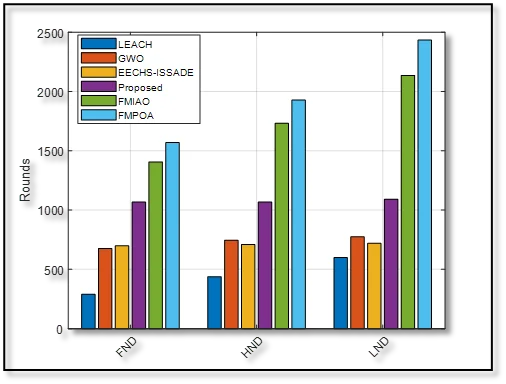
Novelty Statement
A comparative analysis of three key network lifetime metrics; FND, HND, and LND across various protocols: LEACH, GWO, EECHS-ISSADE, Proposed, FMIAO, and FMPOA.
1. Introduction
The convergence of the Internet of Things (IoT) and Wireless Sensor Networks (WSNs) has catalyzed a revolution in how data is sensed, transmitted, and acted upon in real-time environments.[1-4] WSNs, comprising numerous spatially distributed autonomous sensor nodes, act as the sensory backbone of IoT systems.[5] These networks capture vital information from the physical environment-such as temperature, humidity, pressure, motion, and location-and transmit it to centralized processing units or cloud platforms via the Internet. In IoT applications [6] like smart cities,[7] precision agriculture,[8] environmental surveillance, healthcare monitoring,[9] and industrial automation,[10] WSNs form the first layer of data acquisition. The seamless interaction between WSNs and IoT facilitates context-aware decision-making, automated control, and intelligent responses. However, integrating WSNs into the IoT ecosystem imposes stringent requirements on scalability, real-time communication, energy efficiency, and reliability, thus demanding advanced network design strategies.
As the scale of IoT deployments continues to grow, clustering mechanisms have emerged as essential strategies for achieving network efficiency and manageability. In a clustered WSN, sensor nodes are organized into logical groups called clusters, each led by a Cluster Head (CH).[11] The CH is responsible for aggregating data from member nodes and relaying it to the Sink or Base Station.[12] This hierarchical model minimizes direct transmissions to the base station, significantly reducing redundant communication and conserving energy-a critical requirement in battery-powered IoT devices. Clustering not only enhances scalability but also improves load balancing, latency management, and fault tolerance, making it highly suitable for large-scale, heterogeneous IoT networks. When paired with adaptive clustering algorithms, the system can dynamically adjust to changes in topology and energy levels, ensuring prolonged and stable operation in dynamic IoT environments.
While clustering optimizes intra-cluster communication, a major bottleneck remains in inter-cluster routing, particularly the communication between CHs and the central Sink. This phase, often referred to as internal routing, presents multiple challenges. First, energy disparity among CHs due to variable workloads can lead to premature node failures. Second, communication overhead increases when CHs must coordinate multi-hop transmissions without a centralized routing controller. Third, topology changes-due to energy depletion or environmental disruptions-introduce instability and require frequent route recalculations. Lastly, latency-sensitive IoT applications cannot tolerate long delays or packet losses, necessitating robust, low-latency routing mechanisms. Therefore, the internal routing layer is a critical focus area for performance enhancement in clustered IoT-enabled WSNs.
To address the complex demands of IoT-based WSNs, intelligent and adaptive routing mechanisms are essential. Traditional static or distance-based routing methods fail to account for real-time network dynamics such as fluctuating energy levels, node mobility, or environmental changes.[13] Therefore, in this work, we follow the intelligent routing structure as shown in Fig. 1. Bio-inspired algorithms, metaheuristic optimization techniques, and machine learning-based approaches offer the flexibility and intelligence required to make optimal routing decisions under such conditions. An ideal routing protocol for IoT-based WSNs should be energy-aware, delay-sensitive, load-balanced, and scalable across diverse topologies. Adaptive mechanisms like the Pelican Optimization Algorithm (POA) and Mother-Inspired Adaptive Optimization (MIAO) can dynamically evaluate multiple objectives and select the most efficient routing paths, enhancing network longevity, reliability, and communication quality.
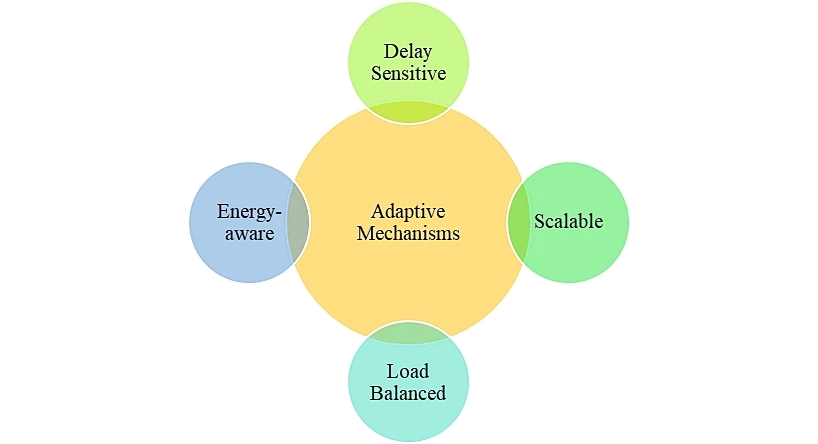
Fig. 1: Importance of intelligent routing.
This research aims to address the internal routing challenges of IoT-integrated WSNs by proposing an optimized cluster-based communication architecture. The three key contribution of the proposed work are integration of cluster-based architecture with adaptive CH Communication, application of POA for route selection and comprehensive performance evaluation. By combining energy-efficient clustering with intelligent CH-to-Sink routing, the network achieves improved structural organization and efficient data delivery. POA is employed to discover optimal CH-to-Sink routes based on real-time energy levels, transmission distances, and delay constraints. This hybrid approach enables dynamic and intelligent routing decisions. The proposed model is validated through simulation, and results are analyses in terms of core IoT network metrics such as energy consumption, network lifetime, packet delivery ratio, end-to-end delay, and routing scalability.
2. Literature survey
Chandrasekaran et al. explains how to maximize mobile safe routing in an intrusion detection system (IDS) for WSNs using the POA.[14] Through dynamic path optimization and the use of swarm intelligence, POA successfully mitigates security threats and improves network resilience. With an energy consumption of 0.08J and 12% of the average energy usage of 0.05J, an active node of 92%, and a dead node of 10%, numerical validation confirms POAs.[14] Suggests using the Multi-objective-Trust Aware Improved Pelican Optimization Approach (M-TAIPOA) to cluster and route data in a secure and energy-efficient manner. Sine chaos mapping, a combination of Levy Flight Strategy and Sine Cosine Optimization (CSO), is used to improve POA in order to jump out of local optima, increase search variety, and improve convergence accuracy. Using an upgraded Artificial Bee Colony (EOR-iABC), M-TAIPOA uses less energy than the current method, Energy Optimization Routing, by 4.5J for 10 cycles for scenario 3.[15] To solve these problems and improve cluster head selection for the best clustering, suggest the Enhanced Pelican Optimization Method for Cluster Head Selection (EPOA-CHS). By combining the Levy flight process with the conventional POA algorithm, this approach guarantees the selection of the best cluster head while simultaneously enhancing the program's optimization level. The EPOA-CHS approach ultimately performs better in these areas than the SEP, DEEC, Z-SEP, and PSO-ECSM procedures, according to extensive experimental study.[16] Provides a novel method for extending the network lifetime of WSNs through energy conservation and node activity maintenance: the Modified Pelican Optimization Algorithm (MPOA). By the 400th iteration, the total amount of live nodes had dropped from 100 to 70, indicating that PSO had significantly reduced node survival. At the conclusion of the simulation, SFO maintained 78 nodes, demonstrating a somewhat improved performance. On the other hand, after 400 cycles, MPOA shown a significant improvement, keeping 85 live nodes.[17] Intends to increase the network's efficacy by putting forth the Energy Efficient Yellow Saddle Goatfish Pelican Optimization algorithm (EEYSGPO), a hybrid optimization method inspired by nature that employs the Yellow Saddle Goatfish Algorithm to determine the best cluster head among a group of nodes. According to simulation results, the EEYSPO method's optimal cluster head and route selection fixed the problems associated with premature convergence or extended the WSN's lifetime or scalability. Network stability is increased by 57.28%, 324.5%, 571.72%), and 91.37%, respectively, using the suggested methods. In order to maintain energy stability and increase network lifetime longevity by resolving issues in the CH selection process, the golden eagle optimization algorithm (GEOA) as well as improved grasshopper optimization algorithm (IGHOA), which are based on the energy efficient cluster-based routing protocol (GEIGOA), are suggested. In comparison to the competing CH selection schemes, it was also established that the computational cost imposed by the suggested GEIGOA with varying numbers of sensor nodes was reduced by 14.98%, 17.21%, 19.76%, and 21.62%.[18] Suggested an enhanced version of the GWO (EECHIGWO) algorithm for energy-efficient cluster head selection in order to mitigate the imbalance among exploration and exploitation, the lack of population diversity, and the early convergence of the standard GWO algorithm. By employing minimum energy levels in WSNs, the simulation results have resolved premature convergence, validated the best choice of cluster heads with the least amount of energy consumption, and improved the network lifetime. In comparison to the SSMOECHS, FGWSTERP, LEACH-PRO, HMGWO, and FIGWO protocols, the suggested method improves network stability by 169.29%, 19.03%, 253.73%, 307.89%, and 333.51%, respectively.[19] Here, cluster heads or non-cluster heads are chosen using the Genetic algorithm (GA) in conjunction with the modified particle swarm optimization (M-PSO) technique. The GA is used to find the best shortest route, & the suggested method calculates the likelihood of selecting the best nodes to be cluster chiefs. Furthermore, the suggested approach performs better than current state-of-the-art methods like GAPSO-H, EC-PSO, and NEST. Overall, though, DMPRP outperforms NEST, EC-PSO, and GAPSO-H by 12%. Provided a thorough analysis of BOAACO, DEEC, LEACH, & Airproofed. Their impact on network efficiency, including energy consumption and network longevity, is being examined by the CHS and routing methods. The simulation results show that it greatly increases the overall efficiency and robustness of WSNs comparing the suggested system to LEACH, DEEC, and BOAACO. To improve the network lifetime of the systems created for Internet of Things applications, the energy-saving CH selection (ESCHS) approach is proposed. For cluster formation, this approach uses the concept of uniform clustering. The node selected to be a CH has residual energy greater than the average residual energy of the corresponding cluster. The results show that the recommended approach outperforms the current approaches in terms of network longevity and energy savings.[20] Suggested an osprey optimization technique to select the optimal CH in a wireless sensor network-based Internet of Things system, based on energy-efficient cluster head selection (SWARAM). The MATLAB2019a tool is used to simulate the suggested SWARAM technique. The SWARAM method's effectiveness in comparison to the current EECHIGWO CH, HSWO, and EECHS-ARO selection algorithms. The proposed SWARAM increases network lifetime by 10% and packet delivery ratio by 10%. Suggest a novel method that uses improved crow swarm optimization (ECSO), updated fuzzy logic, or the Whale optimization algorithm (WOA) to optimize the CH selection and path selection. According to the results, the suggested method performs better than the current methods in terms of throughput, delay, packet delivery ratio, and energy consumption. The suggested system's PDR which reaches 90.9%, is likewise noticeably higher.[21] The multi-objective seagull optimization method (CAR-MOSOA) is used in collision-aware routing to achieve scalable WSN efficiency. The suggested CAR-MOSOA for 400 nodes has better simulation outcomes than the FDEAM, EOMR, TSGWO, and CoCoA. These findings include energy consumption of 33 J, end-to-end delay of 29 s, packet delivery ratio of 95%, and network lifetime of 973 s.[22] Introduces the multipath routing protocol in the IoT-assisted WSN network utilizing the suggested optimization technique known as the Tunicate Swarm Grey Wolf Optimization (TSGWO) method. With a maximum average residual energy of 2.161 J, a maximum link lifetime of 0.075 s, a maximum PDR of 96.38%, and a maximum throughput of 429.49 Kbps, the suggested TSGWO performed better than alternative techniques.[23] Creates an energy-efficient path planning technique that is optimized to increase the network's connection and lifespan. Stable election algorithms (SEA), a novel heuristic clustering technique, is presented to reduce the amount of information exchanged among sensor nodes and avoid frequent cluster head rotation. When compared to current routing techniques, it was successful in extending the network lifetime by up to 66%.[24] Create an energy-efficient routing protocol for Internet of Things applications based on wireless sensor networks that are unfair in networks with a lot of traffic. Three factors like lifetime, reliability, and traffic intensity at the next-hop node are taken into account by the suggested protocol while choosing the best course of action. NS-2 has been used for rigorous simulation. According to the results, the suggested protocol outperforms existing protocols in terms of energy conservation, packet delivery ratio, end-to-end latency, and network longevity.[25] Presenting CBR-ICWSN, an IoT enabled cluster-based routing (CBR) protocol for ICWSN. For the best path selection, the CBR-ICWSN approach uses a routing process based on oppositional artificial bee colonies (OABCs). In terms of network longevity and energy efficiency, the CBR-ICWSN methodology has demonstrated superior performance in experiments compared to the other approaches.
3. Proposed methodology
This section outlines the design and operational workflow of the proposed energy-efficient and intelligent routing framework for IoT-enabled WSNs. The system is structured into multiple phases that include network initialization, clustering, intelligent CH selection, optimized internal routing, and data communication. A detailed flow chart of the proposed methodology is illustrated in the Fig. 2.
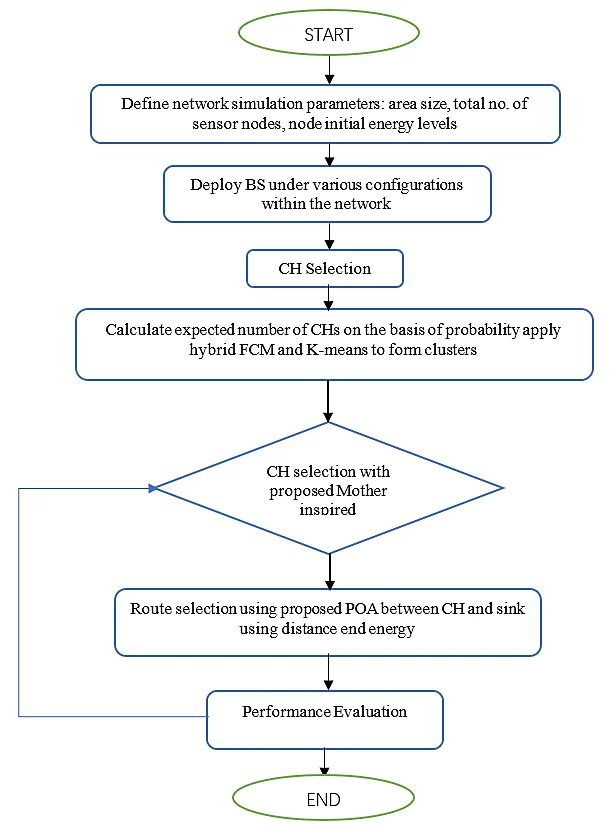
Fig. 2: Flow of steps of proposed methodology.
3.1. Initialization phase
The network initialization phase lays the groundwork for simulating the proposed IoT-enabled WSN architecture. The simulation is implemented using MATLAB 2018 and configure with Fig. 3 with a set of predefined parameters representing the energy and communication characteristics of the sensor nodes. These include energy consumption models, packet sizes, optimal cluster head probability, and the MAC protocol used for medium access. Table 1 presents the simulation settings:
Table 1: Simulation parameters.
| Parameter | Value |
|---|---|
| Network Area Size | 100 × 100 m |
| Initial Energy | 0.5 J |
| Number of Rounds | 6000 |
| Electronics energy | 50 nJ/bit |
| Free space amplifier | 10 pJ/bit/m² |
| Multi-path amplifier | 0.0013 pJ/bit/m⁴ |
| Data aggregation energy | 5 nJ/bit |
| Threshold distance | 87.7 m |
| Packet Length | 4000 bits |
| Control Packet Length | 200 bits |
| Optimal CH Probability (p) | 0.05 |
| MAC Protocol | IEEE 802.15.4 |
These parameters form the core simulation model and guide the network's clustering and communication dynamics throughout all phases.
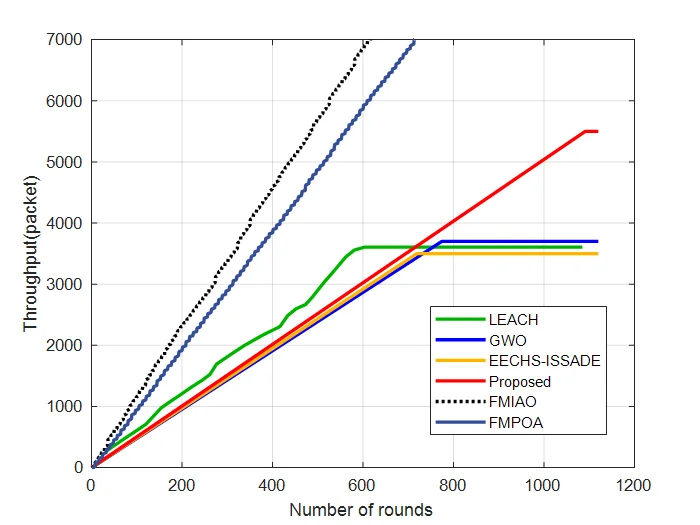
Fig. 3: Throughput vs. Number of Rounds.
In this simulation, sensor nodes are randomly deployed within the 100m × 100m field, mimicking unstructured, terrain-dependent real-world IoT deployments. Each node is considered heterogeneous, representing various IoT sensors measuring attributes like temperature, humidity, light, soil moisture, or gas levels—commonly found in smart agriculture, industrial safety, and environmental monitoring. A Base Station (BS) or Sink is strategically place either within the network boundary or at its periphery, depending on the application requirements. The BS placement is crucial, as it directly affects the energy expenditure of cluster heads during data transmission, particularly in the CH-to-Sink communication phase. Together, these elements establish a realistic, scalable simulation environment reflecting the complexities of modern IoT-based WSN deployments.
3.2 Cluster formation
Clustering is a crucial pre-processing step to minimize network-wide energy consumption and facilitate hierarchical data aggregation. A Hybrid Clustering Algorithm, combining Fuzzy C-Means (FCM) and K-Means,[26] is employed to optimize cluster formation, where FCM enables soft membership for improved flexibility, and K-Means ensures crisp clustering for spatial balance.[27] The expected number of clusters is dynamically estimated based on IoT metrics such as node density, residual energy levels, and traffic characteristics like sensor reporting intervals, allowing clusters to adapt to real-time network load and energy distribution. Additionally, a Fuzzy Node Assignment strategy assigns nodes to clusters based on their proximity to CH candidates and fuzzy membership values, ensuring balanced spatial coverage, preventing cluster overlap, and evenly distributing communication responsibilities, which is vital for scalable IoT systems.
3.3. CH selection using Mother-Inspired Adaptive Optimization (MIAO)
Efficient CH selection is vital for maintaining the longevity and performance of a WSN.[28] The proposed system employs MIAO, a bio-inspired metaheuristic algorithm that mimics maternal decision-making strategies to enhance the selection process. This algorithm evolves CH candidates iteratively by integrating adaptive learning and dynamic feedback mechanisms, allowing it to respond effectively to real-time network conditions.
3.3.1. Mother-Inspired Adaptive Optimization (MIAO)
MIAO is rooted in the intuitive and adaptive nature of maternal decision-making, where survival and optimal resource distribution are prioritized.[29] The algorithm continuously refines CH selection through iterative learning, ensuring that only the most suitable nodes are chosen in each round. The adaptive nature of MIAO allows it to accommodate dynamic network conditions, mitigating challenges such as energy depletion, traffic fluctuations, and node failures.
3.3.2. Multi-objective fitness function
To achieve optimal CH selection, the system employs a multi-objective fitness function, which evaluates CH candidates based on multiple performance metrics. This ensures balanced decision-making, preventing premature energy depletion while optimizing routing efficiency.
- Residual Energy: CHs must possess sufficient residual energy to sustain operations throughout multiple communication rounds. Selecting high-energy nodes prevents early depletion, reducing the frequency of re-clustering and prolonging network lifespan.
- Energy Consumption: The algorithm minimizes total power usage by optimizing both transmission and reception processes. This ensures that network-wide energy utilization remains efficient, preventing excessive resource wastage.
- Distance to BS: The proximity of a CH to the Base Station (BS) plays a crucial role in efficient data transmission. Nodes closer to the BS are preferred to reduce long-range communication overhead, thereby conserving energy and improving network throughput.
- Delay and Latency: Reducing communication delay is essential for real-time IoT applications, where data must be delivered promptly. MIAO ensures that selected CHs maintain minimal latency to support time-sensitive operations.
- Load Balancing: Unequal cluster distribution can lead to bottlenecks and congestion. The algorithm actively prevents any single node or cluster from becoming overburdened by evenly distributing workload, ensuring sustainable network operations.
- Communication Quality: Reliable data transmission is critical for maintaining network integrity. The system assesses link reliability and signal drop rates to ensure uninterrupted connectivity between CHs and the BS.
- Signal-to-Noise Ratio (SNR): High SNR values indicate stronger, clearer communication links with minimal interference. The selection algorithm prioritizes nodes with superior SNR to enhance data transmission quality and reduce errors.
By integrating these multi-objective criteria, the MIAO-based CH selection approach optimizes resource utilization, extends network lifespan, and improves WSN performance under diverse IoT workloads. The adaptive nature of this method ensures resilience against dynamic changes, supporting fault tolerance and reliable communication in large-scale deployments.
3.4 Routing selection using POA
After CHs are selected, a routing backbone is established for inter-cluster communication by constructing a virtual graph where vertices represent CHs and the BS, and edges define possible communication paths based on distance and energy cost. The POA is a heuristic algorithm inspired by pelicans' dynamic foraging behavior, is applied to determine the most energy-efficient and shortest multi-hop paths from CHs to the Sink, adapting to the dynamic topology of WSNs for global optimization of routing paths.[30,31] POA also considers dynamic IoT workloads and sensor reporting rates, enabling real-time adjustments to traffic patterns and node failures. Additionally, the routing table is updated in each communication round based on current energy levels, network topology, and traffic conditions, ensuring fault tolerance and adaptability in large-scale IoT networks.
3.5 Communication phase
This phase describes the actual transmission of data after CH selection and route optimization:
- Intra-Cluster Communication: Member sensor nodes collect environmental data and send it to their respective CHs. Data fusion algorithms (e.g., averaging, min-max, or threshold-based aggregation) are used at CHs to reduce redundant information and minimize data payload size.
- Inter-Cluster (CH-to-Sink) Communication: The aggregated data is transmitted from CHs to the Sink via the multi-hop routes identified by POA. This ensures energy-efficient and delay-tolerant communication, especially in sparse networks or when the BS is located far from the sensing region.
- IoT Suitability: The communication architecture supports high data reliability and low power consumption, which are essential for continuous monitoring in smart cities, industrial IoT systems, and environmental applications.
3.6 Performance evaluation
Performance evaluation serves as a critical component in validating the effectiveness, scalability, and real-world applicability of the proposed cluster-based and optimization-driven internal routing model in IoT-enabled sensor networks. This section involves running detailed simulations across multiple operational rounds to analyze how well the algorithm performs under different network conditions and workloads. The evaluation metrics provide a multidimensional performance profile of the proposed model. Each performance metric is selected to reflect the key quality-of-service (QoS) requirements for IoT applications, such as energy efficiency, reliability, and latency.
3.6.1 Multi-round simulation
The simulation is executing over numerous operational rounds to capture the dynamic behavior of the network as nodes consume energy and potentially die over time. Each round simulates the process of cluster formation, CH selection via the MIAO algorithm, internal CH-to-Sink routing using the POA, and the communication phase. Multi-round evaluation ensures that the proposed algorithm is assessed not just in initial conditions but throughout the network's lifecycle, thereby providing a comprehensive understanding of its long-term sustainability and robustness in real-time IoT scenarios.
3.6.2 Evaluation metrics
3.6.2.1 Energy consumption
This metric quantifies the amount of energy consumed during each round for data transmission, reception, aggregation, and routing. In WSNs, energy is a finite resource—thus, minimizing energy consumption is critical to prolonging the operational period of the network. The proposed system is expected to show reduced energy usage due to optimal CH selection and energy-aware routing paths. Energy consumption is analyzed for Sensor-to-CH communication, CH-to-CH multi-hop routing, and CH-to-Sink transmission.
3.6.2.2 Network lifetime
Network lifetime refers to the duration (in terms of rounds) until the first node dies (FND), half of the nodes die (HND), and the last node dies (LND). This metric reflects how well the algorithm balances the energy load across the network. A longer network lifetime indicates better energy management, which is especially important for IoT applications deployed in remote or hazardous environments where manual battery replacement is not feasible.
3.6.2.3 Packet Delivery Ratio (PDR)
PDR is defined as the ratio of the number of successfully received data packets at the sink to the total number of packets sent by the sensor nodes. This metric is essential to assess the reliability of the network. A high PDR indicates that the routing algorithm can maintain stable and error-free communication even under dynamic conditions, such as node failures or varying energy levels. It directly correlates with the effectiveness of clustering and route optimization in ensuring end-to-end data integrity.
3.6.2.4 End-to-end delay
This metric measures the average time it takes for a data packet to travel from the sensor node to the sink, including delays introduced during cluster formation, CH selection, route discovery, queuing, and transmission. In time-sensitive IoT applications such as emergency monitoring or industrial automation, low latency is crucial. The POA-based routing mechanism aims to reduce this delay by selecting paths that are not only energy-efficient but also shorter and less congested.
4. Results and discussions
This section presents the visual and quantitative outcomes of the proposed intelligent routing framework, focusing on its performance in IoT-enabled Wireless Sensor Networks (WSNs). The results are analyze based on key performance indicators such as routing efficiency, energy consumption, network lifetime, end-to-end delay, and packet delivery ratio. Comparative visualizations illustrate the routing paths optimized by POA, highlighting its effectiveness in minimizing transmission distances and balancing energy usage among CHs. Additionally, delay patterns and energy trends are discussing to evaluate the system's responsiveness and sustainability under dynamic network conditions. The insights gained underscore the critical role of intelligent routing mechanisms in maintaining Quality of Service (QoS) across large-scale, heterogeneous IoT deployments.
Fig. 3 illustrates the performance of various communication protocols by representing 'Throughput (packet) on the Y-axis and the 'Number of rounds' on the X-axis. The graph reveals that FMIAO (dotted black line) and FMPOA (blue line) exhibit a rapid, almost linear increase in throughput, with FMPOA eventually achieving the highest throughput, reaching 7000 packets at around 1000 rounds. The proposed algorithm in red line shows a consistent, near-linear increase in throughput, ultimately reaching approximately 5500 packets by 1100 rounds, outperforming LEACH, GWO, and EECHS-ISSADE significantly in the later rounds. In contrast, LEACH (green line), GWO (orange line), and EECHS-ISSADE (yellow line) demonstrate an initial increase in throughput followed by a plateau or slight decline after approximately 600-800 rounds, stabilizing their throughput around 3500-3600 packets. Overall, the Fig. 3 provides a comparative analysis of these protocols' ability to maintain or increase throughput over an increasing number of operational rounds.
Fig. 4 compares the energy consumption efficiency of different protocols. Based on this graph, FMPOA is the most energy-efficient protocol, followed by FMIAO, then "Proposed," with LEACH, GWO, and EECHS-ISSADE being the least energy-efficient.
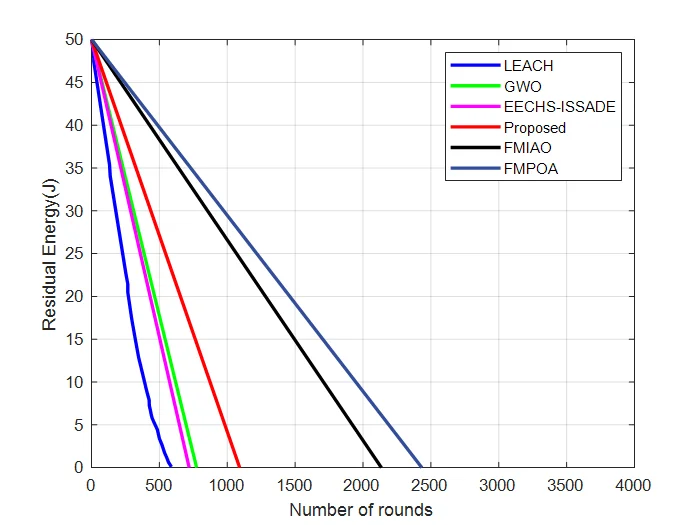
Fig. 4: Residual energy.
Fig. 5 illustrates the survival rate of nodes for various protocols as a function of the number of rounds. All protocols begin with 100 alive nodes. The graph clearly shows that LEACH (blue line), GWO (green line), and EECHS-ISSADE (magenta line) lead to a rapid depletion of alive nodes, with all nodes dying off before 1000 rounds. The "Proposed" protocol (red line) performs better, with all nodes dying around 1100 rounds. FMIAO (black line) demonstrates significantly improved longevity, with nodes surviving up to approximately 2200 rounds. Finally, FMPOA (dark blue line) exhibits the best performance in terms of network lifetime, with its nodes surviving the longest, until around 2500 rounds, indicating superior energy efficiency and network stability compared to the other protocols.
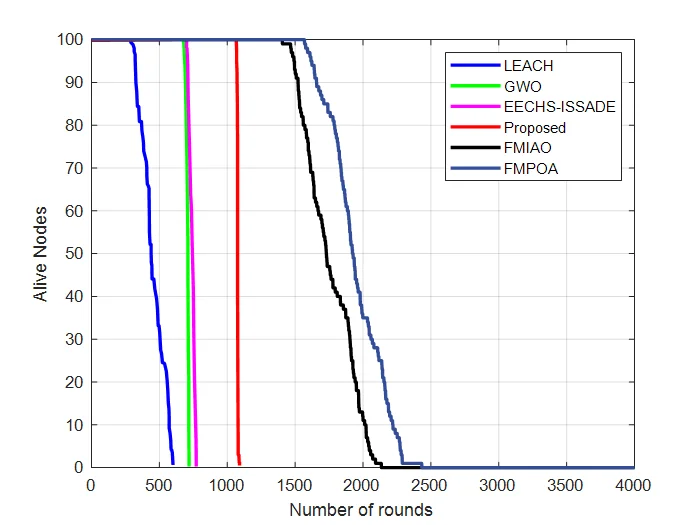
Fig. 5: Number of alive nodes.
Fig. 6 clearly shows a progressive increase in the number of rounds as we move from LEACH to FMPOA. LEACH achieves the fewest rounds, at approximately 300. GWO and EECHS-ISSADE perform similarly, reaching around 680 and 700 rounds, respectively. The "Proposed" protocol significantly improves this to approximately 1070 rounds. FMIAO further extends the network lifetime to about 1400 rounds. Finally, FMPOA demonstrates the best performance, achieving the highest number of rounds, nearly 1600, before the first node dies, indicating its superior ability to prolong network operation compared to all other protocols.
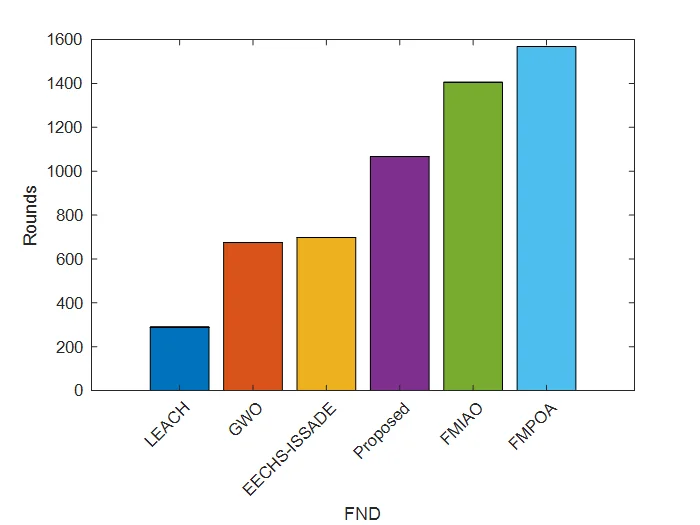
Fig. 6: First node dead (FND).
Fig. 7 illustrates the network's total lifespan for each protocol. LEACH has the shortest network lifetime, with all nodes dying around 600 rounds. GWO and EECHS-ISSADE perform slightly better, with their networks lasting approximately 800 and 750 rounds, respectively. The proposed technique extends the network lifespan significantly to about 1100 rounds. FMIAO further improves this, with the network operating for approximately 2150 rounds. However, FMPOA demonstrates the superior performance, as its network continues to operate for the longest duration, reaching nearly 2450 rounds before all nodes die, signifying its exceptional energy efficiency and network longevity compared to the other protocols.
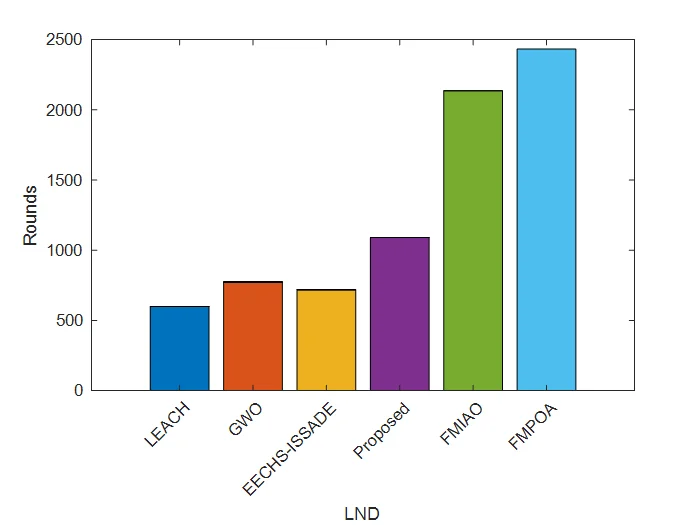
Fig. 7: Last Node Dead (LND).
Fig. 8 presents a comparative analysis of three key network lifetime metrics; FND, HND, and LND across various protocols: LEACH, GWO, EECHS-ISSADE, Proposed, FMIAO, and FMPOA. For FND, FMPOA achieves the highest number of rounds (approximately 1550), followed by FMIAO (around 1400) and then the Proposed protocol (around 1050), while LEACH, GWO, and EECHS-ISSADE have significantly lower FND values. In the HND category, a similar trend is observed, with FMPOA again leading (around 1900 rounds), followed by FMIAO (about 1700 rounds), and the Proposed protocol (around 1050 rounds), all outperforming the other three. Critically, for LND, FMPOA demonstrates the longest network lifetime, sustaining operation for approximately 2450 rounds, far exceeding FMIAO (around 2100 rounds) and the Proposed protocol (around 1070 rounds), while LEACH, GWO, and EECHS-ISSADE show much shorter LND values. Overall, the Fig. 8 comprehensively illustrates that FMPOA consistently outperforms all other protocols across all three network lifetime metrics (FND, HND, and LND), indicating its superior energy efficiency and prolonged network operational duration.
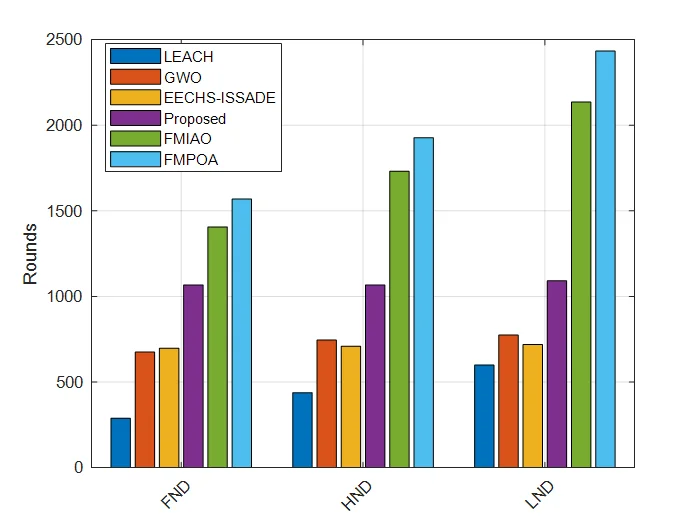
Fig. 8: Comparison of FND, HND, and LND for different protocols.
5. Conclusion and future scope
This study integrates an intelligent routing mechanism with a cluster-based architecture to provide a comprehensive method for optimizing internal routing in IoT-enabled wireless sensor networks. For effective cluster formation, the suggested system uses a hybrid clustering technique. For balanced and energy-conscious CH selection, it uses the MIAO algorithm. This Study summarizing the main contributions and suggesting potential real-world Based on this clustered framework, the Pelican Optimization algorithm is presented for CH-to-Sink communication with the goals of lowering end-to-end latency, maximizing energy efficiency, and improving overall routing effectiveness. The simulation results confirm that the POA-based routing strategy is effective in extending network lifetime and ensuring dependable data transmission, which satisfies the crucial QoS requirements in Internet of Things applications like smart agriculture, industrial monitoring, and urban sensing. In addition to emphasizing the value of intelligent and adaptive routing in limited WSN settings, the study shows how bio-inspired optimization methods can greatly enhance intra-network communication. Given the dynamic and diverse nature of contemporary IoT-based WSNs, the results highlight the value of multi-objective optimization. Future research will concentrate on implementing the suggested system in real-time using IoT hardware platforms like Arduino and Raspberry Pi, allowing for useful validation in real-world settings. Scalability, programmability, and data analytics capabilities will also be improved through integration with cloud-based IoT platforms and Software-Defined Networking (SDN). To further support extremely dynamic scenarios and lessen bottlenecks in large-scale deployments, the use of mobile sinks will also be examined. By making these improvements, the suggested architecture should become more feasible for use in next-generation IoT-driven wireless sensing applications.
Funding Declaration
Data Availability Statement
Conflict of Interest
Artificial Intelligence (AI) Use Disclosure
Supporting Information
References
- [1] A. John, A. Rajput, K. V. Babu, Energy saving cluster head selection in wireless sensor networks for internet of things applications, In 2017 International Conference on Communication and Signal Processing (ICCSP), IEEE, 2017, 0034-0038, doi: 10.1109/ICCSP.2017.8286486.
- [2] M. Majid, S. Habib, A. R. Javed, M. Rizwan, G. Srivastava, T. R. Gadekallu, J. C.-W. Lin, Applications of wireless sensor networks and internet of things frameworks in the industry revolution 4.0: a systematic literature review, Sensors, 2022, 22, 2087, doi: 10.3390/s22062087.
- [3] V. H. González-Jaramillo, Tutorial: Internet of Things and the upcoming wireless sensor networks related with the use of big data in mapping services; issues of smart cities, In 2016 Third International Conference on eDemocracy & eGovernment (ICEDEG), IEEE, 2016, 5-6, doi: 10.1109/ICEDEG.2016.7461464.
- [4] B. Yamini, G. Pradeep, D. Kalaiyarasi, M. Jayaprakash, G. Janani, G. S. Uthayakumar, Theoretical study and analysis of advanced wireless sensor network techniques in Internet of Things (IoT), Measurement: Sensors, 2024, 33, 101098, doi: 10.1016/j.measen.2024.101098.
- [5] S. Hudda, K. Haribabu, A review on WSN based resource constrained smart IoT systems, Discover Internet of Things, 2025, 5, 56, doi: 10.1007/s43926-025-00152-2.
- [6] I. Adumbabu, K. Selvakumar, Energy efficient routing and dynamic cluster head selection using enhanced optimization algorithms for wireless sensor networks, Energies, 2022, 15, 8016, doi: 10.3390/en15218016.
- [7] A. Khalifeh, K. A. Darabkh, A. M. Khasawneh, I. Alqaisieh, M. Salameh, A. AlAbdala, S. Alrubaye, A. Alassaf, S. Al-HajAli, R. Al-Wardat, N. Bartolini, G. Bongiovannim, K. Rajendiran, Wireless sensor networks for smart cities: network design, implementation and performance evaluation, Electronics, 2021, 10, 218, doi: 10.3390/electronics10020218.
- [8] P. Saha, V. Kumar, S. Kathuria, A. Gehlot, V. Pachouri, A. S. Duggal, Precision agriculture using internet of things and wireless sensor networks, 2023 International Conference on Disruptive Technologies (ICDT), Greater Noida, India, 2023, 519-522, doi: 10.1109/ICDT57929.2023.10150678.
- [9] R. Jafari, A. Encarnacao, A. Zahoory, F. Dabiri, H. Noshadi, M. Sarrafzadeh, Wireless sensor networks for health monitoring, In The second annual international conference on mobile and ubiquitous systems: networking and services, IEEE, 2005, 479-481, doi: 10.1109/MOBIQUITOUS.2005.65.
- [10] T. Mahmood, H. Muhammad Waqas, U. Rehman, A MADM framework for classifying wireless sensor networks in industrial automation and monitoring using hesitant bipolar complex fuzzy dombi power operators, Applied Soft Computing, 2025, 185, 113902, doi: 10.1016/j.asoc.2025.113902.
- [11] B. P. Deosarkar, N. S. Yadav, R. P. Yadav, Clusterhead selection in clustering algorithms for wireless sensor networks: a survey, In 2008 International conference on computing, communication and networking, IEEE, 2008, 1–8, doi: 10.1109/ICCCNET.2008.4787686.
- [12] L. Yang, D. Zhang, L. Li, Q. He, Energy efficient cluster-based routing protocol for WSN using multi-strategy fusion snake optimizer and minimum spanning tree, Scientific Reports, 2024, 14, 16786, doi: 10.1038/s41598-024-66703-9.
- [13] S. Misra, S. Goswami, Basic routing algorithms, Network Routing: Fundamentals, Applications, and Emerging Technologies, Wiley Telecom, 2014, 35-58, doi: 10.1002/9781119114864.ch2.
- [14] S. K. Chandrasekaran, V. A. Rajasekaran, Energy-efficient cluster head using modified fuzzy logic with WOA and path selection using enhanced CSO in IoT-enabled smart agriculture systems, The Journal of Supercomputing, 2024, 80, 11149-11190, doi: 10.1007/s11227-023-05780-5.
- [15] S. Garmroudi, G. Kayakutlu, M. O. Kayalica, U. Çolak, Improved pelican optimization algorithm for solving load dispatch problems, Energy, 2023, 289, 129811, doi: 10.1016/j.energy.2023.129811.
- [16] P. Satyanarayana, C. Ahalya, S. S. Rama Krishna, D. Sumanth, Y. S. S. Sriramam, V. Gokula Krishnan, Enhancement of Network Lifespan in WSN using Modified Pelican Optimization Algorithm for IoT Applications, In 2024 5th International Conference on Data Intelligence and Cognitive Informatics (ICDICI), IEEE, 2024, 223-227, doi: 10.1109/ICDICI62993.2024.10810825.
- [17] S. Tadigotla, J. K. Murthy, Multi-objective-Trust aware improved Pelican optimization approach for secure and energy efficient clustering and routing in wireless sensor network, International Journal of Intelligent Engineering and Systems, 2024, 18, 356–367, doi: 10.22266/ijies2025.0229.26.
- [18] M. R. Reddy, M. L. R. Chandra, P. Venkatramana, R. Dilli, Energy-Efficient cluster head selection in wireless sensor networks using an improved Grey Wolf optimization algorithm, Computers, 2023, 12, 35, doi: 10.3390/computers12020035.
- [19] V. Prakash, D. Singh, S. Pandey, S. Singh, P. K. Singh, Energy-optimization route and cluster head selection using M-PSO and GA in wireless sensor networks, Wireless Personal Communications, 2024, doi: 10.1007/s11277-024-11096-1.
- [20] R. Kalaivani, K. Aruna, S. Tamilarasan, J. Jayapriya, Pelican optimization algorithm for mobile secure routing in intrusion detection system in wireless sensor networks, In 2024 International Conference on Data Science and Network Security (ICDSNS), IEEE, 2024, 1-5, doi: 10.1109/ICDSNS62112.2024.10690985.
- [21] P. Jagannathan, S. Gurumoorthy, A. Stateczny, P. Divakarachar, J. Sengupta, Collision-Aware routing using multi-objective seagull optimization algorithm for WSN-Based IoT, Sensors, 2021, 21, 8496, doi: 10.3390/s21248496.
- [22] N. Chouhan, S. C. Jain, Tunicate swarm Grey Wolf optimization for multi-path routing protocol in IoT assisted WSN networks, Journal of Ambient Intelligence and Humanized Computing, 2020, 1-17, doi: 10.1007/s12652-020-02657-w.
- [23] B. R. Al-Kaseem, Z. K. Taha, S. W. Abdulmajeed, H. S. Al-Raweshidy, Optimized energy – efficient path Planning Strategy in WSN with multiple mobile sinks, IEEE Access, 2021, 9, 82833–82847, doi: 10.1109/access.2021.3087086.
- [24] K. Jaiswal, V. Anand, EOMR: An energy-efficient optimal multi-path routing protocol to improve QOS in wireless sensor network for IoT applications, Wireless Personal Communications, 2019, 111, 2493–2515, doi: 10.1007/s11277-019-07000-x.
- [25] Z. Wang, J. Duan, H. Xu, X. Song, Y. Yang, Enhanced pelican optimization algorithm for cluster head selection in heterogeneous wireless sensor networks, Sensor, 2023, 23, 7711, doi: 10.3390/s23187711.
- [26] N. Sankalana, K-Means Clustering: choosing optimal K, process, and evaluation methods, 2024, https://medium.com/@nirmalsankalana/k-means-clustering-choosing-optimal-k-process-and-evaluation-methods, Accessed 4 March 2025.
- [27] J. Pérez-Ortega, C. F. Moreno-Calderón, S. S. Roblero-Aguilar, N. N. Almanza-Ortega, J. Frausto-Solís, R. Pazos-Rangel, A. Martínez-Rebollar, Hybrid fuzzy C-Means clustering algorithm, improving solution quality and reducing computational complexity, Axioms, 2024, 13, 592, doi: 10.3390/axioms13090592.
- [28] R. Ramya, T. Brindha, A comprehensive review on optimal cluster head selection in WSN-IoT, Advances in Engineering Software, 2022, 171, 103170, doi: 10.1016/j.advengsoft.2022.103170.
- [29] I. Matoušová, P. Trojovský, M. Dehghani, E. Trojovská, J. Kostra, Mother optimization algorithm: a new human-based metaheuristic approach for solving engineering optimization, Scientific Reports, 2023, 13, 10312, doi: 10.1038/s41598-023-37537-8.
- [30] T. Vaiyapuri, V. S. Parvathy, V. Manikandan, N. Krishnaraj, D. Gupta, K. Shankar, A novel hybrid optimization for Cluster‐Based routing protocol in Information-Centric wireless sensor networks for IoT based mobile edge computing, Wireless Personal Communications, 2021, 127, 39–62, doi: 10.1007/s11277-021-08088-w.
- [31] M. Yahya, Mother Optimization Algorithm for solar PV system under partial shading, Sustainable Engineering and Technological Sciences (SETS), 2025, 1, 44–51, doi: 10.70516/4rdfh404.
Publisher Note: The views, statements, and data in all publications solely belong to the authors and contributors. GR Scholastic is not responsible for any injury resulting from the ideas, methods, or products mentioned. GR Scholastic remains neutral regarding jurisdictional claims in published maps and institutional affiliations.
Open Access
This article is licensed under a Creative Commons Attribution-NonCommercial 4.0 International License, which permits the non-commercial use, sharing, adaptation, distribution and reproduction in any medium or format, as long as appropriate credit to the original author(s) and the source is given by providing a link to the Creative Commons License and changes need to be indicated if there are any. The images or other third-party material in this article are included in the article's Creative Commons License, unless indicated otherwise in a credit line to the material. If material is not included in the article's Creative Commons License and your intended use is not permitted by statutory regulation or exceeds the permitted use, you will need to obtain permission directly from the copyright holder. To view a copy of this License, visit: https://creativecommons.org/licenses/by-nc/4.0/
© The Author(s) 2025