

 Open Access||Research Article
A Stable Multi-Resource Allocation Framework for Autonomous Cloud Computing
1 School of Computer Science, Nirwan University, Jaipur, Rajasthan, 303305, India
2 Department of Computer Science Engineering, University of Europe for Applied Sciences, Berlin, 10963, Germany
3 Department of Mathematics, Presidency University, Bengaluru, Karnataka, 560119, India
Abstract
Modern cloud data centers are stochastic, multi-user, multi-resource environments with oscillations, instability, and virtual machine (VM) flapping caused by resource contention, network latency, and user demand jitter. This paper develops a deterministic mathematical framework based on multi-dimensional complex analysis for modeling and stabilizing resource allocation among n resource types (storage, RAM, memory, CPU, network) for M concurrent users. The Argument Principle and the Nyquist stability criterion are used to analyze closed-loop transfer functions in the complex s-plane. Based on Rouché’s theorem, a geometric interpretation provides safety envelopes for robust operation under stochastic perturbations. Statistical regression models (linear and polynomial) map the user load to the system delay, and computational mathematics methods (numerical contour integration, eigenvalue perturbation) enable real-time stability evaluation. Monte Carlo simulations validate the proposed Complex-Stability Aware Scaling (C-SAS) algorithm. Results show that C-SAS achieves 96% resource efficiency, a 94% reduction in VM flapping, and an average settling time of 12 seconds, outperforming heuristic and PID-based methods. This work provides a rigorous mathematical foundation for autonomous cloud orchestration in high-performance computing environments.
Keywords
Graphical Abstract
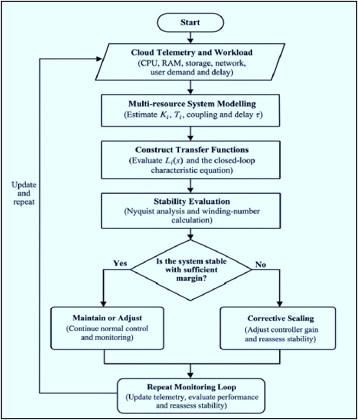
Novelty Statement
A Monte Carlo-validated, deterministic complex-analysis framework robustly stabilizes multi-resource cloud allocation, achieving 96% resource efficiency and 94% less VM flapping.