
Research Article | Open Access
|
Open Access
|


 | Published online: 30 December 2025
Internet of Things and Machine Learning in Smart Agriculture: A
Comprehensive Review
| Published online: 30 December 2025
Internet of Things and Machine Learning in Smart Agriculture: A
Comprehensive Review
Sushilkumar Salve,* Prathamesh Dhotre, Krishna Sathe and Vaibhav Salegaye
Department of Electronics and Telecommunications Engineering, Sinhgad Institute of Technology, Lonavala, Maharashtra, 410401, India
*Email: sushil.472@gmail.com (S. S. Salve)
J. Smart Sens. Comput., 2025, 1(3), 25214 https://doi.org/10.64189/ssc.25214
Received: 28 September 2025; Revised: 29 December 2025; Accepted: 30 December 2025




Abstract
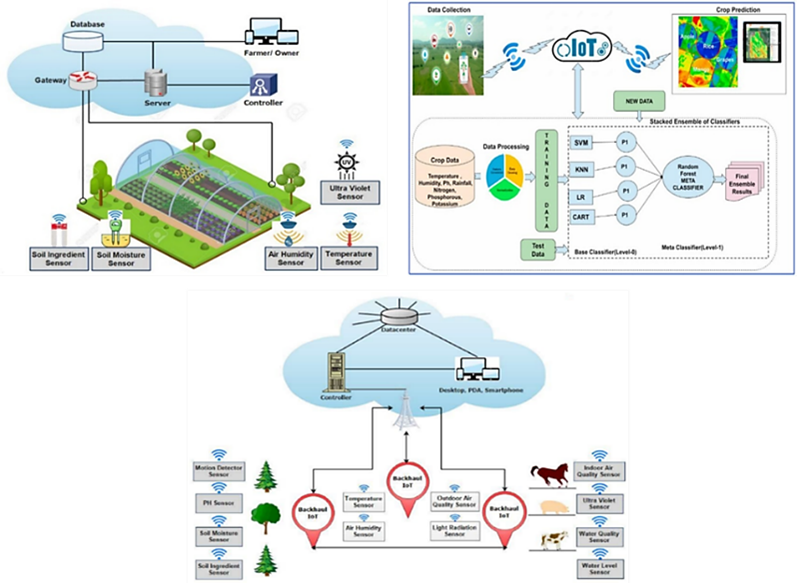
Traditional farming practices in developing nations often face inefficiencies due to limited access to real time information on soil health, weather conditions, and crop growth, resulting in reduced productivity and resource wastage. This review article summarizes smart agriculture systems that integrate the Internet of Things (IoT) and Machine Learning (ML) to enhance crop monitoring, optimize resource utilization, and support sustainable farming practices. IoT-based wireless sensor networks (WSNs) enable continuous real time data collection on environmental and soil parameters, while ML algorithms analyze this data to support informed decision-making. The experimental results demonstrate that the proposed ensemble based ML model achieves high predictive accuracy, validating the effectiveness of combining multiple learning algorithms for smart agriculture applications. Furthermore, real-time data updates allow farmers to respond promptly to changing field conditions, thereby minimizing losses and improving overall productivity. The integration of IoT and ML establishes a robust, data-driven agricultural framework that enhances efficiency, sustainability, and food security.
Graphical Abstract
Novelty statement
This review article summarizes smart agriculture systems that integrate the Internet of Things and Machine Learning to enhance crop monitoring, optimize resource utilization, and support sustainable farming practices.
