
Research Article | Open Access
|
Open Access
|


 | Published online: 31 December 2025
Loan Default Prediction Using Ensemble Machine Learning Algorithms
| Published online: 31 December 2025
Loan Default Prediction Using Ensemble Machine Learning Algorithms
Sanjay Gour* and Pooja Soni
Department of Computer Science & Engineering, Gandhinagar University, Gandhinagar, 382725, Gujarat, India
*Email: sanjay.since@gmail.com (S. Gour)
J. Smart Sens. Comput., 2025, 1(3), 25215 https://doi.org/10.64189/ssc.25215
Received: 11 November 2025; Revised: 26 December 2025; Accepted: 30 December 2025




Abstract
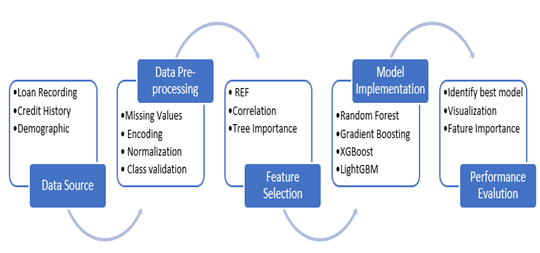
Loan default prediction has become a critical task for organizations operating in the financial sector, as it directly influences risk management, loan approval decisions, and overall organizational profitability. Traditional credit assessment methods employed by financial institutions rely on a limited set of predefined factors and often fail to effectively capture complex patterns associated with loan default behavior. Consequently, these approaches are insufficient for accurately identifying potential defaulters, leading to increased financial risk. To address these limitations, this study focuses on evaluating the performance of several ensemble machine learning algorithms, including Random Forest, Gradient Boosting, XGBoost, and LightGBM, for loan default prediction. An experimental methodology is adopted using a publicly available benchmark dataset. The workflow involves data preprocessing, feature engineering, class imbalance handling, model training, and performance evaluation. The effectiveness of the proposed models is assessed using standard evaluation metrics such as accuracy, precision, recall, F1-score, and the area under the receiver operating characteristic curve (ROC-AUC). In addition, a detailed analysis based on the confusion matrix is conducted to examine classification performance. The results demonstrate the strong capability of ensemble machine learning techniques in accurately predicting loan defaults and highlight their effectiveness in feature-driven predictive modeling within the financial domain.
Graphical Abstract
Novelty statement
This study focuses on evaluating the performance of several ensemble machine learning algorithms, including Random Forest, Gradient Boosting, XGBoost, and LightGBM, for loan default prediction by confusion matrix approach.
