
Review Article | Open Access
|
Open Access
|


 | Published online: 16 March 2026
Artificial Intelligence and Machine Learning in Cybersecurity: A Review of Trends, Challenges, and Applications
| Published online: 16 March 2026
Artificial Intelligence and Machine Learning in Cybersecurity: A Review of Trends, Challenges, and Applications
Pooja Soni and Sanjay Gour*
Department of Computer Science & Engineering, Gandhinagar University, Gandhinagar, 382725, Gujarat, India
*Email: sanjay.since@gmail.com (S. Gour)
J. Smart Sens. Comput., 2026, 2(1), 26202 https://doi.org/10.64189/ssc.26202
Received: 31 December 2025; Revised: 22 February 2026; Accepted: 13 March 2026




Abstract
In the rapidly evolving digital environment, cybersecurity has become a critical component for protecting cloud infrastructures, Internet of Things (IoT) ecosystems, 5G networks, and sensitive digital assets. The increasing complexity and scale of cyber threats-including zero-day attacks, advanced persistent threats, ransomware, and social engineering-have revealed the inadequacy of traditional rule-based and signature-driven security systems. Consequently, Artificial Intelligence (AI) and Machine Learning (ML) have emerged as essential enablers in the advancement of modern cybersecurity solutions. This study provides a comprehensive overview of the evolving threat landscape, attack vectors, and the broader societal implications of cybersecurity. It presents an integrated theoretical and practical perspective on AI- and ML-driven cybersecurity frameworks, highlighting their roles in automated threat detection, behavioral analysis, predictive analytics, and security automation. The paper also examines key theoretical foundations, including behavioral modeling, information theory, adversarial learning, pattern recognition, and automation theory, while addressing emerging challenges such as adversarial machine learning, algorithmic bias, explainability, and data privacy. Furthermore, the review explores recent advancements, including federated learning and Explainable Artificial Intelligence (XAI), along with a statistical analysis of global adoption and utilization trends. It also discusses leading countries in the implementation of AI-driven cybersecurity solutions, supported by relevant data. By synthesizing current research and industry practices, the study proposes a structured roadmap for developing robust, adaptive, and ethically responsible AI-enabled cybersecurity systems capable of addressing both current and future cyber threats. Additionally, the study provides a statistical perspective on technology adoption, market growth, and the expanding role of AI and ML in cybersecurity applications.
Keywords:
Graphical Abstract
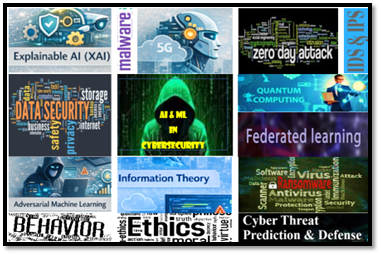
Novelty statement
This review uniquely integrates theory, emerging AI paradigms, ethical challenges, and global adoption trends into a unified cybersecurity roadmap.
