
Research Article | Open Access
|
Open Access
|


 | Published online: 27 March 2026
A Hybrid CNN–Transformer Model for Detection and Recurrence Risk Prediction of Non-Small Cell Lung Cancer
| Published online: 27 March 2026
A Hybrid CNN–Transformer Model for Detection and Recurrence Risk Prediction of Non-Small Cell Lung Cancer
Supriya Narad* and K. T. V. Reddy*
Faculty of Engineering & Technology, Datta Meghe Institute of Higher Education and Research (DU), Sawangi (Meghe), Wardha, Maharashtra, 442001, India
*Email: naradsupriya@gmail.com (S. Narad), ktvreddy.feat@dmiher.edu.in (K. T. V. Reddy)
J. Smart Sens. Comput., 2026, 2(1), 26203 https://doi.org/10.64189/ssc.26203
Received: 28 December 2025; Revised: 12 March 2026; Accepted: 26 March 2026




Abstract
Critical challenges in medical diagnosis are being increasingly addressed through applications of artificial intelligence. Accurate detection and classification of non-small cell lung cancer (NSCLC) nodules smaller than 3 mm, along with reliable recurrence risk prediction, are essential for early diagnosis and improved patient outcomes. However, these tasks remain technically challenging. Existing approaches often struggle to detect and classify very small nodules because of limited image resolution and inadequate feature representation, which in turn negatively impacts recurrence risk prediction. To address these limitations, this study proposes an advanced deep learning framework that integrates a convolutional neural network (CNN)–transformer hybrid model. The CNN component extracts fine-grained local features from high-resolution computed tomography (CT) scans, while the transformer captures long-range contextual dependencies to enhance classification and prediction performance. The experimental results demonstrate a detection accuracy of 95% and a classification accuracy of 93% for nodules smaller than 3 mm. Overall, the proposed framework achieves 96% detection accuracy, 94% classification accuracy for small nodules, and 90% accuracy in recurrence risk prediction. Furthermore, the model provides enhanced interpretability, thereby supporting clinical decision-making. These findings indicate significant advancements in early NSCLC diagnosis and treatment planning.
Keywords:
Graphical Abstract
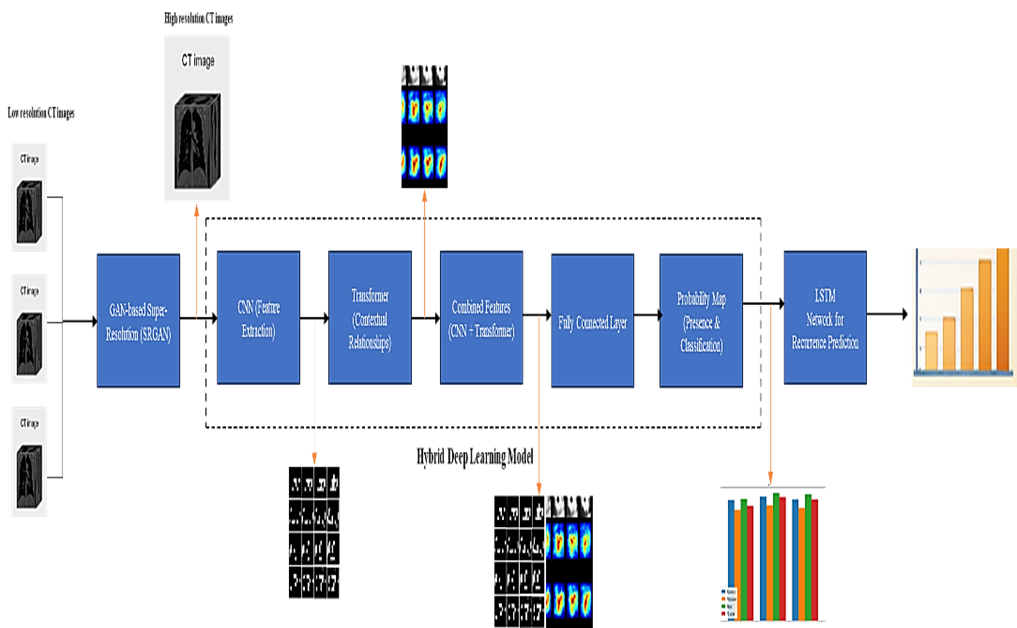
Novelty statement
By integrating CNN–Transformer hybrids, SRGAN, self-attention, and LSTM, the proposed method enable accurate early-stage NSCLC detection.
