

 Open Access||Research Article
Scalable Zero-Trust Supply Chain Management with Soul-Bound Tokens and Merkle Tree Batching
Humayun Majid Khan1 , Samana Jafri1, Zoha Najmul Kalam Ansari1, Adnan Mohd Irfan Ansari1
Department of Computer Science and Engineering (Internet of Things and Cyber Security including Blockchain Technology), M. H. Saboo Siddik College of Engineering, Byculla, Mumbai, 400008, Maharashtra, India
Abstract
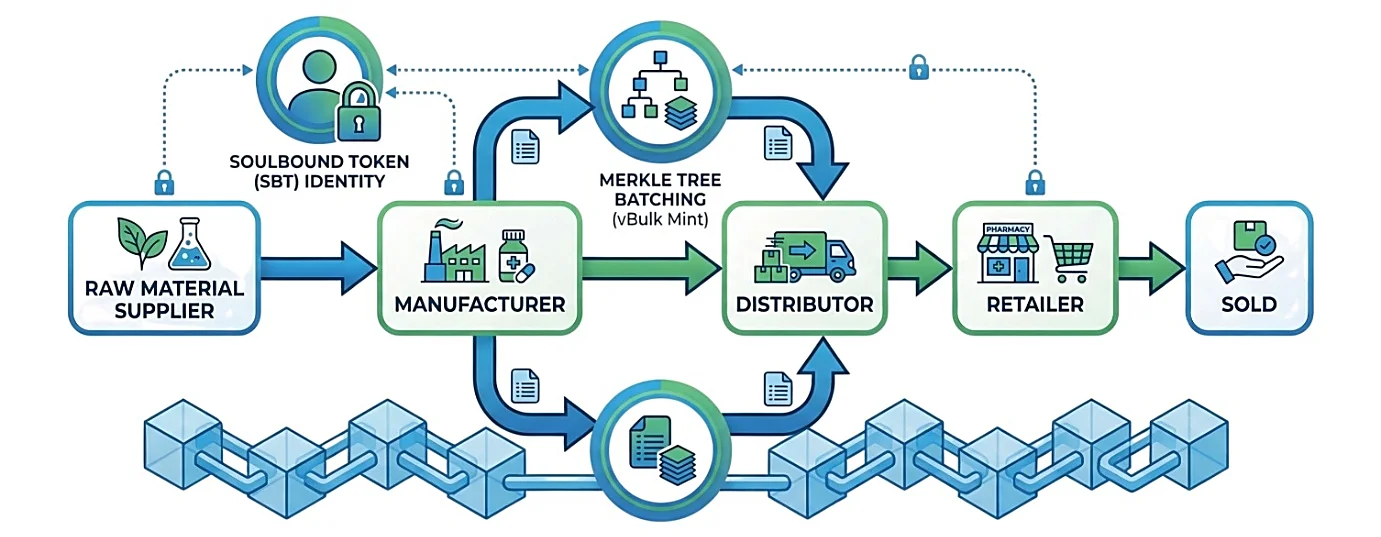
Traditional pharmaceutical supply networks face the problems of transparency, falsification, and unproductive centralization. This work outlines a decentralized secure and highly scalable system of supply chain management, which uses the Ethereum blockchain. The system provides strict information on the consecutive stages of medicine supply through its solidity smart contracts, with the involvement of the raw material and the retailing distribution, which provide a tamper-evident recording of the sequential supply chain stages. Although traditional blockchain solutions face challenges in terms of the high cost of gas and identity spoofing, this paper presents two important novelties to overcome these obstacles. The first is to have a non-transferable credential system whereby we have Soulbound Tokens that are non-transferable digital certificates of the participating entities, meaning that only the verified manufacturers and suppliers can communicate with the network. Second, we suggest a mass registration system based on off-chain Merkle trees. Rather than registering the separate identifiers of pharmaceutical items one at a time, the system packages thousands of product identifiers into a single Merkle root generated off-chain and stored on-chain in constant space. This is augmented with a decentralized authenticator that provides cryptographic Merkle inclusion proofs to provide real-time verification that a digital product identifier belongs to the committed batch. For the evaluated 10,000-identifier batch, Merkle-based registration used 127,813 gas units compared with an estimated 350,000,000 gas units for sequential registration, corresponding to an estimated 99.96% reduction; 50-trial local benchmarks recorded 2.188 ms mean end-to-end Merkle verification and 1.409 ms mean lifecycle-query latency. The experimental implementation demonstrates the feasibility of the proposed architecture for tamper-evident participant authorization, Merkle-based batch registration, and digital identifier verification within the evaluated local environment.
Keywords
Graphical Abstract
Novelty Statement
A pharmaceutical supply chain tracking framework combining non-transferable participant credentials with Merkle-tree batching to strengthen role-based authorization and reduce on-chain registration overhead.
Open Access
This article is licensed under a Creative Commons Attribution NonCommercial 4.0 International (CC-BY-NC 4.0).
© The Author(s) 2026
Graphical Abstract
Novelty Statement
A pharmaceutical supply chain tracking framework combining non-transferable participant credentials with Merkle-tree batching to strengthen role-based authorization and reduce on-chain registration overhead.