
 Open Access||Research Article
Unsupervised Gaussian Mixture Model (GMM)-based Malware Detection in IoT Networks

Department of Computer Science & Engineering (Artificial Intelligence and Machine Learning), G. H. Raisoni College of Engineering and Management, Pune, Maharashtra, 412207, India
Abstract
With the rapid rise of cyber threats, traditional signature-based security systems struggle to detect sophisticated attacks, particularly zero-day threats and evolving malware. Supervised learning methods show promise but rely heavily on labeled datasets, limiting their adaptability. This paper explores an unsupervised learning-based approach for malware and network anomaly detection using the IoT-23 dataset. Our method enhances cybersecurity by providing an adaptive and proactive defense mechanism, effectively identifying threats while minimizing false positives. Unsupervised learning models, such as clustering and probabilistic techniques, excel at detecting novel threats without prior knowledge. Their integration with real-time threat intelligence enhances response capabilities, making them valuable for enterprise security, cloud environments, and critical infrastructure protection. Implementing these models in security information and event management (SIEM) systems improves automated threat mitigation and reduces manual intervention and response time. Future research should focus on refining these models for large-scale deployments, integrating hybrid AI techniques, and strengthening cybersecurity resilience. By continuously evolving to counter emerging threats, unsupervised learning-based security solutions play a pivotal role in next-generation defense strategies.
Keywords
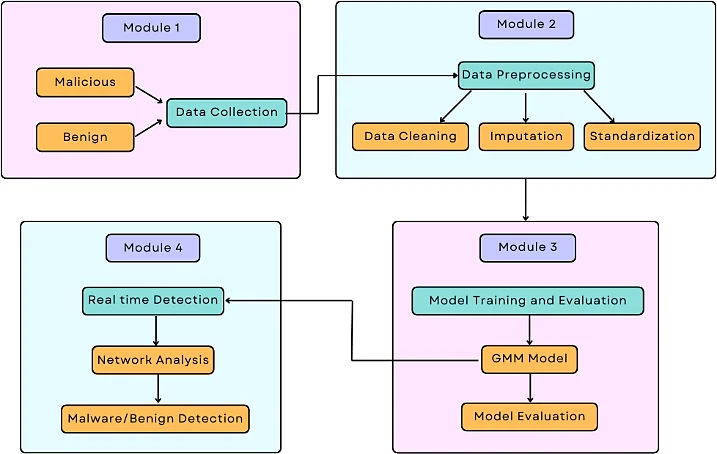
Graphical Abstract