

 Open Access||Review Article
Multimodal AI Under Attack: A Systematic Survey of Deepfake Generation, Detection, Adversarial Vulnerabilities, and Security Defenses
Gopika Fattepurkar1 , Vandana V Navale2, Varsha Rahul Dange3, Radha Shirbhate4
1 Department of Artificial Intelligence and Data Science, Ajeenkya D Y Patil School of Engineering, Lohegaon, Pune, Maharashtra, 412105, India
2 Department of Artificial Intelligence and Data Science, Marathwada Mitra Mandals Institute of Technology, Pune, Maharashtra, 411047, India
3 Department of Computer Science and Engineering (Artificial Intelligence and Machine Learning), Vishwakarma Institute of Technology, Pune, Maharashtra, 411037, India
4 Department of Computer Science and Engineering (Artificial Intelligence), G. H. Raisoni College of Engineering and Management (GHRCEM), Wagholi, Pune, Maharashtra, 412207, India
Abstract
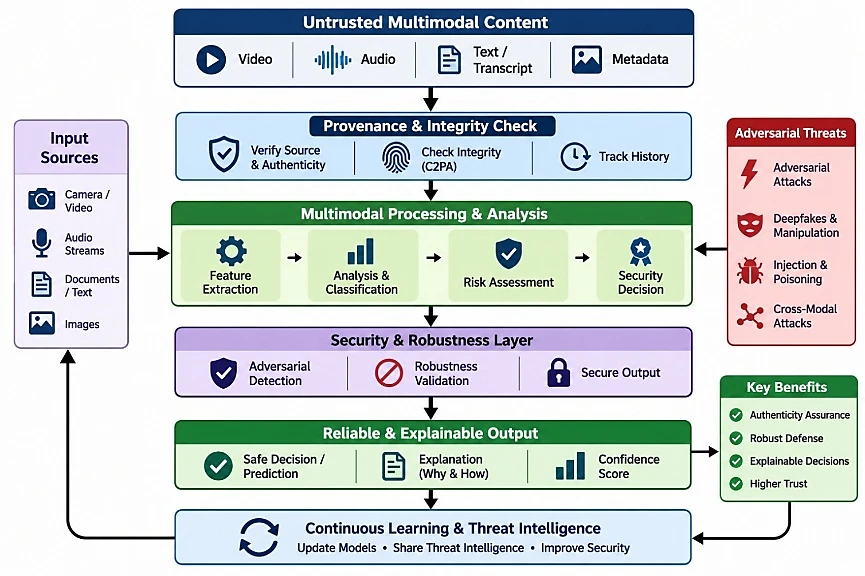
The rapid advancement of generative artificial intelligence has significantly increased the sophistication, scale, and accessibility of deepfake generation. Deepfakes now extend beyond manipulated images and videos to coordinated audio-visual and multimodal synthetic content, creating emerging security and trust challenges. This survey presents a systematic analysis of multimodal deepfake generation, detection techniques, adversarial vulnerabilities, and security defenses. This study examines visual, audio, temporal, semantic, and cross-modal approaches used to identify synthetic and manipulated content. Particular emphasis is placed on multimodal fusion, cross-modal consistency, transformer-based architectures, and multimodal foundation models. The survey further investigates adversarial evasion, poisoning, backdoor, modality manipulation, and adaptive attacks against detection systems. Datasets, benchmarks, and evaluation metrics are compared, with an emphasis on cross-dataset, cross-generator, and zero-day generalization. The analysis reveals that high in-dataset detection performance does not necessarily indicate robustness against unseen generators or adversarial manipulation. This study also identifies important gaps in explainability, provenance verification, uncertainty estimation, and human-assisted forensic decision-making. On the basis of these findings, a unified multimodal AI security and deepfake defense (MASD-F) framework is proposed. The framework integrates multimodal analysis, cross-modal reasoning, adversarial security assessment, provenance verification, explainable decision-making, and continuous threat adaptation. The survey concludes that future deepfake defense systems must evolve from accuracy-oriented classification toward trustworthy, adaptive, and security-aware multimodal forensics.
Keywords
Graphical Abstract
Novelty Statement
This review gives a security-centric synthesis of multimodal deepfakes by unifying cross-modal foundation model analysis, adversarial vulnerability mapping, and zero-day generalization benchmarks, culminating in the novel MASD-F framework for trustworthy, explainable, and adaptive digital forensics.