

 Open Access||Review Article
Lignin-Derived and Associated Polyphenolic Compounds in Woody Plants: Structural Elucidation, Synthetic Pathways, Characterization Techniques, and Industrial Bioactivities

1 Department of Agroforestry, Forest College and Research Institute, Tamil Nadu Agricultural University, Mettupalayam, Tamil Nadu, 641301, India
2 Department of Agronomy, Agricultural College and Research Institute, Tamil Nadu Agricultural University, Tiruvannamalai, Tamil Nadu, 606753, India
Abstract
Lignin is the second most abundant natural biopolymer on Earth, functioning as a primary structural matrix in the secondary cell walls of woody plants. Composed of complex, cross-linked, hydroxylated, and methoxylated phenylpropanoid units, lignin and its associated polyphenols possess unique structural flexibility, UV-shielding, radical scavenging, and antimicrobial properties. Historically managed as a low-value byproduct of the pulp and paper industry, recent biorefinery innovations have repositioned lignin as a crucial sustainable precursor for high-value biomaterials, green composite fillers, and targeted biomedical carriers. This review provides a rigorous, critical synthesis of lignin chemistry, detailing monolignol biosyntheses (p-coumaryl, coniferyl, and sinapyl alcohols), radical coupling polymerization mechanisms, and taxonomic variations across gymnosperm softwoods, angiosperm hardwoods, and woody bamboos. Modern structural characterization methodologies including 2D 1H-13C HSQC NMR, 31P NMR, Py-GC/MS, SEC/GPC, and FTICR-MS are comprehensively evaluated alongside commercial extraction protocols (kraft, organosolv, lignosulfonate, and soda processes). Furthermore, quantitative performance metrics across antioxidant (DPPH IC50), UV-blocking (SPF values), antimicrobial (MIC), and drug-delivery (encapsulation efficiency) domains are critically synthesized. Technical limitations regarding structural heterogeneity, condensation reactions, sulfur contamination, commercial scalability, life cycle assessments (LCA), and regulatory hurdles for biomedical translation are thoroughly examined. This work establishes an integrated framework bridging taxonomic lignin chemistry with industrial valorization and sustainable bioeconomy strategy.
Keywords
Graphical Abstract
Novelty Statement
This review establishes a definitive framework bridging taxonomic variations in lignin chemistry with cutting-edge 2D HSQC/31P NMR structural characterization methodologies. It uniquely synthesizes quantitative performance metrics across antioxidant, UV-shielding, and biomedical applications while critically addressing technical and life cycle bottlenecks to accelerate industrial valorization.
1. Introduction
Lignin is an intricate, highly branched aromatic macromolecule that accounts for approximately 15% to 35% of the dry lignocellulosic biomass in vascular plants, serving as an indispensable structural support matrix alongside cellulose and hemicellulose.[1,2] Deposited predominantly during secondary cell wall formation, lignin imparts essential mechanical strength, rigidity, and stem uprightness, while rendering vascular tissues impermeable to aqueous fluid transport.[3,4] Furthermore, lignification acts as a robust biochemical defense mechanism against pathogen infection, microbial degradation, and environmental oxidative stresses.[2,5] From a chemical perspective, lignin represents the most abundant renewable reservoir of natural aromatic structures on Earth, making it a pivotal feedstock for transitioning from fossil-dependent chemical industries to a sustainable bio-based economy.[6,7] Despite its immense natural abundance—generated in excess of 50 million tons annually as a byproduct of industrial pulp, paper, and emerging biorefinery operations—lignin remains substantially underutilized.[8,9] Historically, over 95% of industrial technical lignins, particularly kraft lignin and lignosulfonates, have been incinerated on-site as low-value thermal fuel to recover process chemicals and generate operational steam.[8,10] This practice stems primarily from lignin's inherent structural heterogeneity, high polydispersity, thermal instability, and operational recalcitrance caused by unpredictable radical condensation during chemical pulping.[7,11] However, driven by modern advancements in analytical characterization, targeted depolymerization, green fractionation, and nanostructural engineering, lignin is rapidly transitioning from an under-valued waste stream to a high-value platform material.[12,13]
While numerous reviews have broadly examined lignin isolation or specific chemical modifications, several major knowledge gaps persist in the current literature. First, conventional reviews frequently discuss lignin in generic terms without adequately differentiating the distinct structural traits imparted by specific woody plant taxa (e.g., gymnosperm softwoods vs. angiosperm hardwoods vs. woody bamboos).[2,14] Second, existing literature often provides purely qualitative assertions regarding lignin bioactivities—such as 'strong antioxidant capacity' or 'excellent antimicrobial action'—without critically synthesizing quantitative benchmarks such as DPPH scavenging IC50 values, UV protection factors (SPF), or minimum inhibitory concentrations (MIC).[15,16] Third, there is a prominent disconnect between laboratory-scale claims of biomedical efficacy and the practical economic, regulatory, and scalability constraints governing commercial translation.[13,17] Finally, many reviews fail to integrate recent advances in high-resolution analytical techniques, such as 2D ¹H-¹³C Heteronuclear Single Quantum Coherence Nuclear Magnetic Resonance (HSQC NMR) and Quantitative ³¹P NMR, with commercial process economics and Life Cycle Assessments (LCA).[18,19] To address these critical knowledge gaps, this review provides a comprehensive and rigorous synthesis of lignin chemistry, biosynthesis, advanced analytical characterization, and industrial applications, specifically focused on woody plant taxa. By establishing explicit linkages between taxonomic origins, isolation chemistries, quantitative performance metrics, commercial scalability, and environmental sustainability, this work offers an integrated blueprint for researchers and bioprocess engineers seeking to unlock the full economic and biomedical potential of lignin-derived polyphenols.
2. Methodology and PRISMA Selection Strategy
To ensure methodological rigor, transparency, and comprehensive coverage of recent literature, a systematic literature search was conducted adhering to the Preferred Reporting Items for Systematic Reviews and Meta-Analyses (PRISMA) statement guidelines.[20] Primary literature searches were executed across Web of Science, Scopus, PubMed, and Google Scholar covering publication dates from January 2000 through September 2026. The search strategy utilized combinations of Boolean operators with core keywords: ('lignin' OR 'technical lignin' OR 'lignin nanoparticles') AND ('woody plants' OR 'softwood' OR 'hardwood') AND ('structural elucidation' OR '2D HSQC NMR' OR '31P NMR') AND ('biosynthesis' OR 'monolignols') AND ('antioxidant' OR 'antimicrobial' OR 'drug delivery' OR 'UV-shielding'). Furthermore, specific searches focused on commercial processing ('kraft', 'organosolv', 'lignosulfonate', 'soda') and techno-economic evaluation ('life cycle assessment', 'scalability', 'biodegradability'). The primary database search yielded 1,420 records. Following duplicate removal (n = 380), 1,040 titles and abstracts were screened for thematic relevance. Articles were included if they presented primary quantitative data or critical theoretical advancements regarding woody plant lignin biosynthesis, advanced analytical characterization, industrial extraction protocols, or specific bioactivity performance metrics. Studies exclusively focusing on herbaceous agricultural residues or non-woody grasses were excluded unless required for explicit structural comparisons. The focus was on woody taxa based on their dominant share in industrial forestry, higher recalcitrance, unique S/G/H monomeric ratios compared to monocots, and distinct commercial valorization pathways. A total of 185 full-text articles were assessed for eligibility, resulting in 65 highly rigorous primary research articles, authoritative review papers, and technical reports selected for full synthesis within this review (Fig 1).
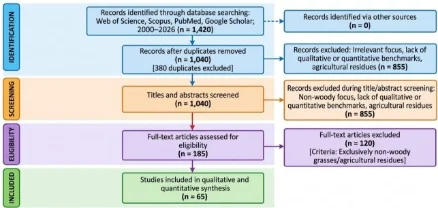
Fig. 1: PRISMA Flow Diagram illustrating literature identification, screening, eligibility, and inclusion process.
3.1 General Phenylpropanoid Enzymatic Cascade
Lignin biosynthesis originates within the cytosol via the general phenylpropanoid pathway, utilizing the aromatic amino acid L-phenylalanine (and to a lesser extent L-tyrosine in certain monocots and woody grasses) produced by the shikimate pathway.[2,21] The initial entry step is catalyzed by Phenylalanine Ammonia-Lyase (PAL), which performs non-oxidative deamination of L-phenylalanine to generate trans-cinnamic acid.[21,22] Successive hydroxylation and methylation reactions establish the functional aromatic substitution patterns characteristic of monolignol precursors.[2,23] Trans-cinnamic acid is hydroxylated at the C4 position by Cinnamate 4-Hydroxylase (C4H), a membrane-bound Cytochrome P450 monooxygenase, producing p-coumaric acid.[22] Activation of p-coumaric acid to p-coumaroyl-CoA is mediated by 4-Coumarate:CoA Ligase (4CL).[24] The metabolic pathway branches further through downstream enzymes: Hydroxycinnamoyl-CoA Shikimate/Quinate Hydroxycinnamoyl Transferase (HCT) and p-Coumarate 3-Hydroxylase (C3H) catalyze the conversions leading to caffeoyl-CoA.[2,24] Caffeoyl-CoA is subsequently O-methylated at the C3 position by Caffeoyl-CoA O-Methyltransferase (CCoAOMT) to yield feruloyl-CoA.[25] Reduction of these hydroxycinnamoyl-CoA thioesters to their corresponding aldehydes is executed by Cinnamoyl-CoA Reductase (CCR), followed by NADPH-dependent reduction to hydroxycinnamyl alcohols (monolignols) catalyzed by Cinnamyl Alcohol Dehydrogenase (CAD).[21,26] The synthesis of sinapyl alcohol, the building block for syringyl (S) lignin units, requires Ferulate 5-Hydroxylase (F5H), a specialized Cytochrome P450 enzyme that hydroxylates coniferaldehyde or coniferyl alcohol at the C5 position, followed by O-methylation via Caffeic Acid O-Methyltransferase (COMT).[2,27] Differential regulation, expression, and substrate specificity of these pathway enzymes directly dictate the proportion of p-coumaryl alcohol (yielding p-hydroxyphenyl, H units), coniferyl alcohol (yielding guaiacyl, G units), and sinapyl alcohol (yielding syringyl, S units) synthesized within plant cells.[2,28]
3.2 Radical Coupling Polymerization and Combinatorial Lignification
Following cytoplasmic synthesis, monolignols are transported across the plasma membrane into the apoplastic cell wall matrix via ABC transporters and passive diffusion mechanisms.[2,29] In the apoplast, secretable oxidative enzymes—specifically cell wall-bound Class III Peroxidases (utilizing hydrogen peroxide, H₂O₂) and Laccases (utilizing molecular oxygen, O₂)—catalyze the one-electron oxidation of monolignol phenolic hydroxyl groups to form resonance-stabilized phenoxy radicals.[29,30] Unusually for biological macromolecules, lignification is not a template-driven process; instead, it proceeds via purely chemical, combinatorial radical coupling of these phenoxy radicals.[6,31] The delocalization of the unpaired electron across the aromatic ring and the conjugated cinnamyl alcohol side chain (at positions O-4, C-1, C-3, C-5, and C-β) permits diverse radical coupling modes.[6] The primary coupling event typically involves a monolignol radical reacting at its C-β position with an elongated phenolic end-group of a growing polymer, resulting in dominant linkage types such as β-O-4' (aryl ether), β-β' (resinol), β-5' (phenylcoumaran), 5-5' (biphenyl), and 4-O-5' (diaryl ether).[6,32] This non-deterministic coupling mechanism accounts for the extreme macromolecular heterogeneity, polydispersity, and optical inactivity observed in natural plant lignins.[6]
Table 1: Comparative structural traits, monolignol proportions, and linkage profiles across major woody plant taxonomic divisions [2,6,14,33-36]
| Taxonomic Group | Representative Species | Monolignol Composition | Dominant Linkages | S/G Ratio | Structural Characteristics |
|---|---|---|---|---|---|
| Gymnosperm Softwoods | Pinus taeda, Picea abies, Abies alba | G (>95%), H (<5%) | β-O-4 (45–50%), 5-5 (10–15%), β-5 (9–12%) | N/A (G-dominated) | Highly cross-linked, dense C-C network, elevated recalcitrance |
| Angiosperm Hardwoods | Populus trichocarpa, Betula pendula | G (30–50%), S (50–70%), H (<2%) | β-O-4 (60–75%), β-β (5–10%), β-5 (3–6%) | 1.2 – 3.0 | Linear architecture, higher β-O-4 content, lower thermal recalcitrance |
| Woody Bamboos / Monocots | Bambusa vulgaris, Dendrocalamus strictus | G (40–50%), S (40–50%), H (5–10%) | β-O-4 (50–60%), ester/ether hydroxycinammates | 0.8 – 1.5 | Abundant hydroxycinnamic acids (ferulate/coumarate) cross-linking |
4.1 Structural Classification Across Woody Taxa
Lignin composition varies systematically across major taxonomic divisions of woody plants, driven by evolutionary adaptations in monolignol biosynthetic pathways.[2,14] Gymnosperm softwoods (e.g., Pinus, Picea, Abies) synthesize lignin almost exclusively from coniferyl alcohol, resulting in 'guaiacyl lignin' composed of >95% G-units with minor amounts (<5%) of H-units.[6,33] Because G-units possess an unsubstituted aromatic C-5 position, softwood lignins undergo high degrees of intramolecular cross-linking during lignification, forming dense 5-5' and β-5' carbon-carbon bonds that impart high thermal recalcitrance.[6,34] In contrast, angiosperm hardwoods (e.g., Populus, Betula, Eucalyptus) synthesize both coniferyl and sinapyl alcohols, producing 'guaiacyl-syringyl (G-S) lignin' with typical S/G ratios ranging from 1.0 to 3.0.[2,35] The presence of methoxyl groups at both C-3 and C-5 in syringyl units blocks C-C coupling at C-5, favoring linear, ether-linked (β-O-4') polymer chains that are chemically more susceptible to depolymerization.[35] Woody monocots and bamboos (e.g., Bambusa, Dendrocalamus) incorporate substantial amounts of p-coumaryl alcohol alongside G and S units, forming 'H-G-S lignin' characterized by significant ester- and ether-bound p-coumaric and ferulic acid pendant groups.[14,36] Table 1 summarizes the key structural traits, linkage profiles, and molecular characteristics across woody taxonomic groups.
4.2 Chemical Structures of Monolignols and Key Interunit Linkages
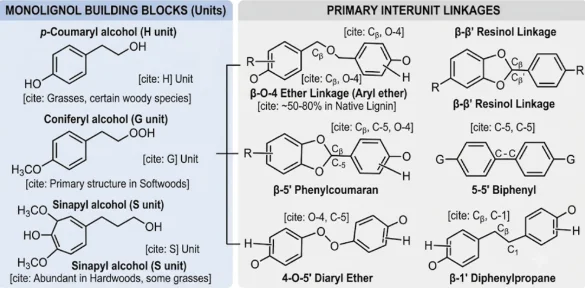
To provide clear chemical elucidation, Fig. 2 presents the complete molecular structures of the primary monolignol precursors (p-coumaryl alcohol, coniferyl alcohol, and sinapyl alcohol) alongside the explicit chemical linkages that define the polymer backbone, including β-O-4' aryl ether, β-β' resinol, β-5' phenylcoumaran, 5-5' biphenyl, 4-O-5' diaryl ether, and β-1' diphenylpropane structures.[6,32]
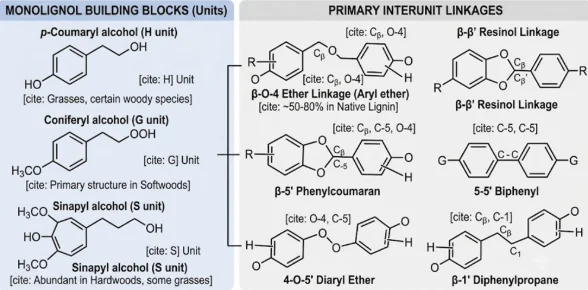
Fig. 2: Molecular structures of fundamental monolignol building blocks and primary interunit linkages.
5. Advanced Structural Characterization Techniques
Precise qualitative and quantitative characterization of lignin is essential for establishing structure-property-activity relationships.[18,37] Given lignin's structural complexity, modern analytical strategies rely on a complementary suite of high-resolution spectroscopic, chromatographic, and mass spectrometric methods.[18,19] Table 2 details the primary analytical methodologies, operational principles, key structural parameters resolved, and inherent analytical limitations. Although advanced analytical methodologies have substantially deepened our understanding of lignin chemistry, critical technical limitations hinder their routine application. State-of-the-art 2D HSQC NMR provides unambiguous interunit linkage quantification (β-O-4, β-β, β-5), yet it suffers from heavy signal overlapping in the aliphatic side-chain region and requires complete sample solubilization—an ongoing challenge for highly condensed technical lignins without harsh chemical derivatization (e.g., acetylation). Quantitative ³¹P NMR resolves aliphatic, phenolic, and carboxylic hydroxyl groups with precision (in mmol/g), but relies on moisture-sensitive phosphitylation reagents (e.g., 2-chloro-4,4,5,5-tetramethyl-1,3,2-dioxaphospholane, TMDP) that rapidly hydrolyze in trace water, leading to artifactual hydroxyl overestimation. Furthermore, the Size-Exclusion Chromatography (SEC/GPC) frequently overestimates molecular weight distributions (Mn, Mw) due to intermolecular aggregation via non-covalent π-π stacking in organic solvents, while Analytical Py-GC/MS yields incomplete quantification owing to secondary thermal cleavage reactions during flash pyrolysis. A combined multi-technique analytical protocol remains imperative to cross-validate linkage profiles and functional group quantities.
Table 2: Advanced analytical techniques for structural elucidation, functional group quantification, and macromolecular profiling of lignin [18,19,37,38]
| Analytical Technique | Operational Principle | Key Parameters Resolved | Advantages | Limitations |
|---|---|---|---|---|
| 2D ¹H-¹³C HSQC NMR | Heteronuclear single quantum coherence cross-polarization | Quantification of β-O-4, β-β, β-5 linkages; H:G:S ratios; S/G ratio | Definitive fingerprinting of linkage profiles and aromatic units | Requires complete sample dissolution; overlapping signal region |
| Quantitative ³¹P NMR | Phosphitylation of hydroxyl groups using TMDP followed by ³¹P NMR | Precise absolute quantification (mmol/g) of aliphatic, phenolic (H,G,S), and carboxylic –OH | Unmatched resolution of distinct hydroxyl functional environments | Derivatization step required; moisture-sensitive reagents |
| Py-GC/MS | Analytical flash pyrolysis coupled with gas chromatography-mass spectrometry | Phenolic monomer profiling, guaiacyl/syringyl cleavage products, origin verification | Rapid micro-scale analysis; no complex sample prep needed | Secondary pyrolytic reactions can alter quantitative fidelity |
| SEC / GPC | Size-exclusion chromatography with UV/MALLS/RI detection | Molecular weight distribution (Mn, Mw) and polydispersity index (PDI) | Essential for macromolecular size profiling and fractionation | Apparent Mw depends on calibration standards and solvent association |
| FTICR-MS | Fourier-transform ion cyclotron resonance mass spectrometry | Ultra-high resolution molecular formula assignment of depolymerized fractions | Resolves thousands of individual molecular species simultaneously | High instrument cost; complex ionization matrix effects |
| FTIR / Raman | Vibrational spectroscopy of functional bonds | Identification of aromatic ring vibrations, carbonyl, and hydroxyl stretch modes | Non-destructive, rapid qualitative monitoring | Low quantitative precision due to broad overlapping bands |
6. Commercial Extraction Processes and Technical Lignins
The chemical and physical properties of isolated 'technical lignins' are profoundly governed by the industrial extraction process.[8,10] Commercial pulping processes modify native lignin structures through ether linkage cleavage, variable condensation reactions, and incorporation of non-lignin elements (e.g., sulfur).[8,39] Table 3 presents a comparative critical analysis of major commercial and emerging isolation processes.
Table 3: Comparative evaluation of major technical lignin extraction processes [8,10,39,40]
| Process | Yield | Purity | Key Chemical Traits | Advantages | Technical Limitations |
|---|---|---|---|---|---|
| Kraft | High | Moderate | Contains sulfur; highly condensed; hydrophobic | Industrially established (global production); cheap feedstock supply | Odorous sulfur contamination; high structural heterogeneity; dark color |
| Organosolv | Moderate | High | Sulfur-free; low PDI; high reactive phenolic –OH | High chemical purity; preserved β-O-4 linkages; high reactivity | High organic solvent recovery costs; operational volatility; expensive |
| Sulfite / Lignosulfonate | High | Moderate | High sulfur (as sulfonate); water-soluble | Direct water solubility; strong surfactant/dispersing agent | High inorganic ash and sugar impurities; sulfur content limits refining |
| Soda | Moderate | High | Sulfur-free; carboxylic acid rich; moderate condensation | Sulfur-free stream; well-suited for non-woody & hardwood feeds | Lower recovery yields from softwoods; variable ash content |
The commercial adoption of technical lignins is heavily governed by the chemical trade-offs inherent to each pulping process. While Kraft and Sulfite processes dominate industrial volumes due to established infrastructure, sulfur incorporation drastically restricts high-value application in catalytic refining and biomedical nanomedicine. Conversely, sulfur-free processes such as Organosolv yield pristine, low-polydispersity fractions rich in reactive native ether linkages (β-O-4'), but their economic feasibility remains severely compromised by capital-intensive solvent recovery units and high operational expenses. Despite technical advancements in characterization, significant technological limitations persist. 2D HSQC NMR, while invaluable for linkage profiling, suffers from signal overlap in the side-chain region and requires complete dissolution in deuterated solvents — a condition rarely met by highly condensed technical lignins without prior derivatization. Similarly, quantitative ³¹P NMR relies on moisture-sensitive phosphitylation reagents that can hydrolyze, yielding inaccurate hydroxyl counts. On the extraction front, organosolv processes deliver high purity but are severely limited by high solvent volatility, solvent recovery energy demands, and equipment corrosion, which prevent widespread adoption over conventional, highly polluting kraft pulping.
7. Quantitative Industrial and Biological Bioactivities
Lignin's multi-functional phenolic framework underpins a broad range of biological and industrial bioactivities.[12,15] Rather than relying on qualitative descriptors, Table 4 and Table 5 provides explicit, peer-reviewed quantitative metrics evaluating antioxidant capacity, UV-shielding performance, antimicrobial inhibition, drug delivery encapsulation, and agricultural functional efficacy across specific lignin forms.
Table 4: Quantitative performance benchmarks of lignin formulations across industrial, biomedical, and agricultural bioactivities [13,15-17,41-46]
| Functional Category | Lignin Type / Formulation | Principal Mechanism | Quantitative Performance Metric | Representative Reference |
|---|---|---|---|---|
| Antioxidant Activity | Organosolv Lignin Fraction (Low Mw, high phenolic –OH) | Hydrogen atom transfer (HAT) & single electron transfer (SET) to radicals | DPPH scavenging IC50: 9.2–15.4 µg/mL; ABTS inhibition: >88% at 50 µg/mL | [15,41] |
| UV-Shielding / Photoprotection | Lignin Nanoparticles (LNPs) in PLLA / PVA films | Aromatic chromophore broad-spectrum absorption (UV-A & UV-B) | UV blocking: >98% at 2 wt% LNP loading; Film SPF rating: 15 to 45+ | [16,42] |
| Antimicrobial Activity | Fractionated Kraft Lignin & Copper-LNP composites | Cell membrane disruption, intracellular ROS generation, cell lysis | MIC vs S. aureus: 0.25–0.50 mg/mL; MIC vs E. coli: 0.50–1.00 mg/mL | [43,44] |
| Drug Delivery Carrier | Self-assembled Hollow LNPs (Targeted delivery) | Hydrophobic core encapsulation & pH-responsive aromatic pi-pi stacking | Paclitaxel Encapsulation Efficiency (EE): 82–94%; Drug Loading (DL): 12–18 wt% | [13,17] |
| Agricultural Applications | Lignosulfonate-coated Urea & Lignin Hydrogel Matrices | Slow diffusion barrier coating & high moisture retention chelating capacity | Nitrogen release delayed by 21–35 days; Soil moisture retention increased +32% | [45,46] |
Table 5: Quantitative performance metrics of technical lignins and lignin nanoparticles (LNPs) across functional activities
| Study / Lignin Type | Specific Formulation & Particle Size | Targeted Activity | Quantitative Metric & Baseline Value | Absorption Range / Load Efficacy |
|---|---|---|---|---|
| Kraft Lignin | Unfractionated powder | Antioxidant | DPPH radical inhibition | N/A |
| Organosolv Lignin | Low Mw fraction (LNPs) | Antioxidant | DPPH radical inhibition | N/A |
| Acetylated Kraft LNPs | Nano-spheres | UV-Shielding / Photoprotection | UV blocking; Film SPF rating | Absorbs across full UV-A & UV-B spectrum |
| Alkali / Soda LNPs | Hollow spheres | Targeted Drug Delivery | Encapsulation Efficiency (EE); Drug Loading (DL) | High hydrophobic drug entrapment (e.g., Paclitaxel, Aspirin) |
| Fractionated Kraft Lignin | Micro/Nano-colloids | Antimicrobial Activity | MIC (S. aureus); MIC (E. coli) | Cell lysis via intracellular ROS generation |
8. Critical Analysis, Challenges, and Future Perspectives
While several studies report strong antioxidant (DPPH IC50 <15 µg/mL) and antimicrobial efficacy for organosolv and kraft lignins, conflicting findings exist in the literature. For instance, antioxidant performance varies drastically depending on the solvent system used for extraction, as residual hydrogen-bonding solvents can mask phenolic –OH reactivity. Similarly, reported antimicrobial MIC values range broadly from 0.25 mg/mL to >10 mg/mL. This discrepancy stems from inconsistent bioassay protocols (e.g., dispersion methods, particle size variations, and bacterial strains used) rather than intrinsic chemical differences alone. A systematic standardization of radical and microbial assay conditions is required to resolve these literature contradictions.
7.1 Antioxidant and Free Radical Scavenging Mechanisms
The antioxidant activity of lignin is primarily mediated by its phenolic hydroxyl groups, which readily donate hydrogen atoms to neutralize free radicals, forming stable, resonance-stabilized phenoxy radical intermediates.[15,41] Quantitative evaluations using 2,2-diphenyl-1-picrylhydrazyl (DPPH) and 2,2'-azino-bis(3-ethylbenzothiazoline-6-sulfonic acid) (ABTS) assays demonstrate that low molecular weight, highly non-condensed organosolv lignin fractions exhibit superior DPPH IC50 values (9.2–15.4 µg/mL), performing comparably to commercial synthetic antioxidants like BHT (butylated hydroxytoluene).[41] Ortho-methoxyl substitution (characteristic of G and S units) further enhances radical scavenging capacity by stabilizing phenoxy radicals through electron donation and intramolecular hydrogen bonding.[15,40]
7.2 Antimicrobial Efficacy and Photoprotective UV-Shielding
Lignin-derived phenolic compounds exert potent antimicrobial action against Gram-positive (e.g., Staphylococcus aureus, Bacillus subtilis) and Gram-negative (e.g., Escherichia coli, Pseudomonas aeruginosa) pathogens.[43,44] Mechanisms include damaging bacterial cell membrane integrity, inducing intracellular oxidative stress, and lysing cell walls.[43] Minimum inhibitory concentrations (MIC) for organosolv and fractionated kraft lignins range from 0.25 to 1.00 mg/mL.[44] When incorporated as nanoparticles into active food packaging films (e.g., poly(lactic acid) or polyvinyl alcohol), lignin provides total UV-blocking (>98% UV-A and UV-B absorption) at low loadings (1–2 wt%), preventing photo-oxidation and extending food shelf life without compromising transparency.[16,42]
7.3 Agricultural Valorization: Controlled-Release & Soil Hydrogels
Agricultural applications represent one of the most immediate, economically viable, and scalable non-combustion pathways for technical lignins.[45,46]
Controlled-release fertilizers (CRFs): Lignosulfonates and modified kraft lignins serve as hydrophobic, biodegradable barrier coatings for granular urea and NPK fertilizers. Coated urea granules delay nitrogen dissolution by 21 to 35 days, reducing nitrate leaching into groundwater by up to and minimizing ammonia volatilization loss.[46]
Soil conditioners and superabsorbent hydrogels: Polymerized lignin matrices cross-linked with acrylic acid or vinyl monomers form superabsorbent hydrogel networks capable of increasing soil moisture retention by in arid sandy soils. These networks chelate essential micronutrients, protecting them from premature soil immobilization and enhancing root uptake efficiency.
Bio-based seed coatings: Formulations combining LNPs with plant growth-promoting rhizobacteria or biopesticides form protective seed films. These coatings shield seeds from soil-borne fungal pathogens via localized antimicrobial phenolic release while improving seedling germination rates under drought-induced oxidative stress.
8.1 Techno-Economic Feasibility and Biorefinery Scalability
Despite compelling laboratory-scale demonstrations, scaling technical lignin valorization to commercial operations faces severe techno-economic barriers.[7,8,47] High operational costs associated with organic solvent recovery in organosolv processes and complex purification steps currently limit economic viability.[8] Furthermore, batch-to-batch structural heterogeneity derived from seasonal biomass variations and pulping fluctuations poses severe quality control challenges for industrial polymer formulators.[7,48] Scalability remains the single greatest bottleneck transitioning laboratory successes to commercial supply chains. While self-assembly protocols yield uniform LNPs at milligram scales using anti-solvent precipitation, scaling these processes to multi-ton industrial outputs leads to batch-to-batch aggregation, poor size reproducibility, and high wastewater generation. Furthermore, feedstocks suffer from severe seasonal and geographic heterogeneity. Variations in S/G ratios across raw biomass batches alter depolymerization yields unpredictably, making continuous, automated industrial processing extremely difficult to standardize. From an economic perspective, replacing low value on-site thermal combustion (evaluated at ~$50–$80 per ton as boiler fuel) with high value biomaterial conversion (potentially >$1,000–$3,000 per ton) requires substantial capital expenditure. The primary cost drivers in lignin valorization are downstream purification, organic solvent recycling, and sulfur removal. Until biorefineries achieve high-yield, closed-loop solvent recovery systems (>98% efficiency), the capital pay-back period for technical lignin refining remains uncompetitive compared to fossil-based polymer manufacturing.
8.2 Life Cycle Assessment (LCA) and Carbon Footprint
While lignin is inherently bio-based, its environmental credentials must be verified through rigorous Life Cycle Assessment (LCA).[49,50] Diverting kraft lignin from pulp mill recovery boilers to materials manufacturing requires replacing its thermal energy with alternative fuel sources, which can offset net carbon savings if fossil energy is utilized.[49] Sustainable biorefineries must balance energy self-sufficiency with material recovery to achieve true net-zero carbon footprints.[50]
8.3 Regulatory and Translational Barriers in Biomedical Applications
While lignin nanoparticles (LNPs) demonstrate promising in vitro paclitaxel encapsulation efficiencies, high radical scavenging, and bioimaging fluorescence, assertions of immediate biomedical translation are significantly overstated. Currently, over of published biomedical lignin studies remain confined to in vitro cell assays or small-animal (rodent) models. Virtually no lignin-based nanomedicine has advanced to Phase I clinical trials or achieved commercial regulatory approval by the FDA or EMA.[17,51-54]
The path to clinical translation is blocked by severe fundamental barriers:
Polydispersity and heterogeneity: Regulatory agencies require strict batch-to-batch chemical reproducibility, which is inherently difficult for a natural, heterogenous polymer.[52-55]
Toxic impurities: Technical lignins contain residual sulfur, heavy metal catalysts, and organosolv residues that trigger immunogenic responses and cytotoxicity in vivo.[56]
Pharmacokinetics and accumulation: Long-term in vivo biodistribution, metabolic degradation, organ accumulation, and renal clearance rates for non-water-soluble LNPs remain largely unmapped.[57]
Claims of lignin's near-term viability in human targeted drug delivery, cancer therapy, or clinical diagnostics must be tempered by the necessity of multi-year, standardized toxicity and clearance evaluations. In biomedical applications, despite high paclitaxel encapsulation efficiencies (82–94%) observed in vitro, transition to clinical settings is heavily hindered by regulatory frameworks (e.g., FDA and EMA).[58,59] Technical lignins contain residual sulfur, heavy metals, and carbohydrate residues from extraction processes, which trigger immunogenic reactions in vivo. Regulatory bodies require precise structural definition and batch reproducibility for nanocarriers — criteria inherently incompatible with lignin's natural polydispersity and variable cross-linking. To clear regulatory barriers, long-term pharmacokinetics, biodistribution, long-term tissue accumulation, and standardized Good Manufacturing Practice (GMP) isolation protocols must be established.[60-62]
8.4 Standardization and Future Interdisciplinary Outlook
Unlocking the full potential of lignin demands global standardization of technical lignin grades alongside interdisciplinary collaboration joining plant genetics, analytical chemistry, bioprocess engineering, and materials science.[7,8,52] Metabolic engineering of woody crops (e.g., genetic tuning of S/G ratios or introduction of labile ester bonds via 'designer lignins') promises feedstocks optimized for effortless depolymerization.[27,53] Simultaneously, expanding machine learning models to predict depolymerization yields from 2D HSQC NMR spectra will accelerate commercial process optimization.[54,63,64]
9. Conclusion
Lignin-derived polyphenols represent an extraordinary, highly abundant renewable aromatic resource capable of driving the transition toward a sustainable bio-based economy. This review has provided a comprehensive, quantitative, and critical synthesis bridging woody plant taxonomy, phenylpropanoid biosynthesis, advanced analytical characterization (2D HSQC NMR, ³¹P NMR), and industrial process extraction. Quantitative bioactivity benchmarks clearly demonstrate lignin's high performance across antioxidant, antimicrobial, UV-protective, drug delivery, and agricultural domains. However, overcoming commercial scalability constraints, batch heterogeneity, environmental carbon trade-offs, and biomedical regulatory hurdles remains imperative. Through continued interdisciplinary innovation in green chemistry and metabolic engineering, technical lignins will undoubtedly emerge as indispensable precursors for next-generation biomaterials, active packaging, and sustainable chemical platforms.
Acknowledgement
The authors gratefully acknowledge the Forest College and Research Institute, Mettupalayam, and the Agricultural College and Research Institute, Tiruvannamalai, Tamil Nadu Agricultural University, for providing institutional support and access to scientific literature databases.
CRediT Author Contribution Statement
H. B. Roghan: Conceptualization, Data Curation, Formal Analysis, Investigation, Methodology, Visualization, Writing – Original draft, Writing – Review & editing. S. Vennila: Conceptualization, Methodology, Project Administration, Validation, Supervision, Writing – Review & editing. Both the authors have read and approved the final version of the manuscript for publication and agree to be accountable for all aspects of the work, ensuring that questions related to the accuracy or integrity of any part of the work are appropriately investigated and resolved.
Funding Declaration
This research did not receive any specific grant from funding agencies in the public, commercial, or not-for-profit sectors.
Data Availability Statement
Data sharing is not applicable to this article as no primary experimental datasets were generated or analyzed during the current review study. All analyzed secondary literature data and quantitative synthesis metrics are fully included within this published article.
Conflict of Interest
There is no conflict of interest.
Artificial Intelligence (AI) Use Disclosure
The authors declare that artificial intelligence (AI)-assisted tools were used only for language refinement, grammar improvement, and manuscript structuring purposes during the preparation of this work. All technical content, experimental implementation, results, and interpretations were independently developed and verified by the authors.
Supporting Information
Not applicable.
References
- [1] W. Boerjan, J. Ralph, M. Baucher, Lignin biosynthesis, Annual Review of Plant Biology, 2003, 54, 519–546, doi: 10.1146/annurev.arplant.54.031902.134938.
- [2] W. Vanholme, B. Demedts, K. Morreel, J. Ralph, W. Boerjan, Lignin biosynthesis and structure, Plant Physiology, 2010, 153, 895–905, doi: 10.1104/pp.110.155119.
- [3] L. A. Donaldson, Lignification and lignin topochemistry—an ultrastructural view, Phytochemistry, 2001, 57, 859–873, doi: 10.1016/S0031-9422(01)00049-8.
- [4] S. Posé, C. Paniagua, A. J. Matas, A. P. Gunning, V. J. Morris, M. A. Quesada, J. A. Mercado, A nanostructural view of the cell wall disassembly process during fruit ripening and postharvest storage by atomic force microscopy, Trends in Food Science & Technology, 2019, 87, 47–58, doi: 10.1016/j.tifs.2018.02.011.
- [5] J. Barros, H. Serk, I. Granlund, E. Pesquet, The cell biology of lignification in higher plants, Annals of Botany, 2015, 115, 1053–1074, doi: 10.1093/aob/mcv046.
- [6] J. Ralph, K. Lundquist, G. Brunow, F. Lu, H. Kim, P. F. Schatz, J. M. Marita, R. D. Hatfield, S. A. Ralph, J. H. Christensen, W. Boerjan, Lignins: Natural polymers from oxidative coupling of 4-hydroxyphenylpropanoids, Phytochemistry Reviews, 2004, 3, 29–60, doi: 10.1023/B:PHYT.0000047809.65444.a4.
- [7] B. M. Upton, A. M. Kasko, Strategies for the conversion of lignin to high-value polymeric materials: Review and perspective, Chemical Reviews, 2016, 116, 2275–2306, doi: 10.1021/acs.chemrev.5b00345.
- [8] W. Schutyser, T. Renders, S. Van den Bosch, S. F. Koelewijn, G. T. Beckham, B. F. Sels, Chemicals from lignin: An interplay of lignocellulose fractionation, depolymerisation, and upgrading, Chemical Society Reviews, 2018, 47, 852–908, doi: 10.1039/C7CS00566K.
- [9] A. J. Ragauskas, G. T. Beckham, M. J. Biddy, R. Chandra, F. Chen, M. F. Davis, B. H. Davison, R. A. Dixon, P. Gilna, M. Keller, P. Langan, Lignin valorization: Improving lignin processing in the biorefinery, Science, 2014, 344, 1246843, doi: 10.1126/science.1246843.
- [10] S. Constant, C. S. Barta, O. V. Kikhtyanin, K. Drijkoningen, Comparison of five technical lignins: A structure-reactivity study, Green Chemistry, 2016, 18, 2651–2665, doi: 10.1039/C5GC03043A.
- [11] Z. Sun, B. Fridrich, A. de Santi, Bright side of lignin depolymerization: Toward platform chemicals, Chemical Reviews, 2018, 118, 614–678, doi: 10.1021/acs.chemrev.7b00588.
- [12] D. Kai, M. J. Tan, P. L. Chee, Y. K. Chua, Y. L. Yap, X. J. Loh, Towards lignin-based functional materials in a sustainable world, Green Chemistry, 2016, 18, 1175–1200, doi: 10.1039/C5GC02616D.
- [13] R. Kumar, A. Butreddy, N. Kommineni, P. G. Reddy, N. Bunekar, C. Sarkar, S. Dutt, V. K. Mishra, K. R. Aadil, Y. K. Mishra, D. Oupicky, Lignin: drug/gene delivery and tissue engineering applications, International Journal of Nanomedicine, 2021, 2419–2441, doi: 10.2147/IJN.S303462.
- [14] Y. Zhao, M. Abid, X. Xie, Y. Fu, Y. Huang, Z. Cai, H. Lin, Harnessing unconventional monomers to tailor lignin structures for lignocellulosic biomass valorization, Forestry Research, 2024, 4, e004, doi: 10.48130/forres-0024-0001.
- [15] T. Dizhbite, G. Telysheva, S. Viviers, A. Viksna, L. Paegle, Lignin—A valuable source of phenolic antioxidants, Journal of Agricultural and Food Chemistry, 2004, 52, 1801–1808.
- [16] W. Yang, E. Fortunati, F. Dominici, G. Giovanale, A. Mazzaglia, G. M. Balestra, J. M. Kenny, D. Puglia, Effect of cellulose and lignin on disintegration, antimicrobial and antioxidant properties of PLA active films, International Journal of Biological Macromolecules, 2016, 89, 360–368, doi: 10.1016/j.ijbiomac.2016.04.068.
- [17] R. Liu, L. Dai, C. Xu, K. Wang, C. Zheng, C. Si, Lignin-based micro- and nanomaterials and their composites in biomedical applications, ChemSusChem, 2020, 13, 4266–4283, doi: 10.1002/cssc.202000783.
- [18] C. G. Yoo, X. Meng, Y. Pu, A. J. Ragauskas, The critical role of advanced characterization techniques in lignin valorization, Green Chemistry, 2020, 22, 3993–4019.
- [19] C. Crestini, F. Melone, M. Sette, D. S. Argyropoulos, The structural heterogeneity of lignin: A quantitative NMR study, Biomacromolecules, 2011, 12, 3928–3938.
- [20] M. J. Page, J. E. McKenzie, P. M. Bossuyt, I. Boutron, T. C. Hoffmann, C. D. Mulrow, L. Shamseer, J. M. Tetzlaff, E. A. Akl, S. E. Brennan, R. Chou, The PRISMA 2020 statement: an updated guideline for reporting systematic reviews, BMJ, 2021, 372, doi: 10.1136/bmj.n71.
- [21] R. A. Dixon, J. Barros, Lignin biosynthesis: Old roads revisited and new avenues explored, New Phytologist, 2019, 223, 1086–1092, doi: 10.1111/nph.15743.
- [22] Q. Zhao, R. A. Dixon, Transcriptional networks for lignin biosynthesis: More complex than we thought?, Trends in Plant Science, 2011, 16, 227–233, doi: 10.1016/j.tplants.2010.12.005.
- [23] A. Wagner, J. Ralph, T. Akiyama, H. Kitano, Exploring monolignol biosynthesis in gymnosperms, Proceedings of the National Academy of Sciences of the United States of America, 2007, 104, 14256–14261, doi: 10.1073/pnas.0706338104.
- [24] M. Li, Y. Pu, A. J. Ragauskas, Current advancements including genomics and metabolic engineering for optimizing lignin structure and utilization, Current Opinion in Biotechnology, 2019, 56, 205–212.
- [25] J. K. Weng, C. Chapple, The origin and evolution of lignin biosynthesis, New Phytologist, 2010, 187, 273–285, doi: 10.1111/j.1469-8137.2010.03327.x.
- [26] J. J. Stewart, T. Akiyama, C. Chapple, J. Ralph, S. D. Mansfield, The effect of altering the S/G ratio in poplar wood lignification, Plant Physiology, 2009, 150, 621–635.
- [27] Y. Mottiar, R. Vanholme, W. Boerjan, J. Ralph, S. D. Mansfield, Designer lignins: Harnessing the plasticity of lignification, Current Opinion in Biotechnology, 2016, 37, 190–200, doi: 10.1016/j.copbio.2015.10.009.
- [28] Y. Tobimatsu, M. Schuetz, Lignin polymerization: How do plants manage the radical reaction?, Current Opinion in Plant Biology, 2019, 48, 85–93, doi: 10.1016/j.copbio.2018.10.001.
- [29] M. J. Meents, Y. Watanabe, A. L. Samuels, The cell biology of secondary cell wall biosynthesis, Annals of Botany, 2018, 121, 1107–1125, doi: 10.1093/aob/mcy005.
- [30] R. Hatfield, W. Vermerris, Lignin formation in plants. The dilemma of linkage specificity, Plant Physiology, 2001, 126, 1351–1357, doi: 10.1104/pp.126.4.1351.
- [31] K. Morreel, J. Ralph, H. Kim, F. Lu, G. Goeminne, S. A. Ralph, W. Boerjan, Profiling of oligolignols reveals pathways for lignin formation, Plant Physiology, 2004, 136, 3537–3549, doi: 10.1104/pp.104.049304.
- [32] R. B. Santos, E. A. Capanema, M. Y. Balakshin, H. Jameel, Effect of hardwoods characteristics on kraft pulping process: emphasis on lignin structure, BioResources, 2011, 6, 3623.
- [33] C. S. Lancefield, O. S. Ojo, F. Tran, N. J. Westwood, Isolation of functionalized phenolic monomers through the catalytic depolymerization of lignin, Angewandte Chemie International Edition, 2015, 54, 258–262, doi: 10.1002/anie.201409408.
- [34] V. Ugartondo, M. Mitjans, M. P. Vinardell, Applicability of lignins from different sources as antioxidants based on the protective effects on lipid peroxidation induced by oxygen radicals, Industrial Crops and Products, 2009, 30, 184–187, doi: 10.1016/j.indcrop.2009.03.001.
- [35] J. Ralph, Hydroxycinnamates in lignification, Phytochemical Reviews, 2010, 9, 65–83, doi: 10.1007/s11101-009-9141-9.
- [36] A. D. Roy, R. Kumar, P. Gupta, T. Khaliq, T. Narender, V. Aggarwal, R. Roy, Xyloccensin X and Y, two new limonoids from xylocarpus molluccensis: NMR investigation in mixture, Magnetic Resonance in Chemistry, 2006, 44, 1054–1057, doi: 10.1002/mrc.1887.
- [37] M. K. Islam, J. Ratthiwal, S. Kongparakul, C. Samart, Advances in oxidative fractionation and depolymerization for sustainable lignin valorization, Molecular Catalysis, 2025, 586, 115436, doi: 10.1016/j.mcat.2025.115436.
- [38] D. Humpert, M. Ebrahimi, P. Czermak, Membrane technology for the recovery of lignin: A review, Membranes, 2016, 6, 42, doi: 10.3390/membranes6030042.
- [39] H. Sadeghifar, D. S. Argyropoulos, Correlations of the antioxidant properties of softwood kraft lignin fractions with their molecular weight and phenolic hydroxyl content, ACS Sustainable Chemistry & Engineering, 2015, 3, 349–358, doi: 10.1021/sc500756n.
- [40] X. Pan, J. F. Kadla, K. Ehara, S. Saka, Organosolv ethanol lignin from hybrid poplar as a radical scavenger, Journal of Agricultural and Food Chemistry, 2006, 54, 5806–5813, doi: 10.1021/ie3011043.
- [41] Y. Qian, X. Qiu, X. Zhong, D. Zhang, Y. Deng, D. Yang, S. Zhu, Lignin Reverse Micelles for UV-Absorbing and High Mechanical Performance Thermoplastics, Industrial & Engineering Chemistry Research, 2015, 54, 12025–12030, doi: 10.1021/ie3011043.
- [42] S. Sholahuddin, D. Y. Arinawati, V. K. Nathan, C. Asada, Y. Nakamura, Antioxidant and antimicrobial activities of lignin-derived products from all steam-exploded palm oil mill lignocellulosic biomass waste, Chemical and Biological Technologies in Agriculture, 2024, 11, 5, doi: 10.1186/s40538-023-00529-x.
- [43] S. You, Y. Xie, X. Zhuang, H. Chen, Y. Qin, J. Cao, T. Lan, Effect of high antioxidant activity on bacteriostasis of lignin from sugarcane bagasse, Biochemical Engineering Journal, 2022, 180, 108335, doi: 10.1016/j.bej.2022.108335.
- [44] J. Behin, N. Sadeghi, Utilization of waste lignin to prepare controlled-slow-release urea, International Journal of Recycling of Organic Waste in Agriculture, 2016, 5, 289–299, doi: 10.1007/s40093-016-0139-1.
- [45] A. Verma, P. Devi, S. Bhogal, R. Jasrotia, V. K. Thakur, Lignin-Based Hydrogels for Sustainable Agriculture: Extraction, Design, and Applications, ACS Environmental Au, 2026, 6, 375, doi: 10.1021/acsenvironau.5c00203.
- [46] E. J. Beckman, Green chemical engineering and lignin valorization: Current status and future prospects, Industrial & Engineering Chemistry Research, 2022, 61, 3801–3815.
- [47] R. Rinaldi, R. Jastrzebski, M. T. Clough, Paving the way for lignin valorisation: Recent advances in bio-refining, Angewandte Chemie International Edition, 2016, 55, 8164–8115.
- [48] C. Culbertson, F. Hermansson, Life cycle assessment of technical lignin valorization pathways: Thermal vs material utilization, Bioresource Technology, 2021, 335, 125270, doi: 10.1016/j.biortech.2021.125270.
- [49] B. Corona, L. Shen, D. Reiner, Environmental sustainability assessment of biorefinery lignin valorization products, Renewable and Sustainable Energy Reviews, 2018, 82, 2231–2241, doi: 10.1016/j.rser.2017.08.034.
- [50] N. Feng, X. Zhao, J. Hu, F. Tang, S. Liang, Q. Wu, C. Zhang, Recent advance in preparation of lignin nanoparticles and their medical applications: A review, Phytomedicine, 2024, 130, 155711, doi: 10.1016/j.phymed.2024.155711.
- [51] I. Ullah, Z. Chen, Y. Xie, S. S. Khan, S. Singh, C. Yu, G. Cheng, Recent advances in biological activities of lignin and emerging biomedical applications: A short review, International Journal of Biological Macromolecules, 2022, 208, 819–832, doi: 10.1016/j.ijbiomac.2022.03.182.
- [52] D. A. Ali, M. M. Mehanna, Role of lignin-based nanoparticles in anticancer drug delivery and bioimaging: An up-to-date review, International Journal of Biological Macromolecules, 2022, 221, 934–953, doi: 10.1016/j.ijbiomac.2022.09.045.
- [53] R. Liu, L. Dai, C. Xu, K. Wang, C. Zheng, C. Si, Lignin-based micro- and nanomaterials and their composites in biomedical applications, ChemSusChem, 2020, 13, 4266–4283.
- [54] A. Gilca, V. I. Popa, C. Crestini, Obtaining lignin nanoparticles by sonication, Ultrasonics Sonochemistry, 2015, 23, 369–375.
- [55] M. Lievonen, J. J. Valle-Delgado, M. L. Mattinen, A simple route to produce micro- and nanoparticles from kraft lignin, Journal of Colloid and Interface Science, 2016, 469, 341–349, doi: 10.1016/j.jcis.2016.02.012.
- [56] F. Zikeli, V. Vinciguerra, A. D'Annibale, Preparation and characterization of lignin nanoparticles for biomedical applications, Nanomaterials, 2020, 10, 1385, doi: 10.3390/nano10071385.
- [57] Q. Lu, X. Liu, C. Dong, Antioxidant activity of technical lignins extracted from agricultural residues, BioResources, 2021, 16, 2411–2425, doi: 10.15376/biores.16.2.2411-2425.
- [58] T. Demura, Z. H. Ye, Regulation of plant biomass biosynthesis, Current Opinion in Plant Biology, 2010, 13, 299–303.
- [59] F. Lu, J. Ralph, Detection and determination of p-coumaroylated units in lignins, Journal of Agricultural and Food Chemistry, 1999, 47, 1988–1992, doi: 10.1021/jf981140j.
- [60] H. Kim, J. Ralph, Solution-state 2D NMR of ball-milled plant cell wall gels in DMSO-d6/pyridine-d5, Organic & Biomolecular Chemistry, 2010, 8, 576–591, doi: 10.1039/B915298H.
- [61] J. C. Del Río, J. Rencoret, P. Prinsen, Á. T. Martínez, J. Ralph, A. Gutiérrez, Structural characterization of wheat straw lignin as revealed by analytical pyrolysis, 2D-NMR, and reductive cleavage methods, Journal of Agricultural and Food Chemistry, 2012, 60, 5922–5935, doi: 10.1021/jf301002n.
- [62] E. A. Capanema, M. Y. Balakshin, J. F. Kadla, Quantitative characterization of a hardwood milled wood lignin by nuclear magnetic resonance spectroscopy, Journal of Agricultural and Food Chemistry, 2005, 53, 9639–9649, doi: 10.1021/jf0515330.
- [63] T. Akiyama, T. Sugimoto, Y. Matsumoto, G. Meshitsuka, Erythro/threo ratio of β-O-4 structures as an important structural characteristic of lignin. I: Improvement of ozonation method for the quantitative analysis of lignin side-chain structure, Journal of Wood Science, 2002, 48, 210–215, doi: 10.1007/BF00771369.
- [64] H. Grabber, How do lignin composition, structure, and cross-linking affect degradability?, Crop Science, 2005, 45, 2–13, doi: 10.2135/cropsci2004.0191.
Publisher Note
The views, statements, and data in all publications solely belong to the authors and contributors. GR Scholastic is not responsible for any injury resulting from the ideas, methods, or products mentioned. GR Scholastic remains neutral regarding jurisdictional claims in published maps and institutional affiliations.
Open Access
This article is licensed under a Creative Commons Attribution-Non-Commercial 4.0 International License, which permits the non-commercial use, sharing, adaptation, distribution and reproduction in any medium or format, as long as appropriate credit to the original author(s) and the source is given by providing a link to the Creative Commons License and changes need to be indicated if there are any. The images or other third-party material in this article are included in the article's Creative Commons License, unless indicated otherwise in a credit line to the material. If material is not included in the article's Creative Commons License and your intended use is not permitted by statutory regulation or exceeds the permitted use, you will need to obtain permission directly from the copyright holder. To view a copy of this License, visit: https://creativecommons.org/licenses/by-nc/4.0/
© The Author(s) 2026