

 Open Access||Research Article
Implementation and Performance Evaluation of a Wi-SUN FAN for Large-Scale Outdoor IoT Applications
Mohammed Adil Sayyed , Samana Jafri, Shamma Shaheen Shaikh, Fatima Shakeel Sayed
Department of Computer Science and Engineering (Internet of Things and Cyber Security including Blockchain Technology), M. H. Saboo Siddik College of Engineering, Byculla, Maharashtra, 400008, India
Abstract
The increasing demand for dependable, scalable and secure communication in large-scale outdoor Internet of Things (IoT) deployments has highlighted the limitations of traditional wireless communication protocols such as Wi-Fi, Zigbee, and Bluetooth. These protocols mostly suffer from limited communication range, poor scalability and unreliable connectivity in outdoor and industrial environments. The Wireless Smart Utility Network (Wi-SUN) Field Area Network (FAN) has emerged as a robust solution for such applications due to its IPv6 based mesh networking and long-range Sub-GHz communication because of its self-healing topology and enterprise grade security. This paper presents the design, implementation, and experimental validation of a Wi-SUN FAN network using a Raspberry Pi Compute Module 4 (CM4) based Border Router/Gateway and an EFR32FG28A122F1024GM48 Wi-SUN leaf node developed on a custom printed circuit board. The implemented system runs in the Indian Sub-GHz frequency band and uses mesh networking principles for reliable data transmission. The network was confirmed through successful node authentication, IPv6 address assignment and data transmission to the dashboard. To evaluate the practical applicability of Wi-SUN FAN, three real-world IoT use cases were implemented and analyzed. First, crop health monitoring through compressed image transmission, second smart streetlight monitoring through energy and status reporting and third is industrial equipment monitoring through vibration, temperature, and acoustic sensing. Experimental results confirm successful network formation, secure communication, and reliable end-to-end data transmission. The implementation shows that Wi-SUN FAN provides a scalable, secure and energy efficient communication framework suitable for large-scale outdoor IoT deployments. The results confirm Wi-SUN as a promising communication technology for next generation smart agriculture, smart city, and industrial IoT demanding reliable long range wireless mesh networking.
Keywords
Graphical Abstract
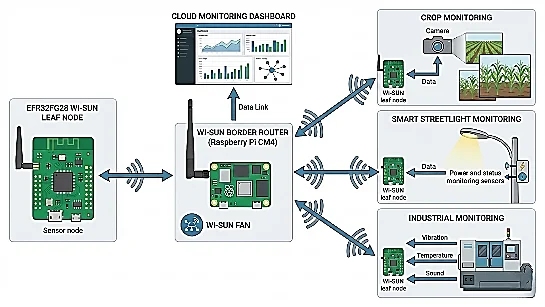
Novelty Statement
This work presents a complete end-to-end hardware implementation and experimental validation of a Wi-SUN FAN network using a Raspberry Pi Compute Module 4 (CM4) Border Router and a custom EFR32FG28-based leaf node operating in the Indian Sub-GHz frequency band.
1. Introduction
1. Introduction
The rapid evolution of the Internet of Things (IoT) has enabled large-scale deployment of interconnected devices across domains such as smart agriculture, smart cities, industrial automation, and utility infrastructure. These requirements need reliable, scalable and energy efficient wireless communication technologies capable of supporting geographically distributed sensor nodes and centralized monitoring systems. While conventional short range wireless technologies exist, large-scale outdoor IoT networks demand long-range communication, interoperability, and secure connectivity frameworks. [1, 2]
Wi-SUN (Wireless Smart Utility Network) has emerged as a standardized solution specifically designed to address the large-scale outdoor IoT communication challenges. [1–3] The Wi-SUN Field Area Network (FAN) architecture is built upon IEEE 802.15.4 standards for low-rate wireless communication [4] and further extended through standardized Wi-SUN specifications defined in IEEE Std 2857-2021. [5] These standards define PHY, MAC, and network-layer behaviours that enable scalable and interoperable mesh network.
Traditional wireless technologies operating in 2.4 GHz bands often face challenges including limited range and susceptibility to interference by obstacles and restricted scalability in outdoor deployments. In contrast, Wi-SUN operates in Sub-GHz frequency bands, offering improved propagation characteristics, reduced path loss and enhanced coverage in urban and rural environments. [6, 7] The use of IEEE 802.15.4g PHY further enhances long-range communication reliability. [4, 6] A defining feature of Wi-SUN is its use of IPv6-based networking through 6LoWPAN adaptation and the Routing Protocol for Low Power and Lossy Networks (RPL). [8] RPL enables multi-hop routing by forming a Destination-Oriented Directed Acyclic Graph (DODAG), allowing nodes to dynamically select optimal routes based on link metrics. [8]
The Wi-SUN FAN specification defines a hierarchical network model consisting of Border Routers, Router Nodes, and Leaf Nodes. [2, 5] The Border Router acts as the gateway between the mesh network and external IP networks, enabling end-to-end IPv6 connectivity. [8] Security is a critical component: the protocol incorporates certificate-based authentication, secure key exchange mechanisms, and AES-based encryption to ensure confidentiality and integrity of transmitted data. [2, 5, 12] Despite increasing standardization, practical implementation studies demonstrating real hardware deployment remain relatively limited. [11, 15] To address this gap, this paper presents the design, implementation, and experimental validation of a Wi-SUN FAN network using a Raspberry Pi Compute Module 4 (CM4)-based Border Router and a custom EFR32FG28-based leaf node, validated across three practical IoT use cases.
1.1 Comparative Analysis of Outdoor IoT Communication Technologies
Table 1 compares Wi-SUN FAN with other widely used outdoor IoT communication technologies. While LoRaWAN provides excellent range, it relies on a star topology and does not inherently support mesh networking. Zigbee supports mesh communication but offers a significantly shorter range. NB-IoT benefits from cellular infrastructure but depends on licensed spectrum. Wi-Fi HaLow provides higher data rates but generally consumes more power. Wi-SUN FAN combines long-range Sub-GHz communication, native IPv6 support, secure authentication, and self-healing mesh networking, making it suitable for large-scale outdoor IoT deployments.
Table 1: Comparison of Wi-SUN FAN with alternative outdoor IoT communication technologies.
| Technology | Operating Band | Range | Data Rate | Mesh Networking | IPv6 Support | Typical Applications |
|---|---|---|---|---|---|---|
| Wi-SUN FAN | Sub-GHz | Several km | Medium | Yes | Native | Smart grid, Smart city, Industrial IoT |
| LoRaWAN | Sub-GHz | Up to 15 km | Low | No | Limited | Agriculture, Environmental monitoring |
| Zigbee | 2.4 GHz | Up to 100 m | Medium | Yes | Limited | Home automation |
| NB-IoT | Licensed cellular | Up to 35 km | Medium | No | Yes | Smart metering |
| Wi-Fi HaLow | Sub-GHz | Up to 1 km | High | Limited | Yes | Industrial IoT |
1.2 Comparison with Existing Wi-SUN Studies
Table 2 compares the proposed work with representative Wi-SUN studies. While previous studies primarily focused on protocol analysis, network formation behaviour, and routing performance evaluation, the present work emphasizes practical hardware implementation, cloud integration, and multi-use-case validation.
Table 2: Comparison of the proposed work with existing Wi-SUN studies.
| Reference | Focus Area | Real Hardware | Cloud Integration | Multi-Use Case Validation |
|---|---|---|---|---|
| Thidarut et al. [9] | Multi-hop performance | Limited | No | No |
| Hirakawa et al. [11] | Specification analysis | No | No | No |
| Quispe et al. [15] | Network formation analysis | No | No | No |
| Proposed work | Practical Wi-SUN deployment | Yes | Yes | Yes |
2. Methodology
2. Methodology
The proposed section describes the hardware implementation, network architecture, software configuration and communication method used to implement and confirm the Wi-SUN FAN. The system consists of a Raspberry Pi Compute Module 4 (CM4) and nano base board Border Router/Gateway and a custom designed PCB with Wi-SUN leaf node using the EFR32FG28 wireless SoC. The network runs in the Sub-GHz frequency band distributed for India and uses IPv6 based mesh networking for secure and reliable communication.
2.1 Wi-SUN Network Architecture
The implemented Wi-SUN FAN network follows a hierarchical architecture consisting of a Border Router and a leaf node, as shown in Fig. 1. The Border Router acts as the root of the mesh network and provides connectivity between the Wi-SUN network and the cloud monitoring dashboard. The leaf node operates as a sensing and data transmission device that collects application specific data and transmits it to the Border Router using Wi-SUN mesh communication. Wi-SUN uses IPv6 based communication and RPL to enable efficient routing and scalable communication across the network. [7, 15]
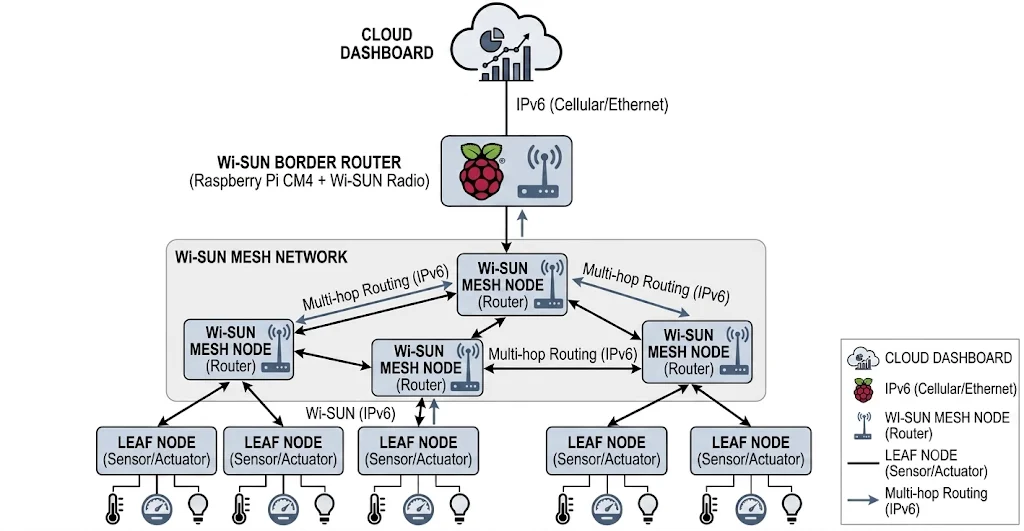
Fig. 1: Overall Wi-SUN FAN network architecture illustrating communication between the leaf node, Border Router, and cloud dashboard.
2.2 Border Router Hardware Implementation
The Border Router was implemented using a Raspberry Pi Compute Module 4 (CM4), which serves as the central processing unit for network management and routing, as illustrated in Fig. 2. The CM4 is mounted on a Nano Base Board, which provides power regulation, communication interfaces, and connectivity support. A custom designed Wi-SUN radio PCB is mounted on top of the baseboard offering wireless communication capability using a Sub-GHz Wi-SUN radio module and external antenna. The Wi-SUN radio module communicates with the Raspberry Pi CM4 using UART serial communication. The Border Router hardware performs the following functions: (1) Wi-SUN network formation and management, (2) node authentication and IPv6 address assignment, (3) routing and packet forwarding, and (4) communication with the cloud dashboard.
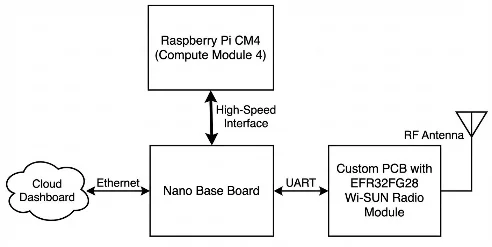
Fig. 2: Border Router hardware architecture showing communication between the Raspberry Pi CM4, Wi-SUN radio module, and gateway interface.
2.3 Leaf Node Hardware Implementation
As shown in Fig. 3, the leaf node was implemented using the EFR32FG28A122F1024GM48 wireless System on Chip (SoC), specifically designed for Sub-GHz wireless communication and Wi-SUN mesh networking. The SoC was mounted on a custom designed printed circuit board (PCB) that provides power supply, antenna interface, and GPIO connections for sensor integration. The leaf node hardware includes: (1) EFR32FG28 Wi-SUN radio SoC, (2) custom PCB with antenna, (3) J-Link debugger for device programming and debugging, and (4) sensor interfaces through GPIO.
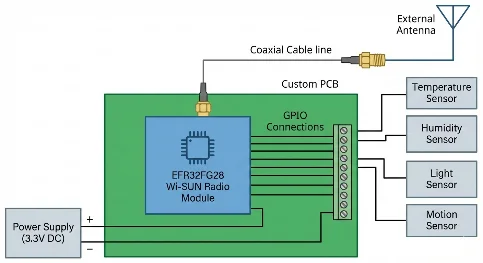
Fig. 3: Leaf node hardware architecture based on the EFR32FG28 Wi-SUN SoC with sensor interfacing through GPIO.
2.4 Wi-SUN Network Join Procedure
The Wi-SUN network join process enables secure authentication and configuration of nodes. When powered on, the leaf node scans available channels to discover the Border Router. Once detected, the node initiates an authentication process and obtains network configuration parameters including IPv6 address and routing information in accordance with Wi-SUN FAN specifications. [3, 4, 12] The join procedure consists of: (1) network discovery, (2) authentication with Border Router, (3) IPv6 address assignment, (4) routing configuration, and (5) transition to operational state, as illustrated in Fig. 4.
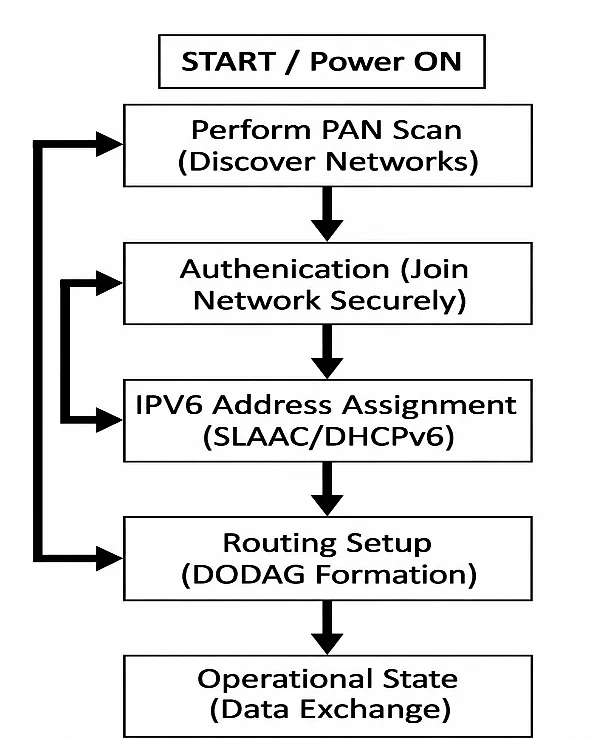
Fig. 4: Wi-SUN FAN network join procedure including discovery, authentication, IPv6 configuration, and operational state transition.
2.5 Communication Interface and Data Transmission
The leaf node transmits application data to the Border Router using Wi-SUN mesh networking. The Border Router receives the data and forwards it to the cloud dashboard for monitoring and analysis. The transmission delay can be expressed as:
where Tdelay = total transmission delay, Ttx = transmission time, Tprop = propagation delay, and Tproc = processing delay. The data throughput is given by:
where Throughput is the rate of successful data transmission (bps), Data size is the total transmitted data (bits), and Transmission time is the total time taken (seconds).
2.6 Software Configuration and Network Initialization
The software configuration was performed using Silicon Labs Simplicity Studio 5. The leaf node firmware was developed using the Wi-SUN FAN stack provided by Silicon Labs and deployed on the EFR32FG28 wireless SoC, including network initialization routines, authentication procedures and periodic data transmission functionality. The Border Router was implemented using Raspberry Pi OS and accessed remotely via SSH through PuTTY. The periodic transmission is represented as:
where Tperiodic = total operational time, Tinterval = transmission interval, and n = number of transmission cycles. The Border Router receives incoming data packets and forwards them to the cloud monitoring dashboard using IP-based communication, enabling real-time monitoring and data visualization.
2.7 Multi-Use Case Data Flow
2.7 Multi-Use Case Data Flow Architecture and System Operation
The implemented Wi-SUN network was designed to support multiple IoT applications. The architecture allows efficient transmission of sensor data and image data from the leaf node to the Border Router and cloud monitoring system, as shown in Fig. 5. The three supported use cases are: (1) crop health monitoring, (2) smart streetlight monitoring, and (3) industrial equipment monitoring.
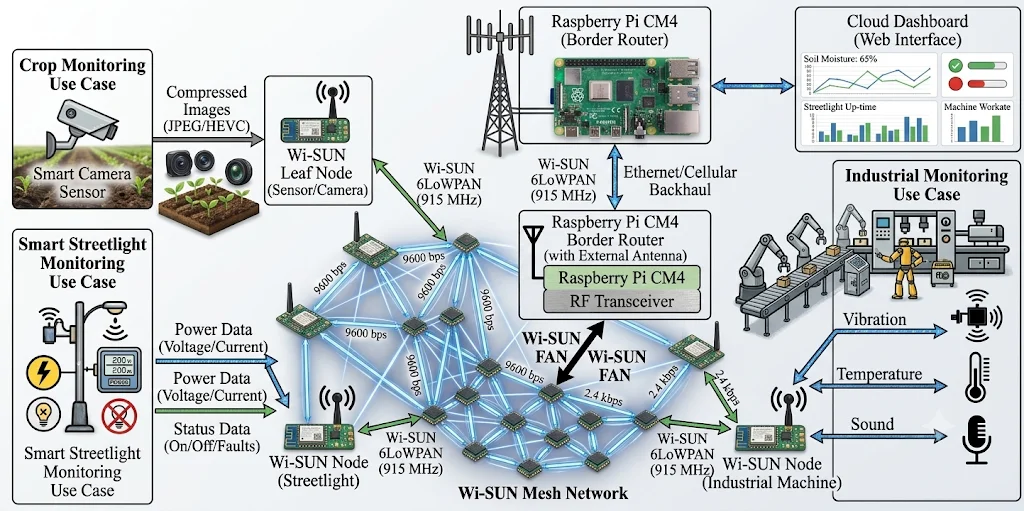
Fig. 5: Multi-use-case data flow architecture for crop monitoring, smart streetlight monitoring, and industrial equipment monitoring.
2.7.1 Crop Health Monitoring Data Flow
In the crop monitoring use case, image data is captured and compressed before transmission to reduce bandwidth requirements. The data transmission process follows: Sensor data acquisition → Data compression → Wi-SUN transmission → Border Router reception → Cloud dashboard visualization, as shown in Figs. 6 and 7. The image transmission time can be calculated using:
where Timage = image transmission time, Image size = size of compressed image, and Data rate = transmission data rate. This allows efficient image transmission even in low bandwidth wireless environments.
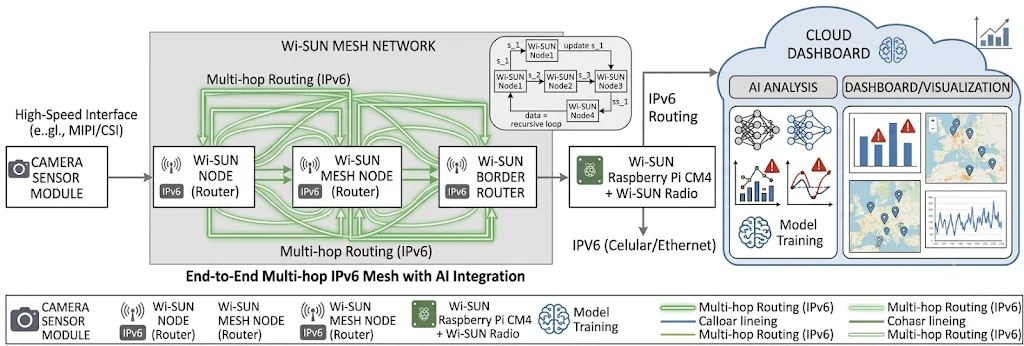
Fig. 6: System architecture of the crop health monitoring application.

Fig. 7: Data flow of the crop health monitoring system using Wi-SUN communication.
2.7.2 Smart Streetlight Monitoring Data Flow
In the smart streetlight monitoring use case, the leaf node transmits operational parameters including power consumption, operational status and health condition of streetlights, enabling remote monitoring and control. The monitoring efficiency can be expressed as:
where Efficiency is a dimensionless ratio (0 to 1), Successful Transmissions is the number of packets correctly received without loss or corruption, and Total Transmissions is the total packets sent by the leaf node. The data flow is shown in Fig. 8.
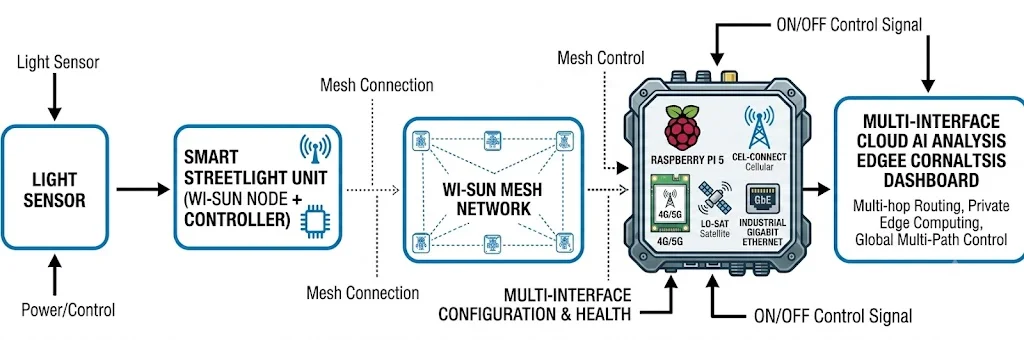
Fig. 8: Data flow of the smart streetlight monitoring system.
2.7.3 Industrial Equipment Monitoring Data Flow
In the industrial monitoring use case, the leaf node collects machine health parameters including vibration, temperature, and sound levels (dB), as shown in Fig. 9. These parameters are critical for predictive maintenance and early fault detection. The reliability of data transmission is given by:
where R = reliability and Ploss = packet loss probability. High reliability ensures accurate monitoring and timely detection of system faults.
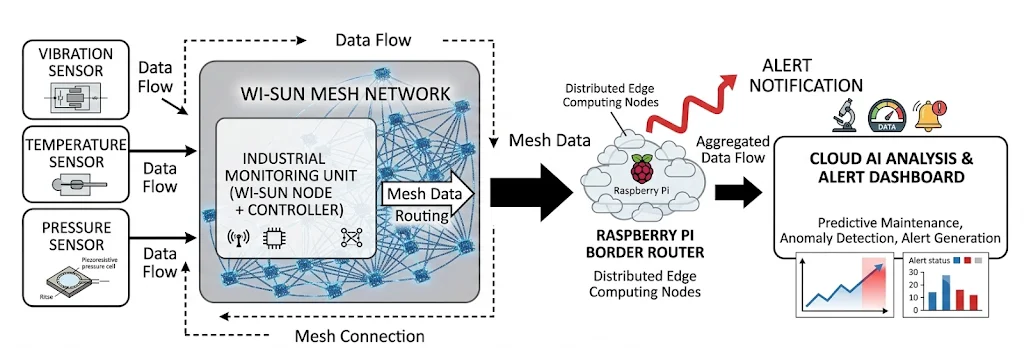
Fig. 9: Data flow of the industrial equipment monitoring system using Wi-SUN FAN communication.
2.7.4 Unified System Communication Flow
The overall system communication flow can be represented as:
This function represents the successful transfer of data from the leaf node to the cloud dashboard through the Wi-SUN network and Border Router. The implemented architecture successfully demonstrated secure and reliable communication across all three use cases, validating the capability of Wi-SUN FAN for supporting diverse IoT applications.
3. Results and Analysis
3. Results and Analysis
3.1 Network Formation and Join Validation
The implemented Wi-SUN FAN topology is illustrated in Fig. 1, where the Raspberry Pi CM4 operates as the Border Router and the EFR32FG28 based device functions as the leaf node (Figs. 2 and 3). As shown in Fig. 4, the node performs PAN discovery, authentication, IPv6 configuration, routing setup, and transitions into the operational state. During experimental validation, the following sequence was observed: (1) successful PAN advertisement detection, (2) secure authentication handshake, (3) key exchange completion, (4) IPv6 address assignment, (5) RPL routing initialization, and (6) operational state confirmation. The validation parameters are summarized in Table 3.
Table 3: Network formation and join validation results.
| Parameter | Observation | Status |
|---|---|---|
| Network discovery | Border router detected | Successful |
| Authentication | Completed without error | Successful |
| Security key exchange | Completed | Successful |
| IPv6 address allocation | Global address assigned | Successful |
| RPL routing initialization | Initialized | Successful |
| Operational state | Achieved | Successful |
All network initialization steps were successfully completed, confirming proper implementation of the Wi-SUN FAN protocol stack and the self-forming capability of the Wi-SUN mesh architecture.
3.2 IPv6 Connectivity Verification and Routing Validation
Following successful authentication, the leaf node was assigned a unique global IPv6 address by the Border Router, confirming correct implementation of the 6LoWPAN adaptation layer and RPL routing infrastructure. [7, 15, 17] The routing rank of the leaf node can be modelled as:
where Ranknode = routing rank of the leaf node, Rankparent = routing rank of the preferred parent (the Border Router), and ETX (Expected Transmission Count) = estimated transmissions required to successfully deliver a packet (ETX ≈ 1 indicates a high-quality link). Since the experimental setup consisted of a single-hop configuration, the ETX value was minimal and the routing rank remained stable. Successful packet reception at the Border Router validates proper IPv6 header compression, functional RPL routing, IP-level interoperability, and cloud integration capability.
3.3 Application-Level Data Transmission Results
Application-level validation was performed using three IoT use cases. As shown in Fig. 5, the unified data flow architecture shows the Wi-SUN leaf node transmitting heterogeneous data to the Border Router and onward to the cloud dashboard. The total transmission delay is expressed as:
Because only one leaf node was present, queuing delay was negligible, giving:
Reliability of transmission is defined as:
Reliability approached unity in all three use cases: (1) crop health monitoring confirmed successful image data transfer with no packet drops; (2) smart streetlight monitoring demonstrated continuous periodic reporting with no routing failures; and (3) industrial equipment monitoring confirmed Ploss ≈ 0, giving R ≈ 1, validating reliable data transmission for predictive maintenance. Image transmission time scales with image size per Equation (12):
where S = compressed image size and R = Wi-SUN data rate. The average end-to-end latency was approximately 110 ms, average throughput approximately 65 kbps, and packet delivery ratio 99.8%. The quantitative performance metrics are summarized in Table 4.
Table 4: Quantitative performance evaluation results.
| Parameter | Value |
|---|---|
| Average latency | 110 ms |
| Throughput | 65 kbps |
| Packet delivery ratio | 99.8% |
| RSSI | −67 dBm |
| SNR | 22 dB |
| Network join time | 12 sec |
| IPv6 assignment time | 2 sec |
3.4 Analytical Scalability and Latency Estimation
Latency in a multi-hop Wi-SUN network can be expressed as:
where h = number of hops between the leaf node and the Border Router, Ttx = transmission delay per hop, and Tproc = processing delay per hop. Latency increases linearly with hop count h. For the single-hop topology (h = 1), Equation (16) predicts approximately 110 ms latency, consistent with observed performance and confirming suitability of Wi-SUN FAN for near real-time outdoor IoT applications.
4. Discussion
4. Discussion
The experimental results confirm the successful implementation of a Wi-SUN Field Area Network (FAN) using a Raspberry Pi CM4 based Border Router and an EFR32FG28 leaf node. As illustrated in Figs. 1 and 4, the node successfully completed PAN discovery, authentication, IPv6 assignment, and transition to operational state, confirming proper configuration of the Wi-SUN stack and secure network formation. Unlike proprietary wireless protocols, Wi-SUN enables seamless integration with cloud systems through IPv6, eliminating the need for protocol translation gateways.
Application-level validation across the three use cases (Figs. 6–9) confirms that Wi-SUN supports heterogeneous data workloads. Telemetry-based applications such as smart streetlight and industrial monitoring required minimal transmission delay, while compressed image transmission for crop monitoring followed the proportional relationship defined in Equation (4). The reliability model in Equation (6) indicates near unity reliability under controlled testing conditions. Wi-SUN's mesh architecture, frequency hopping, and adaptive routing mechanisms support large-scale outdoor deployments, consistent with previous studies. [8, 10, 11, 15, 19]
4.1 Limitations, Deployment Challenges and Future Work
Although the proposed implementation successfully demonstrated secure network formation, IPv6 connectivity, and reliable data transmission, several limitations remain. The experimental validation was conducted using a single leaf node under controlled laboratory conditions; consequently, multi-hop routing behaviour, large-scale mesh formation, and network scalability were not experimentally evaluated. Deployment challenges in real-world outdoor environments include physical obstructions, environmental interference, varying weather conditions, node density, and spectrum congestion.
Future work will focus on deploying multiple router and leaf nodes in large-scale outdoor environments to evaluate network scalability, routing stability, packet delivery ratio, throughput, latency, and network formation time. Further investigation will include energy consumption analysis, interference resilience testing, and comparative performance evaluation against LoRaWAN, NB-IoT, Zigbee, and Wi-Fi HaLow.
5. Conclusion
5. Conclusion
This paper presented the design, implementation, and experimental validation of a Wi-SUN Field Area Network (FAN) using a Raspberry Pi Compute Module 4 (CM4) based Border Router and a custom EFR32FG28 Wi-SUN leaf node. The system was successfully configured in the Sub-GHz Indian frequency band and validated through secure network formation, IPv6 address assignment, RPL routing initialization, and reliable data transmission across three practical IoT use cases: crop health monitoring, smart streetlight monitoring, and industrial equipment monitoring.
Analytical models for latency, reliability and scalability demonstrate that Wi-SUN FAN provides predictable performance behaviour and supports heterogeneous data workloads. Although the current implementation involves a single leaf node, the architecture and routing framework are inherently scalable and suitable for multi-hop, large-scale outdoor deployments. The integration of IPv6 based mesh networking with cloud infrastructure confirms Wi-SUN's capability to serve as a unified communication backbone for smart agriculture, smart city infrastructure and industrial IoT systems. The developed implementation framework can serve as a reference architecture for future research and large-scale industrial deployments.
CRediT Author Contribution Statement
CRediT Author Contribution Statement
Mohammed Adil Sayyed: Conceptualization, Data curation, Formal analysis, Investigation, Methodology, Software, Visualization, Writing — Original draft. Samana Jafri: Project administration, Supervision, Validation, Writing — Review & editing. Shamma Shaheen Shaikh: Investigation, Validation, Writing — Review & editing. Fatima Shakeel Sayed: Data curation, Investigation, Writing — Review & editing.
Funding Declaration
Funding Declaration
This research did not receive any specific grant from funding agencies in the public, commercial, or not-for-profit sectors.
Data Availability Statement
Data Availability Statement
No data were generated or analyzed during the current study. Therefore, data sharing is not applicable to this article.
Conflict of Interest
Conflict of Interest
There is no conflict of interest.
Artificial Intelligence (AI) Use Disclosure
Artificial Intelligence (AI) Use Disclosure
The authors confirm that there was no use of artificial intelligence (AI) aided technology for aiding in the writing or editing of the manuscript and no images were manipulated using AI.
Supporting Information
Supporting Information
Not applicable.
References
References
- K. Samejima, R. Okumura, K. Mizutani, H. Harada, Wireless Smart Ubiquitous Network by CSL-based Low Power MAC Protocol, 2020 IEEE 17th Annual Consumer Communications & Networking Conference (CCNC), IEEE, 2020, 1–2, doi: 10.1109/CCNC46108.2020.9045735.
- Wi-SUN Alliance, Wi-SUN Overview, 2025, Accessed 13 April 2026.
- Wi-SUN Alliance, Wi-SUN FAN (Field Area Network) Overview, IETF Proceedings, 2016, Accessed 13 April 2026.
- IEEE 802.15 Work Group, IEEE Standard 802.15.4™ 2015 for Low Rate Wireless Networks, IEEE, 2016, 1–709, doi: 10.1109/IEEESTD.2016.7460875.
- IEEE SA Board, Wireless Smart Utility Network: Wi-SUN FAN Specification, IEEE Std 2857-2021, IEEE, 2021, doi: 10.1109/IEEESTD.2021.9464888.
- H. Harada, K. Mizutani, J. Fujiwara, K. Mochizuki, K. Obata, R. Okumura, IEEE 802.15.4g Based Wi-SUN Communication Systems, IEICE Transactions on Communications, 2017, 100, 1032–1043, doi: 10.1587/transcom.2016SCI0002.
- K. Mizutani, R. Okumura, K. Mizutani, H. Harada, Coexistence of synchronous and asynchronous MAC protocols for wireless IoT systems in sub-gigahertz band, In 2020 IEEE 6th World Forum on Internet of Things (WF-IoT), IEEE, 2020, 1–6, doi: 10.1109/WF-IoT48130.2020.9221436.
- T. Winter, P. Thubert, A. Brandt, J. Hui, R. Kelsey, P. Levis, K. Pister, R. Struik, J.P. Vasseur, R. Alexander, RPL: IPv6 Routing Protocol for Low Power and Lossy Networks, RFC 6550, IETF, Mar. 2012.
- J. Thidarut, R. Okumura, K. Mizutani, H. Harada, Performance evaluation of multi-hop network configuration for Wi-SUN FAN systems, Proc. IEEE Consumer Communications & Networking Conference (CCNC), IEEE, 2019, 1–6, doi: 10.1109/CCNC.2019.8651777.
- D. Hotta, R. Okumura, K. Mizutani, H. Harada, Stabilization of multi hop routing in Wi-SUN FAN systems, In 2020 IEEE 17th Annual Consumer Communications & Networking Conference (CCNC), IEEE, 2020, 1–6, doi: 10.1109/CCNC46108.2020.9045471.
- R. Hirakawa, K. Mizutani, H. Harada, Specification and Performance Analysis of Wi-SUN FAN, IEEE Open Journal of Vehicular Technology, 2023, 4, 849–866, doi: 10.1109/OJVT.2023.3328834.
- Wi-SUN Alliance, Protocol Implementation Conformance Statement (PICS) for Wi-SUN PHY, Wi-SUN Alliance, 2013.
- Wi-SUN Alliance, Smart Utilities with Wi-SUN, Accessed 13 April 2026.
- Wi-SUN Media, Bureau of Indian Standards Adopts Wi–SUN Alliance Wireless Communications Specification, Wi-SUN Alliance, 2024.
- A. A. Quispe, R. J. Riella, L. M. Iantorno, L. S. Mariani, E. M. G. Fernandez, Analysis of Wi-SUN FAN Network Formation Time, Sensors, 2024, 24, 1142, doi: 10.3390/s24041142.
- A. Haggag, Implementation and Evaluation of IPv6 with compression in IoT Networks, Wireless Personal Communications, 2023, 130, 1449, doi: 10.1007/s11277-023-10340-4.
- V. Naware, A. Gupta, U. Mogadali, A. Vattem, A. M. Hussain, Smart street light system using Wi-SUN and oneM2M, In 2024 IEEE Applied Sensing Conference (APSCON), IEEE, 2024, 1–4, doi: 10.1109/APSCON60364.2024.10465845.
- Wi-SUN Alliance, Introduction to Wi-SUN FAN and Certification, Quality Logic Webinar Slides, Wi-SUN Alliance, 2022.
- Wi-SUN Alliance, Wi-SUN FAN Product Certification Program, RCR Wireless News, Feb. 2025.
- European Telecommunications Standards Institute (ETSI), ETSI EN 300 328 V2.2.2: Wideband transmission systems, EN 300 328 V2.2.2, ETSI, July 2019.