

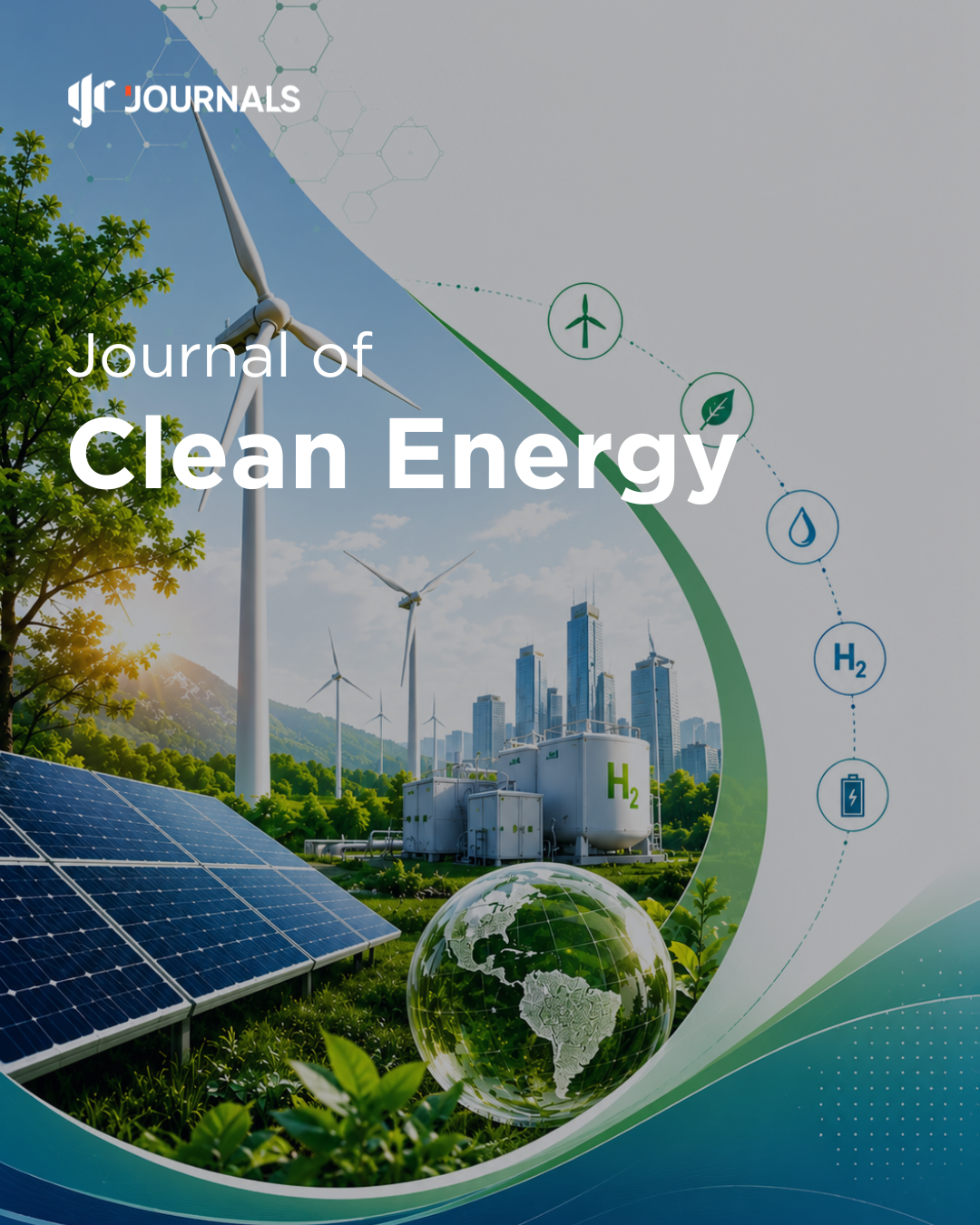
Journal of Clean Energy

A single-blind peer-reviewed, quarterly, open-access journal committed to advancing cutting-edge research across the full spectrum of clean energy synthesis and sustainable applications.
Journal of Clean Energy
About the Journal
Journal of Clean Energy Synthesis and Applications is a multidisciplinary, peer-reviewed, quarterly, open-access journal dedicated to advancing research and innovation in clean energy technologies, sustainable energy systems, and their practical applications. The journal serves as a comprehensive platform for high-quality research that addresses global energy challenges while promoting the development, integration, and deployment of environmentally responsible energy solutions.
It provides an advanced forum for researchers, engineers, industry professionals, policymakers, and academicians engaged in areas such as renewable energy technologies, energy storage systems, hydrogen and bioenergy production, smart grids, carbon capture and utilization, and sustainable energy infrastructure. The journal emphasizes both scientific innovation and real-world implementation, bridging the gap between fundamental research, engineering development, policy frameworks, and societal impact.
This journal welcomes a wide range of scholarly contributions, including original research articles, systematic reviews, technical notes, and case studies that present innovative approaches and practical solutions in the field of clean energy. Particular emphasis is placed on emerging technologies, computational modeling and simulation, energy optimization, lifecycle analysis, intelligent energy systems, and the integration of clean energy solutions within industrial, transportation, and urban environments.
With each issue, the journal aims to deliver impactful research and actionable knowledge that supports the transition toward a sustainable energy future. Through the dissemination of rigorous and influential scholarship, the journal seeks to advance clean energy innovation, enhance energy efficiency, reduce environmental impact, and contribute to global efforts toward climate resilience and sustainable development.