

 Open Access||Research Article
Influence of Pressure-Cooking Parameters on the Color, Texture, Nutrient Composition, Antioxidant Capacity, Flavor and Sensory Profile of Drumstick (Moringa oleifera)
R. Rashmitha1, G. Sai Preetham1, V. Chandrasekar1 , V. Eyarkai Nambi2, N. Baskaran3
1 Department of Food Process Technology, School of Sensory Sciences, National Institute of Food Technology, Entrepreneurship, and Management-Thanjavur (NIFTEM-T), Thanjavur, Tamil Nadu, 613005, India
2 Department of Food Plant Operations, Incubation and Entrepreneurship, National Institute of Food Technology, Entrepreneurship, and Management-Thanjavur (NIFTEM-T), Thanjavur, Tamil Nadu, 613005, India
3 Department of Food Safety and Quality Assurance, National Institute of Food Technology, Entrepreneurship, and Management-Thanjavur (NIFTEM-T), Thanjavur, Tamil Nadu, 613005, India
Abstract
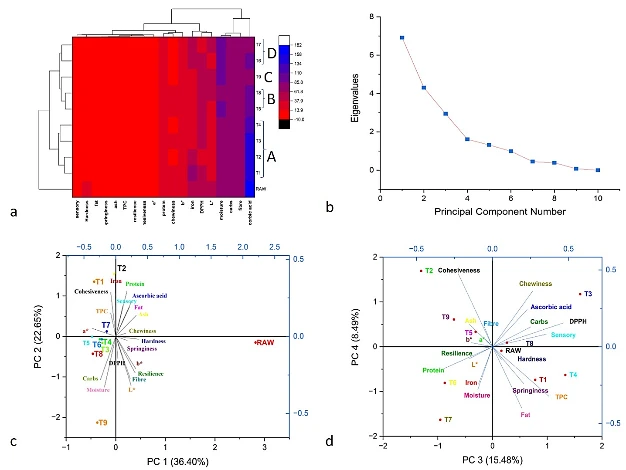
Our country's rich culinary culture has allowed us to enjoy a variety of vegetables and fruits, resulting in several health benefits. Drumstick, also known as Moringa oleifera, is a remarkable vegetable that is highly regarded and piques our curiosity. Therefore, the aim of the present study focused mainly on the effects of pressure cooking on the physicochemical, nutritional, antioxidant, flavor, and sensory profiles of drumsticks. The drumstick-water ratio and the amount of salt used during pressure cooking varied. The total phenol content and DPPH activity of pressure-cooked drumsticks ranged from 0.29–0.48 mg GAE/g and 31.76–56.70%, respectively. The flavor profiles consisted of 9 aldehydes, 2 alcohols, 5 organic compounds, 2 sulfur compounds, and ketones. Additionally, the phytonutrients identified by /MS were n-hexadecanoic acid, d-glucitol, 1-S-heptyl-1-thio-, benzeneacetonitrile, 4-hydroxy-, benzeneacetonitrile, 3-hydroxy-, and d-glucitol and 1-S-heptyl-1-thio-. Treatment T3 resulted in a high sensory score, whereas T9 resulted in a poor sensory score. Hierarchical cluster analysis supported the sensory results with nutrient components and grouped the treatments into four groups: Raw, A (T1-T4), B (T5 & T8), C (T9), and D (T6 & T7). The principal component analysis categorized all 19 data sets of treatments into four principal components. The results of this study reveal that the drumstick-water ratio and salt content during pressure cooking have no significant effect on any of the other parameters except vitamin C.
Keywords
Graphical Abstract
Novelty Statement
This study focused mainly on the effects of pressure cooking on the physicochemical, nutritional, antioxidant, flavor, and sensory profiles of drumsticks.