

 Open Access||Research Article
Leveraging Python for Potentiometric Titrations: An AI-Enhanced Approach to Hydrochloric Acid Detection

Department of Chemistry, Muffakham Jah College of Engineering and Technology Hyderabad, Telangana, 500034, India
Abstract
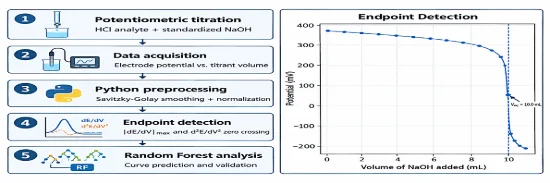
Potentiometric titration is a classical analytical method for determining the concentration of acids and bases with high precision. Traditional titration techniques, however, often require manual interpretation of titration curves, which may introduce errors and limit reproducibility. This study presents an AI-enhanced approach to hydrochloric acid (HCl) detection through potentiometric titration using Python-based automation and machine learning. The system integrates automated data acquisition, preprocessing, and curve fitting to identify equivalence points with greater accuracy. By applying regression models and anomaly detection algorithms, the proposed framework reduces subjectivity and improves consistency in endpoint determination. Experimental trials using standard NaOH titrants demonstrated that the AI-assisted approach achieved higher precision in detecting HCl concentrations compared to traditional manual methods. The Python framework also provides visualization tools and real-time feedback, enabling a user-friendly interface for laboratory and educational settings. This study highlights the potential of combining artificial intelligence and classical analytical chemistry to advance modern titration practices.
Keywords
Graphical Abstract
Novelty Statement
Automated AI-driven titration enables accurate HCl detection, reproducible analysis, real-time visualization, reduced errors, and scalable laboratory integration.