

 Open Access||Research Article
A Hybrid Edge-AI Framework for Proactive Indoor Air Quality Management: Integrating LSTM-Based Prediction with Multi-Criteria Risk Mitigation
Moinuddin Khan , Sadeem Khan, Saloni Kadam, Alfiya Ansari, Abdul Arham Malik, Amol Sankpal, Feroz Shaikh
Department of Computer Engineering, Anjuman-I-Islam M. H. Saboo Siddik College of Engineering, Mumbai, Maharashtra, 400008, India
Abstract
Conventional smart-home purifiers function as passive filtration units, often lacking mechanisms to mitigate secondary hazards like airflow-driven fire propagation. This research proposes an autonomous, vision-aware Edge-AI safety framework that integrates real-time air quality forecasting, predictive maintenance, and active hazard mitigation into a unified embedded architecture. A localized LSTM network performs AQI forecasting with a mean absolute percentage error (MAPE) of 5.8%, with 32ms inference latency. To enhance reliability, the framework introduces offline voice intelligence (VC-02) for internet-independent reporting and a multi-axial vision layer for redundant fire verification, neutralizing false-positive triggers. Physical validation was conducted using 4 real fire and non-fire sources and one non fire source (orange coloured cloth) confirming that the system operates reliably under realistic residential conditions. To assess the challenge of the conflict that arises between air circulation and the accelerating combustion process, the forecasting engine was tested on a real-life indoor environmental dataset acquired from the publicly available DALTON repository. Tested on the novel test sequences, the quantized on-device LSTM model reached a level of RMSE of 3.12 IAQ units and a level of MAPE of 5.8%, demonstrating a high accuracy of the model in practical applications, indicating strong mathematical feasibility for real-time applications. The system employs high-priority hardware interrupts linked to an active multi-directional suppression mechanism. Experimental results confirm a deterministic response, achieving an 87ms latency for relay deactivation and pump-based intervention. Bench-marking against industry leaders indicates superior safety responsiveness, transitioning the device from a passive cleaner to an active safety robot. This work directly addresses the United Nations SDG-3 (Good Health) and SDG-11 (Sustainable Cities) objectives by providing autonomous safety infrastructure for high-density urban residential environment.
Keywords
Graphical Abstract
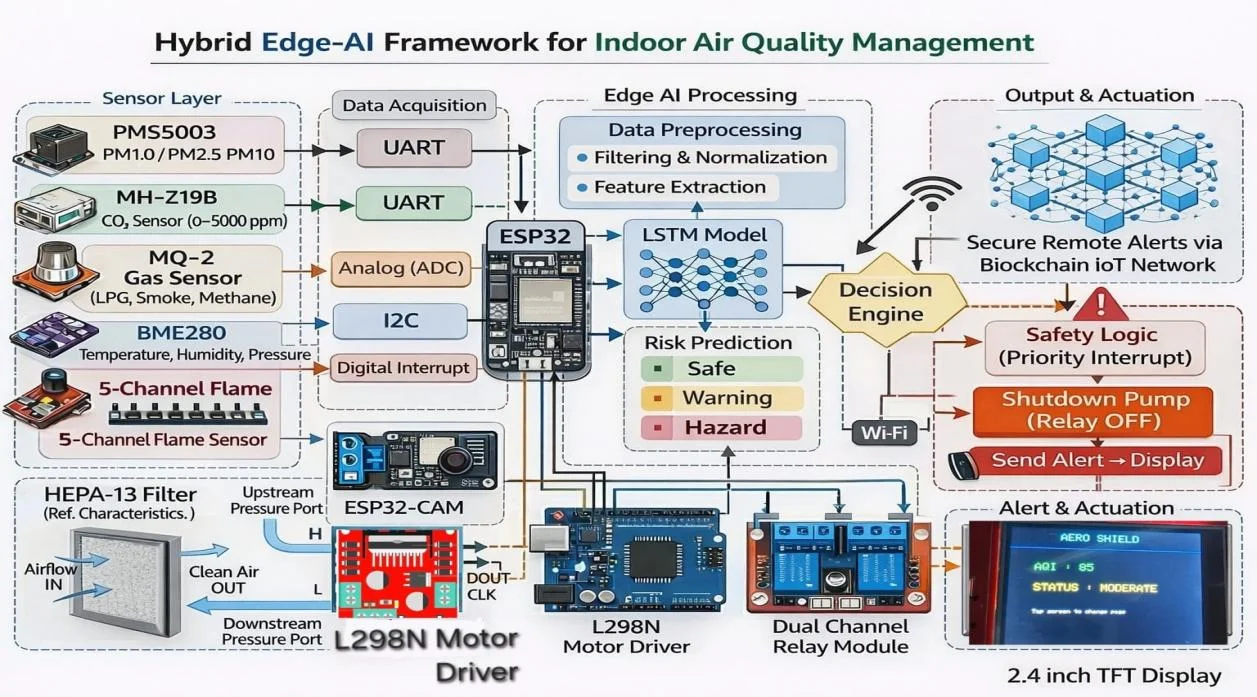
Novelty Statement
This study introduces a unified Edge-AI safety architecture integrating AQI forecasting, predictive maintenance, vision-based fire verification, offline voice alerts, and autonomous hazard suppression.