

 Open Access
Abstract
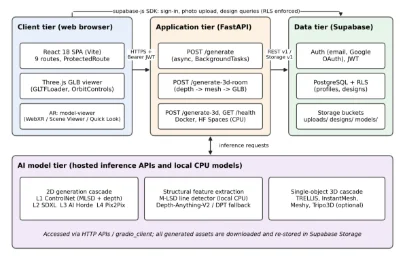
Most people planning a redesign choose furniture, colour and materials from catalogues, floor plans or imagination. AR interior tools typically overlay individual catalogue objects, and general-purpose image generators can restyle a room but often move its walls or perspective in the process. This study presents Home Gennie, a web-based system that restyles a photograph of the user's own room while keeping its geometry intact, reconstructs the restyled room in three dimensions from that same photograph, and displays it in AR without any app installation. Straight-line and monocular depth maps extracted from the photograph condition a ControlNet diffusion model, so furnishings, materials and lighting are regenerated while the architectural lines stay put; a four-layer cascade keeps the service available when an endpoint fails. The redesigned image is then converted into a colour-textured, full-room mesh by back-projecting a monocular depth map through a pinhole camera model and placed in AR through the browser. Tested on 15 room photographs submitted by users of the deployed system, line-conditioned generation preserved room structure substantially better than unconditioned text-only generation (structural similarity 0.720 ± 0.125 vs. 0.453 ± 0.148; Mann–Whitney p = 0.0059). Full-room reconstruction produced meshes of 262,144 vertices (about 10 MB) in a mean of 4.47 s over 30 production requests, and 65.5% of requests resolved to a permanent image. Pretrained models can be combined into an accessible preview tool, though the reconstructed scale is approximate and geometry is preserved only when the first cascade layer answers the request.
Keywords
Graphical Abstract
Novelty Statement
Unlike AR tools that overlay catalogue furniture, or generators that re-imagine a room without structural constraints, the proposed system restyles the user's own room photograph under explicit line- and depth-based geometric conditioning, reconstructs the complete restyled room as a 3D mesh from that single image, and delivers it to AR in a standard web browser without depth sensors or app installation.