

 Open Access||Research Article
Q-MedDict: Quantum Dictionary Multimodality for Lung Tissue and Lab Data
Sazia Parvin1 , Md Sarwar Kamal1
Melbourne Polytechnic Melbourne, VIC, 3072, Australia
Abstract
A lung cancer record can contain very different kinds of data. A tissue slide shows cells and tissue shape. A blood test gives numbers such as white blood cell count, haemoglobin, albumin, glucose, and creatinine. A urine test gives numbers such as urine albumin and urine creatinine. Many computer models use only one of these data types. We propose Q-MedDict, a quantum-inspired dictionary model for image and laboratory data. The model stores information as key–value pairs. The key is a bit string. The value is an amplitude. Gate-like rules move or mix the amplitudes. The method follows the idea of dictionary-based quantum image encoding, but it adds a second branch for blood and urine data. The image branch was tested on two public lung adenocarcinoma H&E images. The laboratory branch used public NHANES release statistics for blood and urine variables. We did not pair CMB-LCA patients with NHANES people because they are different cohorts. The two branches were compared by the same encoding measures instead. With only 25% of block coefficients, the two lung images kept 99.80% and 99.35% of transform energy. Their SSIM values were 0.919 and 0.910. A 50% dictionary state for blood kept 98.64% of transform energy with cosine similarity 0.993. A 50% urine state kept 98.53% with cosine similarity 0.993. These results show one common pattern: image, blood, and urine information can be placed in the same dictionary form and reduced while most of the encoded signal stays present. The result is a small proof-of concept. It is not a lung cancer diagnostic model. A matched cohort with slides and laboratory tests from the same people is needed for clinical prediction.
Keywords
Graphical Abstract
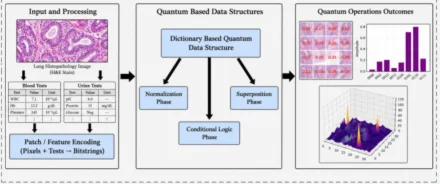
Novelty Statement
This study proposes Q-MedDict, a quantum-inspired dictionary model for image and laboratory data.