
 Open Access||Research Article
Deep Learning-Based Maize Leaf Blight Detection and Treatment Recommendation with Comparative Evaluation and Web-Based Deployment of YOLO Architectures
Muhammad Adamu Shuaibu I. T. Balami1,2 , Godiya Yakubu1, Abdulrasheed Ibrahim1
1 Center for Embedded Artificial Intelligence and Smart Energy Systems, Abubakar Tafawa Balewa University, Bauchi, Nigeria
2 Department of Embedded Artificial Intelligence, Abubakar Tafawa Balewa University, Bauchi, Nigeria
Abstract
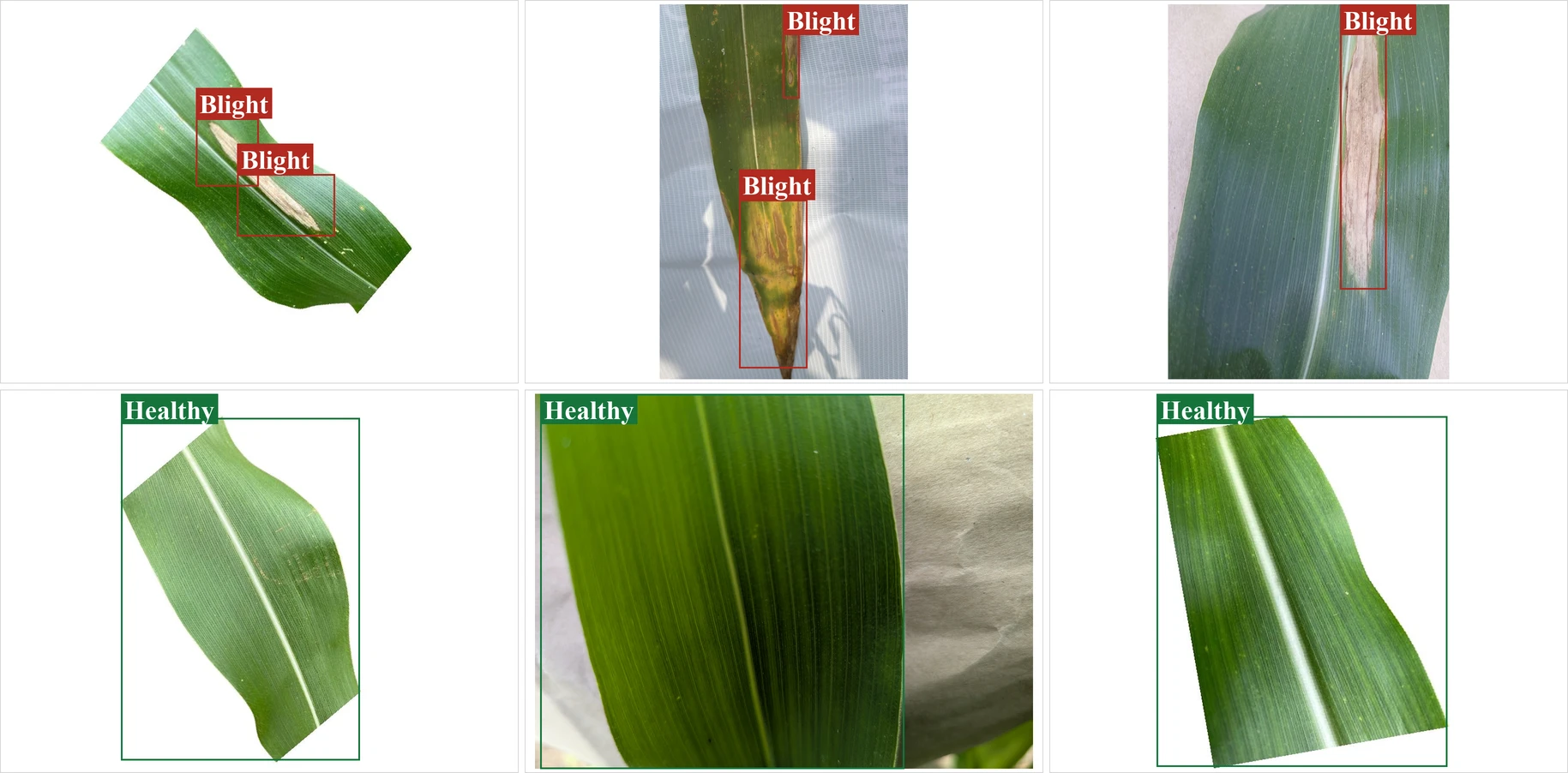
This study designed, comparatively evaluated, and deployed a browser-accessible decision-support system that couples one of four single-stage detectors from successive YOLO generations (YOLOv8n, YOLOv9t, YOLOv10n, and YOLO11n) to a verified disease-management knowledge base for maize leaf blight, so that a detected lesion is converted into a severity tier and an agronomic action rather than into a bare class label. A two-class corpus of 1,100 field and extension images (600 blighted, 500 healthy) was annotated on a managed vision platform. The platform export registered 1,088 images, of which 1,087 carried annotation, totalling 1,734 bounding boxes. A documented audit, the re-annotation of two frames, and the addition of twelve late frames then raised the prepared dataset to 1,100 annotated images with 1,749 boxes, that is 1,129 blight and 620 healthy instances at 1.59 per image. The corpus was partitioned before any transformation into class-stratified training (770), validation (165), and test (165) subsets under seed 42, and all four detectors were fine-tuned from COCO-pretrained weights on a single Tesla T4 device under one protocol (640 px input, 100 epochs, patience 20, batch 16, identical online augmentation, deterministic execution). Accuracy, per-class behaviour, image-level discrimination, parameter count, weight footprint, and inference throughput were measured, with uncertainty quantified by paired bootstrap resampling of 2,000 replicates. The four generations were separated rather than saturated: precision 0.868–0.909, recall 0.781–0.824, F1 0.829–0.848, mAP@50 0.871–0.891, and mAP@50:0.95 0.686–0.710, while image-level accuracy ranged from 0.982 to 1.000. YOLOv9t was the most accurate detector (mAP@50:0.95 = 0.710) but also the slowest, at 20.7 FPS and 166.9 ms per image on CPU. YOLO11n was the fastest, at 29.3 FPS and 116.9 ms, and it achieved the highest blight recall (0.776), but it returned the lowest mean average precision. YOLOv10n was the most precise (0.909) at 28.0 FPS. Paired bootstrap intervals showed the deficit of YOLO11n to be resolvable (difference −0.024, 95% CI −0.039 to −0.003) whereas the advantage of YOLOv9t over YOLOv8n and YOLOv10n was not, so YOLOv10n was deployed. The 5.8 MB checkpoint was packaged behind a Flask service exposing server-rendered pages, a JSON endpoint, and an SQLite audit store, and returned a severity index, tier, urgency window, FRAC-group chemical class, cultural control, prevention, and safety statement for every submitted image. Recency does not predict suitability on a single-class agricultural task: the second generation in the set was the most accurate and the fourth the least, and the most accurate detector was the slowest. Because perception and advice are separated, the detector reports only what it can observe while the knowledge base supplies what should be done, which makes the recommendation auditable and revisable without retraining.
Keywords
Graphical Abstract