

 Open Access||Research Article
Vitamin and Mineral Supplement Use and Anti-Hepatitis A Virus Seropositivity: NHANES 2013-2018 Cross-Sectional Association
Ling Yang1, Hadeer M. Nageeb2, Mostafa I. Abdelglil3, Mohamed T. Shaaban2, Mingxuan Hou1,4, Hussein S. Salama2
1 Department of Geriatrics, Shanghai Fourth People's Hospital Affiliated to Tongji University, Shanghai, Hongkou, 200434, China
2 Department of Botany and Microbiology, Menoufia University, Shebin Elkom, Menoufia, 32511, Egypt
3 Department of Medical Laboratory Techniques, Al-Farahidi University, Baghdad, Al-Saydiya, 10021, Iraq
4 School of Exercise and Health, Shanghai University of Sport, Shanghai, Yangpu, 200438, China
Abstract
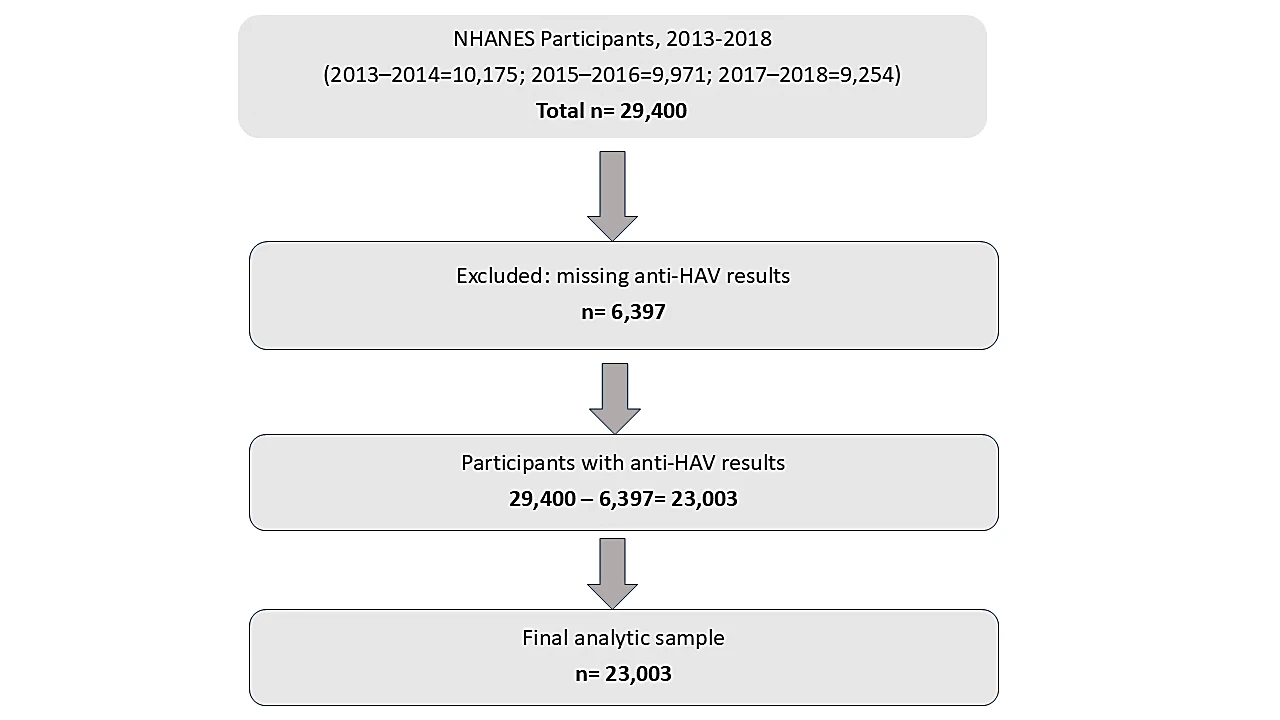
Dietary vitamins and minerals play important roles in maintaining normal immune function. However, the relationship between short-term dietary supplement intake and hepatitis A virus (HAV) serostatus remains insufficiently characterized. This study aimed to investigate the association between vitamin and mineral supplement intake during a 24-hour period and anti-HAV seropositivity among participants in the National Health and Nutrition Examination Survey (NHANES) from 2013 to 2018. This cross-sectional study used data from three NHANES cycles: 2013–2014, 2015–2016, and 2017–2018. Data from participants aged 6 years and older with available information on anti-HAV antibody and dietary supplement intake based on two 24-hour recall periods were combined. The final analytical sample included 23,003 participants. Anti-HAV serostatus was classified as positive or negative. Vitamin and mineral supplement intake were evaluated in relation to anti-HAV serostatus using logistic regression analysis. Odds ratios (ORs), 95% confidence intervals (CIs), and p values were used to assess the associations. Overall, the investigated dietary supplemental nutrients were not significantly associated with anti-HAV serostatus. However, vitamin D intake showed a statistically significant exploratory association with anti-HAV seropositivity (OR = 1.000, 95% CI: 1.000–1.001; p = 0.004). Although the association reached statistical significance, the estimated effect size was very small. Furthermore, the analysis involved multiple nutrient comparisons, increasing the possibility of chance findings. Therefore, the vitamin D results should be interpreted cautiously and should not be considered evidence of a causal relationship. In this NHANES-based cross-sectional study, dietary supplement intake was generally not significantly associated with anti-HAV serostatus. The exploratory association observed for vitamin D warrants further investigation. Longitudinal studies with detailed assessments of supplement use, vaccination history, and potential confounding factors are needed to determine whether this association is reproducible and clinically meaningful.
Keywords
Graphical Abstract
Novelty Statement
This study examines whether short-term vitamin and mineral supplement use is associated with hepatitis A (anti-HAV) serostatus in a nationally representative US population, using NHANES data from 2013 to 2018.