

 Open Access||Review Article
Systems Biology of Plant Secondary Metabolism: Integrating Multi-Omics to Decipher Biosynthesis, Regulation, Ecological Functions, and Metabolic Engineering
Hitesha Gole, Sudarshan Rajput , Anushri Deulkar
Department of Pharmaceutical Chemistry & QAT, Bharati Vidyapeeth (Deemed to be University), Poona College of Pharmacy, Erandwane, Pune, Maharashtra, 411038, India
Abstract
Plant secondary metabolites are structurally diverse bioactive compounds that play essential roles in plant growth, development, defense, ecological interactions, and environmental adaptation while serving as valuable resources for pharmaceutical, nutraceutical, and agricultural applications. The integration of multi-omics and computational biology has revolutionized the understanding of specialized metabolism by connecting genes and transcripts with complex regulatory networks governing metabolite biosynthesis, transport, and accumulation. From a systems biology perspective, this review aims at giving a comprehensive account of the diversity, biotic functions, genomic organization, transcriptional regulation, interactions with the plant proteome and metabolome, as well as regulatory networks and evolutionary dynamics of plant secondary metabolism. Moreover, it emphasizes the role of AI, network biology, synthetic biology, metabolic engineering and precision breeding in discovery of pathways, functional gene annotation, predictive metabolic modeling, and crop improvement. The applications of systems biology in developing climate-resilient crops, in enhancing resistance to pest and diseases, in biofortifying crops for nutrition and in sustainable production of high-value phytochemicals are also discussed. Lastly, current challenges, such as the integration of multi-omics, computational challenges, functional annotation and experimental validation are critically discussed and future opportunities based on pan-genomics, single-cell and spatial multi-omics, AI-assisted breeding and next-generation metabolic engineering are highlighted. This review, which combines recent advances in molecular, computational and biotechnological fields, shows that systems biology is a powerful tool for understanding and dissecting plant secondary metabolism and its relevance for sustainable agriculture, plant biotechnology and the discovery of natural products from plants.
Keywords
Graphical Abstract
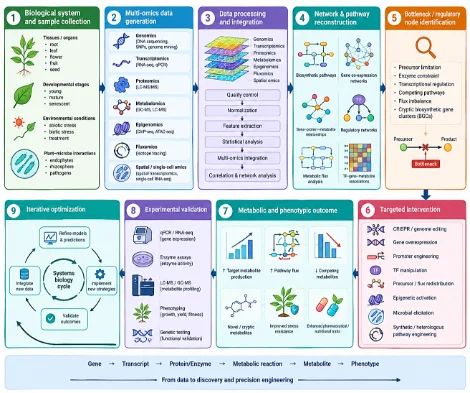
Novelty Statement
This review delivers a comprehensive systems biology synthesis mapping multi-omics integration and computational biology across the evolutionary dynamics, genomic organization, and regulatory networks of plant secondary metabolism. It moves beyond traditional trait analyses by establishing a forward-looking roadmap that links emerging frontiers such as pan-genomics, spatial multi-omics, and AI-assisted breeding - directly to the sustainable engineering of climate-resilient, biofortified crops.