

 Open Access||Review Article
Tree-Based Restoration of Degraded Forest Landscapes: Implications for Biodiversity, Carbon Storage and Sustainable Development

1 Department of Agroforestry, Forest College and Research Institute, Tamil Nadu Agricultural University, Mettupalayam, Tamil Nadu, 641 301, India
2 Department of Agronomy, Agricultural College and Research Institute, Tamil Nadu Agricultural University, Tiruvannamalai, Tamil Nadu, 606 753, India
Abstract
Forest degradation threatens biodiversity, climate regulation and the livelihoods of hundreds of millions of people, and tree-based restoration has become a central strategy in global and national environmental agendas. This review synthesizes peer-reviewed evidence on how different tree-based restoration approaches-natural regeneration, assisted natural regeneration, enrichment and mixed native planting, agroforestry and plantations - influence biodiversity recovery, carbon storage and progress toward sustainable development goals (SDGs). Evidence indicates that secondary forests regain aboveground biomass faster than species composition: Neotropical regrowth results in the recovery of approximately 90% of old-growth biomass within approximately six to seven decades, whereas species composition may take centuries. Natural and assisted regeneration generally results in the greatest biodiversity gains at the lowest cost, whereas mixed native plantings and agroforestry can accelerate recovery and secure livelihood benefits when regeneration is constrained. Evidence from Western Ghats in India shows that weed control and native planting can accelerate recovery in isolated, degraded fragments. However, monoculture plantations and tree planting in naturally open ecosystems can reduce biodiversity and ecosystem services. Carbon benefits depend on forest type, climate, permanence and the avoidance of leakage. We propose an integrated framework that links restoration choice, ecological outcomes and development goals and identify five priorities: matching methods to the landscape context, favoring native species diversity, securing land tenure and community participation, financing long-term maintenance, and adopting standardized monitoring. Tree-based restoration can contribute meaningfully to collective sustainability only when it complements, rather than substitutes for, forest protection and emission reduction.
Keywords
Graphical Abstract
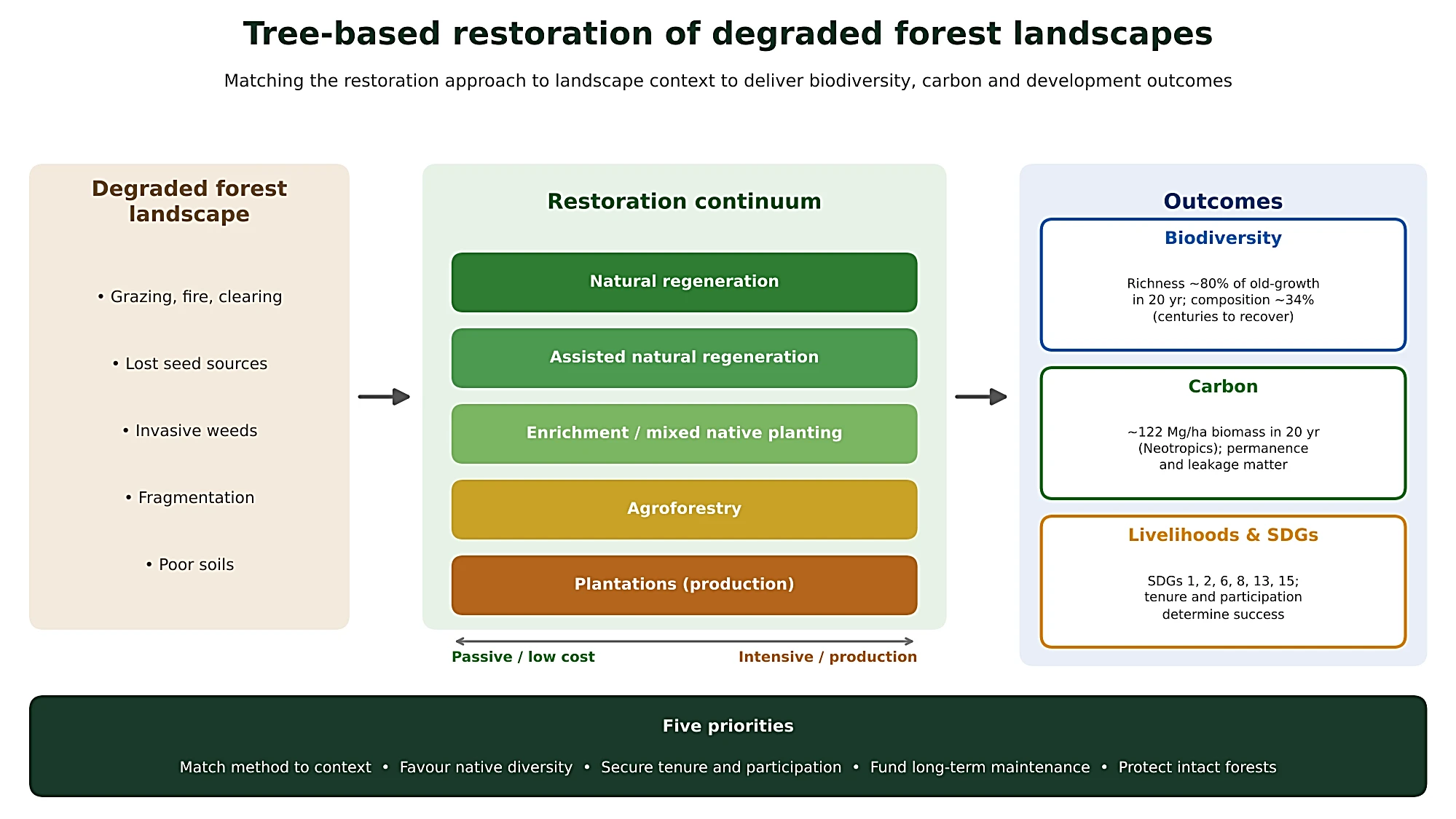
Novelty Statement
Many existing syntheses address biodiversity, carbon and development outcomes separately, or focus on a single approach such as natural regeneration or tree planting. This review adds three elements. First, it places five tree-based approaches on one gradient of intervention intensity and compares their biodiversity, carbon and livelihood outcomes in a single framework (Figure 1, Table 2, Figure 2). Second, it separates the recovery times of biomass, species richness and species composition and complements the largely Neotropical evidence with case evidence from India's Western Ghats and from national programmes. Third, it makes the comparative scoring transparent (Table 1) and turns the evidence into five practical priorities for restoration programmes in tropical and subtropical landscapes.
1. Introduction
Forests cover approximately one-third of the global land area and underpin climate regulation, water supply, soil protection and the livelihoods of many rural communities. However, forest loss and degradation continue at a large scale: satellite analyses recorded approximately 2.3 million km² of global forest loss between 2000 and 2012 alone.[1] Degradation is the gradual decline in structure, species composition and function without complete conversion. It is often less visible than deforestation, but it affects far larger areas and impairs ecosystem services.[2,3] In response, ecosystem restoration has become a global priority, and forest and landscape restoration are now embedded in international commitments, national climate pledges and land-degradation neutrality targets.[4,5] Tree-based approaches are central to these commitments because trees rebuild canopy cover, stabilize soils, restore habitats and store carbon in biomass and soils. The scale of the opportunity is considerable. One global assessment estimated that approximately 0.9 billion hectares of land could support an additional tree canopy, with a potential storage of approximately 205 Gt of carbon.[6] This estimate has been strongly debated for two reasons: it risks encouraging tree planting on land that is already used productively or that naturally supports grasslands and savannas, and natural forests store carbon more reliably than simple plantings do.[7,8] Critics emphasize that tree planting is not a simple solution and that poorly designed schemes can fail, harm biodiversity or disadvantage local people.[9] Evidence-based guidance on planning, species selection, governance and monitoring is therefore essential.[10,11]
Restoration is also a national priority in South Asia. In 2023, the forest and tree cover of India was 25.17% of its geographical area (21.76% forest cover and 3.41% tree cover), and the country has pledged to create an additional carbon sink of 2.5–3 billion tonnes of CO₂ equivalent by 2030 through additional forest and tree cover.[12] In addition, in India, 26 million hectares of degraded and deforested land are projected to be restored by 2030, and 21.76 million hectares are reported to be restored by June 2026.[13] However, much of the quantitative evidence on how quickly biodiversity and biomass recover comes from Neotropical forests and its transferability to Asian landscapes, which may differ in terms of species pools, population pressure, fire and grazing regimes and invasive weeds, needs to be examined. This review therefore draws on evidence from Asia and India wherever it is available. The objectives of this review are to (i) classify the main tree-based restoration approaches and the contexts in which each is appropriate; (ii) synthesize evidence on biodiversity and carbon outcomes, with particular attention to Asian and Indian programmes; (iii) examine how restoration contributes to the SDGs and where trade-offs arise; and (iv) outline priorities for research, policy and practice. This review is intended to support practitioners and decision makers working on degraded forest landscapes in tropical and subtropical regions, where restoration potential and development needs are both greatest.
2. Methodology
2.1 Review approach
A narrative, evidence-synthesis approach was adopted. Peer-reviewed articles, meta-analyses and major international restoration guidelines addressing tree-based restoration, biodiversity recovery, carbon accumulation and sustainable development outcomes were identified through targeted searches of Web of Science, Scopus and Google Scholar for the period from January 2000 to October 2026 using combinations of the terms “forest landscape restoration”, “natural regeneration”, “tree planting”, “biodiversity recovery”, “carbon sequestration” and “sustainable development”, supplemented by region-specific terms (“India”, “Western Ghats”, “South Asia”, “agroforestry” and “plantation”) to retrieve evidence from Asia. Reference lists of key reviews and national assessments were also screened to identify further relevant studies. Priority was given to global and pantropical meta-analyses, large comparative datasets and widely cited syntheses. Findings were grouped by restoration approach and by outcome category (biodiversity, carbon, socioeconomic).
2.1.1 Study selection
Titles and abstracts were screened first, followed by assessment of the full text. A study was retained when it (i) addressed forest or tree-based restoration in degraded forest landscapes (or, for risk assessment, tree planting in nonforest ecosystems); (ii) reported quantitative, or well-documented qualitative, outcomes for biodiversity, carbon or socioeconomic indicators; (iii) was a peer-reviewed article, a major international guideline or an official national assessment; and (iv) was published in English. Global syntheses were not restricted to one biome, but evidence from tropical and subtropical regions was prioritized in line with the scope of this review. Studies that were purely modeling exercises were used only where they were widely applied in policy (for example, global potential and priority area assessments), and opinion pieces without data were used only to frame risks and guidance. When several studies addressed the same question, the most recent and largest-scale synthesis was preferred. Regional evidence from Asia and India was included as case-based examples rather than pooled estimates. Because the review is narrative rather than systematic, no formal quality scoring or PRISMA flow diagram was applied, and the selection may not be exhaustive.
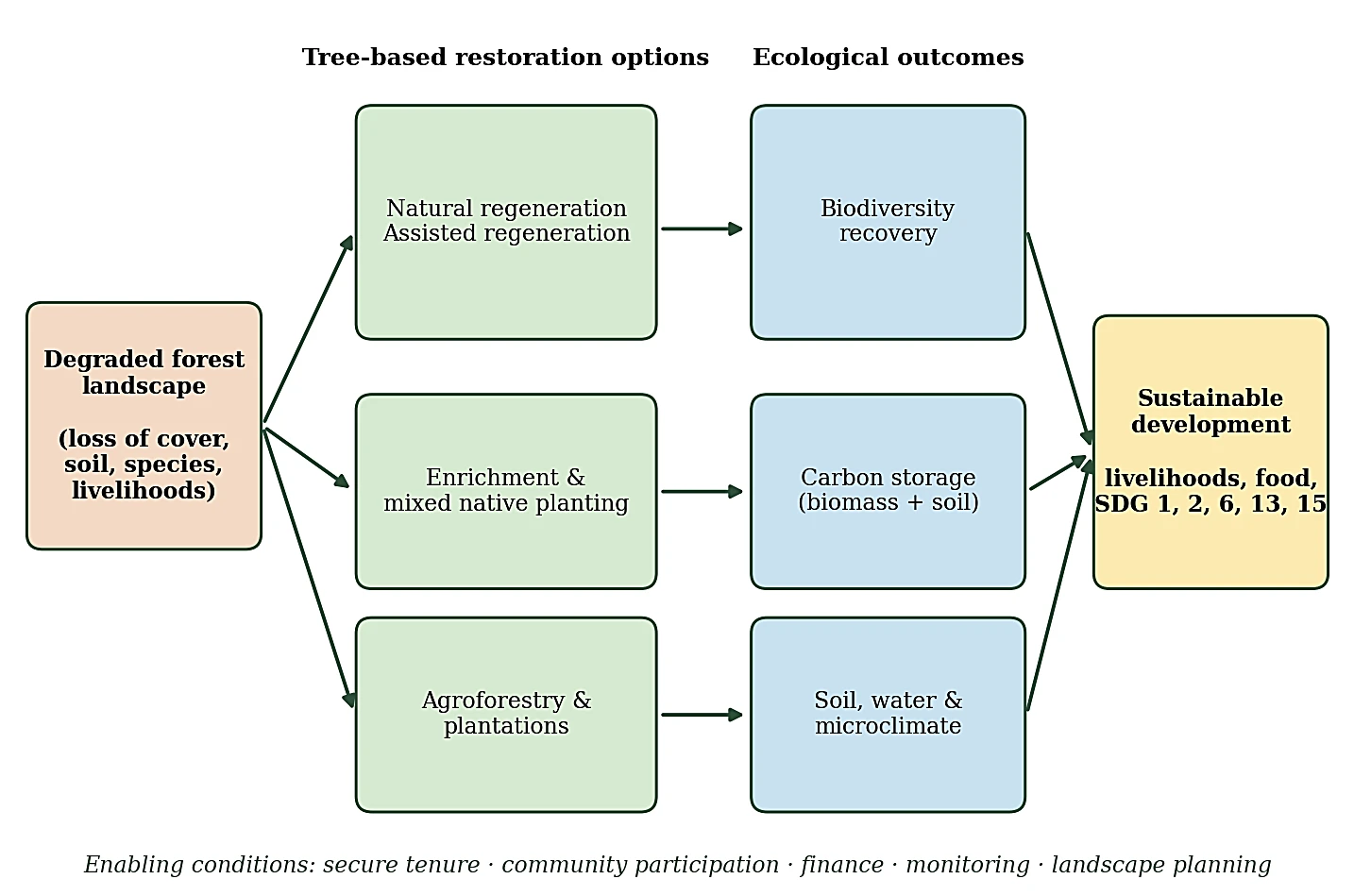
Fig. 1: Conceptual framework linking tree-based restoration options to ecological outcomes and sustainable development in degraded forest landscapes.
Table 1: The basis for the relative scores (1 = low, 5 = high) is shown in Fig. 2. Each cell gives the score and the main supporting evidence or reasoning.
| Approach | Carbon uptake | Biodiversity | Livelihood benefits | Cost-effectiveness |
|---|---|---|---|---|
| Natural regeneration | 4 – High uptake by natural regrowth (3.05 Mg C ha⁻¹ yr⁻¹ over the first 20 years in Neotropical secondary forests;[17] rates ~32% above IPCC defaults on average[18]); slower where seed sources are scarce | 5 – Closest return to reference conditions; success higher than under active restoration in tropical forests after controlling for confounders[19,20] | 2 – Few direct products; requires protection and restricted use of land[21] | 5 – Lowest cost, as it relies on protection[20,21] |
| Assisted natural regeneration | 4 – Similar to natural regeneration, with faster canopy development through weeding and protection[21] | 4 – Retains most benefits of natural recovery with some acceleration from management[21] | 3 – Community labor and engagement give income and employment, but few direct products (Table 2) | 4 – Low cost, but sustained labor and enforcement are needed (Table 2) |
| Enrichment/mixed native planting | 4 – Faster canopy closure; in the Western Ghats, mixed-native planting recovered 47% of the carbon gap to benchmark forest in 7–15 years[22] | 4 – Restores diversity and structure, but recovery of species composition is partial (14% of the compositional gap closed in 7–15 years)[22] | 3 – Employment in nurseries and planting; limited direct products (Table 3) | 2 – Higher cost; seedling supply and survival constraints (Table 2)[9,10] |
| Agroforestry | 3 – Lower per hectare than natural regrowth: modeled mean 0.21 Mg C ha⁻¹ yr⁻¹ at ~19 trees ha⁻¹ in India (methods not directly comparable) [23] | 3 – Intermediate between cropland and forest; varies with tree diversity, density and management (Table 2) | 5 – Strongest food, fodder, fuel and income benefits; flexible (Tables 2 and 3) | 3 – Moderate establishment and maintenance costs, partly offset by crop and tree products |
| Plantation (monoculture) | 4 – Rapid early growth, but lower permanence and long-term storage than natural or mixed forests;[7] permanence is not scored here | 1 – Monocultures typically support less biodiversity than natural or mixed forests;[7,9] mixed-native plantations perform better | 4 – Timber, fuelwood and income, but benefits may be captured by outsiders[9] | 3 – Establishment costs offset by economic returns; risk of failure and poor permanence[9] |
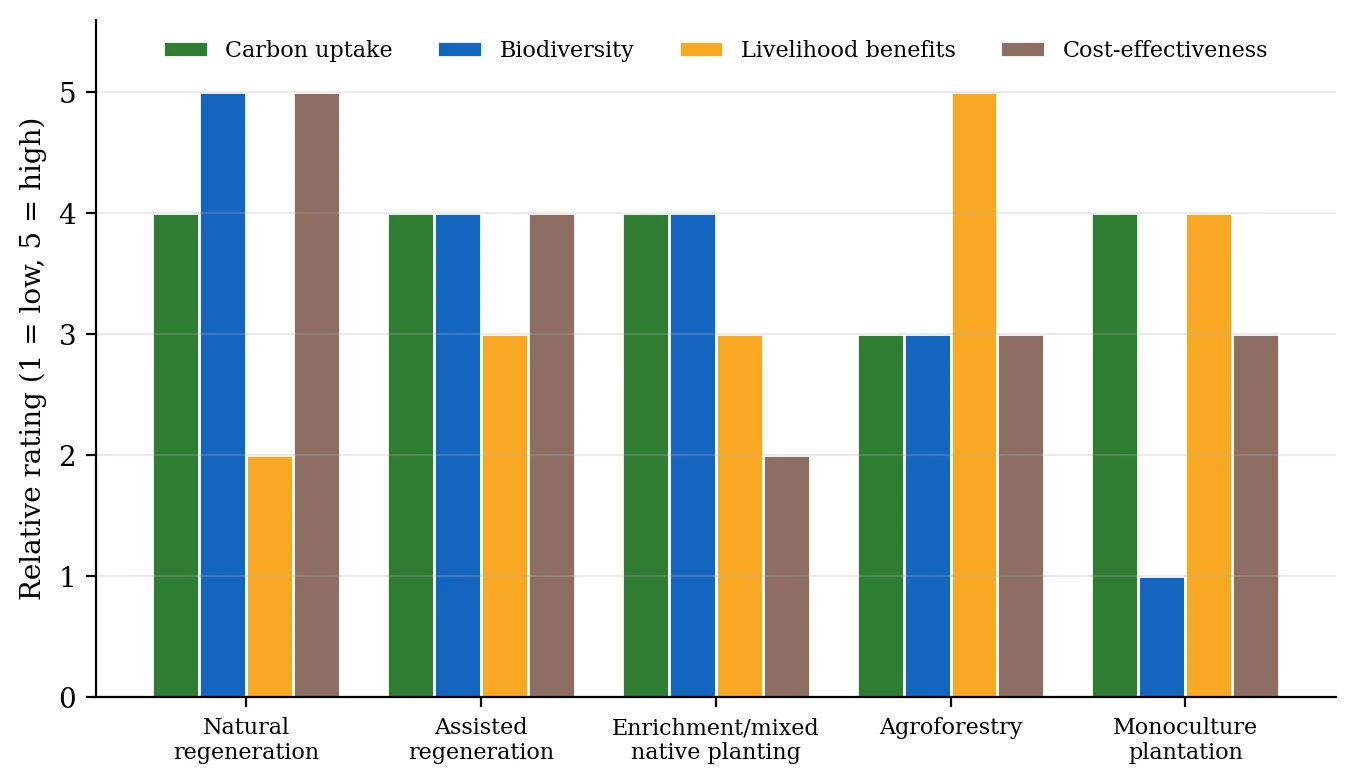
Fig. 2: Relative, semiquantitative ratings of five tree-based restoration approaches against carbon uptake, biodiversity, livelihood benefits and cost-effectiveness. Ratings use an ordinal scale from 1 (low) to 5 (high) and are the authors' synthesis of the evidence discussed in Sections 3.1–3.3.[7,16-18] The criteria and the basis for each score are given in Table 1. The ratings are indicative judgments, not measured values, and are distinct from the empirical estimates in Table 4.
Table 2: Main tree-based restoration approaches, typical contexts, strengths and limitations.[15,21] Entries describe general tendencies; see the note below the table.
| Approach | Description | Typical context | Key strengths | Key limitations |
|---|---|---|---|---|
| Natural regeneration | Protection of degraded land to allow spontaneous forest recovery | Land with nearby forest remnants, intact soils and low pressure | Lowest cost; highest native species recovery; self-sustaining | Slow where seed sources are scarce; needs protection from fire and grazing |
| Assisted natural regeneration | Natural regeneration plus protection, weeding, fire control and selective thinning | Partially degraded forests and fallows with regeneration potential | Low cost; accelerates recovery; engages communities | Requires sustained labor and enforcement |
| Enrichment and mixed native planting | Planting of native species, often including late-successional and keystone species | Severely degraded land lacking seed sources or soils | Restores diversity and structure; faster canopy closure | Higher cost; seedling supply and survival constraints |
| Agroforestry | Deliberate integration of trees with crops or livestock | Densely populated agricultural landscapes | Strong livelihood and food-security benefits; flexible | Biodiversity and carbon usually lower than in natural forest, but strongly dependent on species composition, tree density and management |
| Plantations (monoculture or mixed) | Even-aged stands for timber, fuelwood or cover; production-oriented where established mainly for timber or commercial use | Heavily degraded land; production-oriented systems | Rapid growth; clear economic returns | Risk of low biodiversity, pest vulnerability and poor permanence, especially in short-rotation monocultures; mixed native stands generally perform better |
**Note: Outcomes for agroforestry and plantations are system specific. Biodiversity and carbon benefits vary with species composition, plantation structure (for example, monoculture versus mixed stands, stand age and density), management practices (rotation length, harvesting, weeding and fertilizer use) and site conditions (climate, soils and previous land use). The entries above therefore describe general tendencies, not fixed values.
Table 3: Contributions of tree-based restoration to selected sustainable development goals and suggested monitoring indicators
| SDG | Contribution of restoration | Example indicators |
|---|---|---|
| SDG 1 & 8: No poverty; decent work | Employment in nurseries, planting and monitoring; income from nontimber products and agroforestry | Jobs created; household income; value of forest products |
| SDG 2: Zero hunger | Agroforestry improves soil fertility, shade and fodder; diversified diets from tree products | Crop yields; fodder availability; dietary diversity |
| SDG 6: Clean water | Improved infiltration, reduced erosion and sedimentation, protection of watersheds | Water quality; dry-season flow; sediment load |
| SDG 13: Climate action | Carbon sequestration; microclimate regulation; reduced vulnerability to extreme events | Carbon stock change (t C ha⁻¹); canopy cover |
| SDG 15: Life on land | Habitat restoration; connectivity; recovery of native species; reduced land degradation | Species richness; forest area; proportion of degraded land |
2.2 Definitions and analytical framework
Restoration is understood here as the process of assisting the recovery of an ecosystem that has been degraded, damaged or destroyed.[11] Definitions of what constitutes a forest, and therefore of successful forest restoration, vary among institutions and strongly influence reported outcomes.[14] Restoration approaches were placed along a gradient of intervention intensity-from passive (natural) regeneration to intensive planting-following the framing used in landscape-scale restoration reviews.[15,16] Outcomes were assessed using relative recovery against reference (old-growth or mature) forests where available. The conceptual pathway from restoration action to development outcome is shown in Fig. 1. In this review, “natural regeneration” and “passive restoration” are used interchangeably, and “active restoration” refers to interventions that include planting. The relative scores in Fig. 2 were derived from the evidence using the criteria and scoring basis given in Section 3.3 and Table 1.
3. Results and discussion
3.1 Tree-based restoration approaches
Five broad approaches are in common use. Their principal characteristics, strengths and limitations are summarized in Table 2. Natural regeneration relies on the removal of pressures such as grazing, fire and clearing, allowing forests to regrow from seed banks, stumps and dispersal from remnant vegetation; natural regeneration is the least expensive option and is frequently the most effective when seed sources and soil conditions remain adequate.[21] Assisted natural regeneration involves low-cost measures such as fire protection, weeding and the protection of saplings. When seed sources are depleted or soils are severely degraded, enrichment and mixed native planting can restart succession. Agroforestry integrates trees with crops or livestock. Plantations, which range from monocultures to mixed-species stands, aim primarily at production or rapid cover.
3.1.1 Scope of agroforestry and plantations
Agroforestry and plantations differ from the first three approaches in terms of their primary objectives. The goals of natural regeneration, assisted natural regeneration and enrichment planting include the recovery of native forest structure, composition and function. Agroforestry and plantations are production-oriented tree-based systems: agroforestry is managed mainly for crop, fodder, and timber outputs, and plantations, particularly those established for timber, pulpwood or other commercial purposes, are managed for yield and harvest rotation. They are included here because they are widely considered national and global restoration and tree-cover targets; because they can restore productivity, soil cover and tree cover on degraded land; and because they are often the only feasible option in densely populated landscapes.[14,15] They should not, however, be equated with the ecological restoration of native forests.[11] Their biodiversity and carbon outcomes depend strongly on species composition, stand structure, rotation length, management and site conditions (Table 2). The mixed-species and native-species plantations and diversified agroforestry sit toward the restoration end of this gradient, whereas short-rotation monocultures sit toward the production end.
3.2 Biodiversity outcomes
A global meta-analysis of restoration projects revealed that biodiversity and vegetation structure in restored forests were closer to those in reference conditions where restoration was passive or low-intensity and where surrounding landscapes retained high forest cover and little human pressure.[19] An analysis of 221 study landscapes revealed that forest restoration enhanced biodiversity by 15–84% and vegetation structure by 36–77% relative to those in degraded ecosystems.[19] In tropical forests, a meta-analysis of 133 studies revealed that restoration success for biodiversity and vegetation structure was 34–56% and 19–56% greater, respectively, under natural regeneration than under active restoration once confounding factors were controlled.[19] Across ecosystems, restoration increased biodiversity and the
Table 4: Selected evidence on biodiversity, carbon and landscape-scale outcomes of tree-based restoration. The values are as reported in the cited studies; the estimates are not directly comparable across rows because the methods, reference conditions and regions differ.
| Outcome | Key finding | Scale/region | References |
|---|---|---|---|
| Biomass recovery | Mean aboveground biomass of 122 Mg ha⁻¹ after 20 years of regrowth (net carbon uptake 3.05 Mg C ha⁻¹ yr⁻¹, approximately 11 times the uptake of old-growth forest); median of ~66 years to regain 90% of old-growth aboveground biomass; 20–225 Mg ha⁻¹ across sites, increasing with water availability | Neotropics; 45 chronosequence sites, ~1,500 plots; secondary forests on former agricultural land | [17] |
| Species richness | ~80% of old-growth tree species richness recovered after 20 years of regrowth; median of about five decades for full recovery (rarefied richness per 25 stems) | Neotropics; 56 sites, 1,630 plots, >183,000 trees | [24] |
| Species composition | Only ~34% of old-growth species composition recovered after 20 years; full recovery takes centuries | Neotropics; same dataset as above | [24] |
| Restoration success | Forest restoration enhanced biodiversity by 15–84% and vegetation structure by 36–77% relative to degraded ecosystems; success greater under passive/low-intensity restoration, in landscapes with more forest cover and lower human pressure | Global meta-analysis; 221 study landscapes | [19] |
| Natural vs active restoration | In tropical forests, restoration success was 34–56% (biodiversity) and 19–56% (vegetation structure) higher under natural regeneration than under active restoration after controlling for confounding factors | Tropics; meta-analysis of 133 studies in 115 landscapes | [20] |
| Biodiversity and services | Restoration increased biodiversity by 44% and ecosystem services by 25% relative to degraded ecosystems, but values remained below intact reference ecosystems | Global meta-analysis; 89 restoration assessments, multiple ecosystem types | [25] |
| Carbon accumulation (natural regrowth) | Aboveground carbon accumulation rates over the first 30 years of regrowth vary more than 100-fold across the globe; IPCC default rates underestimate rates by ~32% on average | Global 1-km map built from 13,112 field measurements; data concentrated in ten countries | [18] |
| Active restoration in the Western Ghats | Relative to natural regeneration, 7–15 years of weed removal and mixed-native planting recovered 82% of canopy cover, 49% of tree species density, 47% of aboveground carbon storage and 14% of compositional similarity toward benchmark rainforest (plot means of aboveground carbon: 49.0, 143.9 and 287.6 Mg ha⁻¹ in naturally regenerating, actively restored and benchmark plots) | Anamalai Hills, Tamil Nadu, India; 25 paired plots and 17 benchmark plots | [22] |
| Agroforestry carbon (India) | Modeled mean carbon sequestration potential of 0.21 Mg C ha⁻¹ yr⁻¹ (30-year simulation); average ~19 trees ha⁻¹ on farmers' fields | 26 districts in ten states, India; existing agroforestry systems | [23] |
| Priority areas | Restoring 15% of converted lands in priority areas could avoid ~60% of expected extinctions and sequester ~299 Gt CO₂ (30% of the atmospheric CO₂ increase since the Industrial Revolution); cost-effectiveness up to 13-fold higher with optimized spatial allocation | Global, all terrestrial biomes | [26] |
| Tree-cover potential | ~0.9 billion ha of land could support additional canopy cover, with potential storage of ~205 Gt C; estimate contested | Global | [6] |
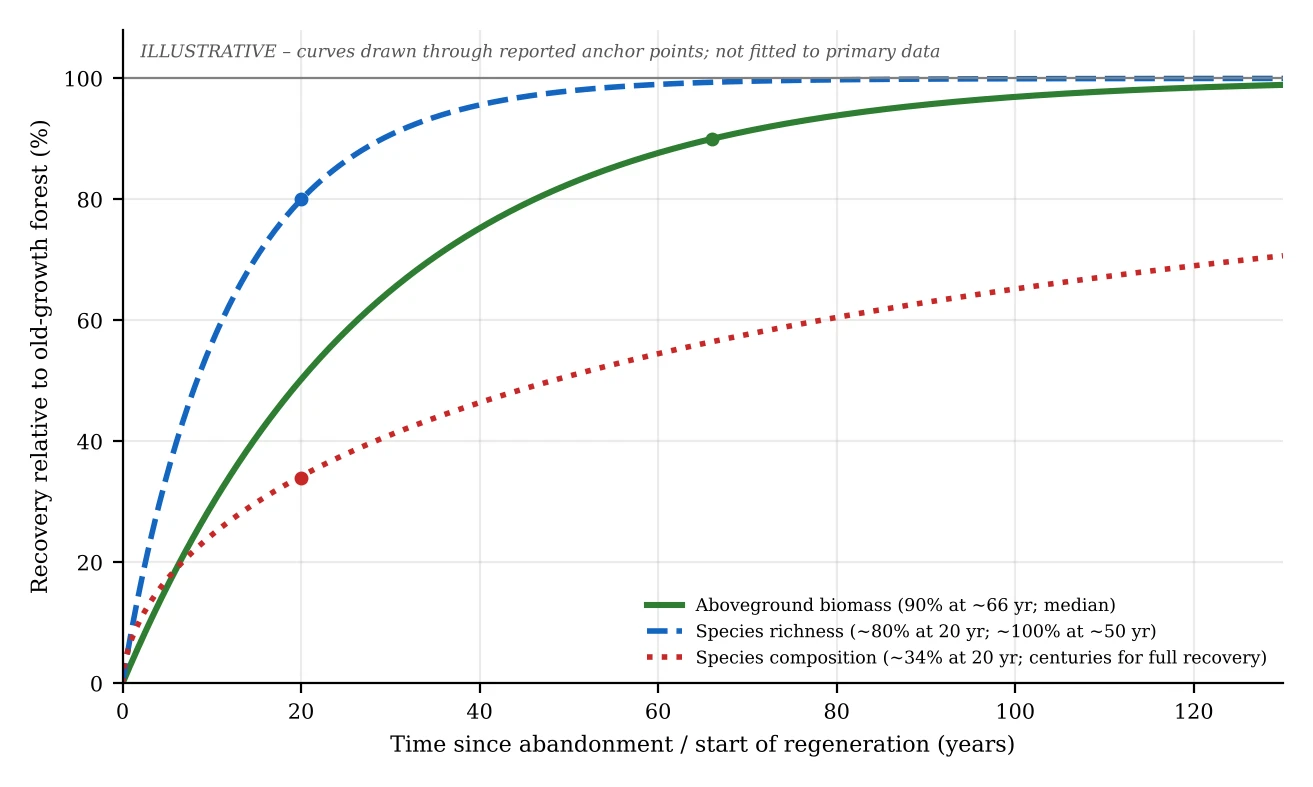
Fig. 3: Schematic recovery trajectories of aboveground biomass, species richness and species composition in regenerating tropical forests, drawn through the approximate recovery times reported for Neotropical secondary forests (biomass: 90% at a median of approximately 66 years; richness: approximately 80% at 20 years and full recovery at approximately 50 years; composition: approximately 34% at 20 years and centuries for full recovery).[17,24] This is a conceptual illustration: the curves are smooth functions passed through these reported anchor points, are not fitted to primary data and should not be read as empirical measurements.
ecosystem service provision relative to those of degraded sites (by 44% and 25%, respectively, across 89 assessments), although restored sites remained below the levels of intact reference ecosystems.[25] These findings emphasize that restoration should not be viewed as a substitute for the conservation of intact forests. Recovery of different biodiversity attributes occurs at markedly different speeds. A synthesis of Neotropical secondary forests revealed that tree species richness recovers quickly, reaching approximately 80% of old-growth richness within 20 years and fully recovering after a median of approximately five decades, whereas species composition recovers far more slowly (only approximately 34% after 20 years) and may require centuries.[24] The aboveground biomass recovered more slowly than the richness did: the mean was 122 Mg ha⁻¹ after 20 years of regrowth, and the median time to reach 90% of the old-growth values was approximately 66 years.[17] These patterns are schematically depicted in Fig. 3, which is illustrative and does not show the measured data. Active planting does not always improve outcomes. A global review of forest recovery revealed that the benefits of active versus passive restoration depend on prior land use, climate and landscape context, with passive restoration performing as well as or better than planting in many situations.[16,20] Planting should therefore be targeted where natural regeneration is unlikely to succeed and should use diverse native assemblages rather than a few fast-growing species.
3.2.1 Evidence from Asia and India
Most of the quantitative recovery evidence above comes from the Neotropics, and Asian forests may behave differently because of differences in species pools, human population pressure, recurrent fires and grazing, and invasive weeds. Data for Asia are relatively sparse; for example, the global carbon accumulation dataset has limited plot coverage in northeast Asia.[23] Studies from India's Western Ghats illustrate both the potential and the constraints. In the rainforest fragments of the Anamalai Hills (Tamil Nadu), the density and species richness of regenerating old-growth species were approximately 62% and 48% lower, respectively, than those in the continuous forest, indicating dispersal and establishment barriers to natural regeneration.[27] In the same landscape, a paired comparison of 25 actively restored plots (weed removal and mixed-native planting, 7–15 years old) and 25 naturally regenerating plots, set against 17 benchmark rainforest plots, revealed that active restoration recovered 82% of the canopy cover, 49% of the tree species density and 47% of the aboveground carbon storage relative to the gap between natural regeneration and the benchmark forest, whereas the compositional similarity recovered only 14%.[22] The benefits of planting for canopy cover and late-successional species were greater for more isolated fragments.[22] These results are consistent with the global message that the restoration method should be matched to the landscape context: natural regeneration is preferable when seed sources are close and disturbance is low, whereas weed control and native planting can be justified in isolated, invaded fragments.[16,20] National restoration targets in India are expressed mainly as areas brought under restoration; outcome-based monitoring would allow evidence such as that from the Western Ghats to be scaled up and compared across approaches.[13]
3.3 Carbon storage and climate mitigation
Forests are major carbon sinks. An assessment of inventory and remote-sensing data revealed a persistent net sink in the world's forests, in which tropical regrowth and temperate and boreal forests offset gross emissions from deforestation.[28] Natural forest regrowth is particularly effective: mapped estimates of carbon accumulation suggest that the regrowth of natural forests can sequester large quantities of carbon, with rates varying with climate, soils and prior land use, and that default IPCC rates underestimate aboveground carbon accumulation by approximately 32% on average.[18] These maps were constructed from 13,112 field measurements and show more than 100-fold variation in accumulation rates across the globe during the first 30 years of regrowth.[18] Complementing this, it has been argued that restoring natural forests is the most reliable route to long-term carbon removal because natural and mixed forests store more carbon over time than monoculture plantations do and provide additional benefits.[7] Carbon outcomes of agroforestry and plantations are more variable. In India, the modeled carbon sequestration potential of existing agroforestry areas averaged 0.21 Mg C ha⁻¹ yr⁻¹ across 26 districts in ten states, with an average of approximately 19 trees ha⁻¹ on farmer fields and large differences among systems and regions.[23] This is lower per hectare than the rates reported for natural regrowth, such as 3.05 Mg C ha⁻¹ yr⁻¹, over the first 20 years in Neotropical secondary forests, although the two estimates come from different methods and are not directly comparable.[17] Agroforestry stores carbon on productive farmland where forest regrowth is not an option, and it also supplies food and income. Carbon uptake can be rapid during early growth but depends on species, rotation length and the fate of harvested wood, and the permanence of carbon uptake is generally lower in planted forests than in natural or mixed forests.[7] These outcomes vary with species composition, plantation structure, management and site conditions (Table 2).
Climate benefits are, however, conditional. Credible mitigation depends on permanence, additionality, avoidance of leakage and accurate accounting; forests cannot compensate for continued fossil-fuel emissions and must be seen as complementary to rapid emission reductions.[29] Restoring trees on naturally nonforest ecosystems, such as grasslands and savannas, may yield minimal carbon gains while damaging unique biodiversity, changing water balance and altering albedo.[8] Table 4 summarizes key quantitative findings from the literature on the biodiversity and carbon outcomes of forest restoration, including numerical estimates, units and study context (region and sample size) wherever the cited studies report them. A comparison of the five approaches across the four decision criteria is shown in Fig. 2. It is a semiquantitative, expert-judgment summary based on a qualitative synthesis of the studies reviewed, using the criteria and scoring basis set out in Table 1. It is not an empirical measurement and should be read separately from the quantitative evidence in Table 4.
3.3.1 Scoring basis for Figure 2
In Fig. 2, each approach was rated from 1 (low) to 5 (high) on four criteria. Carbon uptake refers to the rate of aboveground carbon accumulation and storage over approximately the first 30 years after intervention relative to the other approaches; long-term permanence is discussed above and is not scored. Biodiversity refers to the expected recovery of native species richness, composition and habitat structure relative to those of the reference forest. Livelihood benefits refer to direct food, fodder, fuel, timber, income and employment benefits for local people. Cost-effectiveness refers to the expected ecological and climate benefits per unit of cost, taking establishment, maintenance and protection costs into account. The scores are relative rankings among the five approaches, not absolute measurements. They were assigned by comparing the evidence in Sections 3.1–3.3 (Tables 2 and 4), and they represent typical tendencies that may differ for individual projects depending on species composition, management and site conditions. Table 1 provides the basis for each score.
3.4 Contribution to sustainable development
Restoration contributes to development through multiple pathways: climate action (SDG 13), life on land (SDG 15), poverty reduction and decent work (SDGs 1 and 8), food security (SDG 2) and clean water (SDG 6). The benefits of restoring priority areas can increase; a global prioritization study estimated that restoring 15% of converted lands in the best-ranked areas could avoid approximately 60% of expected extinctions and sequester approximately 299 Gt CO₂ (30% of the increase in atmospheric CO₂ since the Industrial Revolution), with cost-effectiveness up to 13-fold greater when spatial allocation is optimized.[26] Table 3 summarizes the links between the restoration outcomes and the SDGs. Social outcomes are not automatic. Where restoration restricts access to land or displaces agriculture or where benefits are captured by outsiders, local support erodes and projects fail. Successful programs ensure land and tree tenure; involve communities in design and benefit sharing; and align restoration with local priorities such as food, fuel and income.[9,10]
3.5 Trade-offs, risks and constraints
Four categories of risk recur in the literature. First, ecological mismatch: Planting trees in ancient grasslands, savannas or wetlands can destroy habitats and reduce ecosystem services.[8] Second, low survival and poor species choice occur: large planting targets often emphasize the number of trees planted rather than their survival, diversity or function.[9] Third, permanent fires, droughts, pests and policy reversals can release stored carbon.[29] Fourth, competing land uses and leakage occur, in which pressure is displaced to other forests. Addressing these risks requires landscape-level planning, realistic targets and long-term monitoring rather than a single focus on the area or seedlings planted.
4. Implications for Policy and Practice
The synthesis supports five priorities for restoration programs.
(1) Match methods to context. Regeneration potential, seed sources, soils and pressures should be assessed before planting; natural or assisted regeneration should be promoted wherever feasible and intensive planting should be reserved for sites where recovery is otherwise unlikely.[16,17] In the western Ghats, for example, active restoration resulted in greater gains in canopy cover and late-successional species in more isolated fragments than in fragments close to intact forest.[22]
(2) Prioritize native diversity. Diverse native species assemblages, including late-successional species, should be used to support biodiversity and long-term carbon storage.[7,19]
(3) Secure rights and participation. Clarify land and tree tenure, share benefits equitably and integrate local knowledge into planning.[10]
(4) Finance maintenance and monitoring Budgets should cover protection, replanting, maintenance and monitoring for at least a decade, with outcome-based indicators such as survival, canopy cover and species composition.[11]
(5) Integrate restoration with protection. Protecting remaining intact forests and cutting emissions are prerequisites for restoring them to deliver climate and biodiversity benefits.[25,29]
Research needs include long-term monitoring across forest types, particularly outside the Neotropics, including South and Southeast Asia, where recovery data are sparse; better quantification of soil carbon and noncarbon climate effects; and economic and social evaluations of restoration performance under different tenure and governance arrangements.[23] For India and other countries that track restoration progress largely as the area under restoration, outcome-based monitoring of survival, canopy cover, species composition and carbon would allow restoration approaches to be compared directly, as has been done in the Western Ghats.[13,22]
5. Conclusions
Tree-based restoration offers a pathway to reverse forest degradation while advancing biodiversity conservation, climate mitigation and sustainable livelihoods. The evidence reviewed shows that outcomes depend less on how many trees are planted than on where how and with whom restoration is performed. Natural and assisted regeneration generally offer the best balance of biodiversity and cost-effectiveness; mixed native planting and agroforestry address constraints and livelihood needs, and monoculture plantations and planting in nonforest ecosystems carry significant risks. Biomass has recovered over decades, but species composition has recovered over centuries; thus, restoration is a long-term process and cannot replace the protection of intact forests. Evidence from Western Ghats in India shows that targeted active restoration can accelerate recovery in isolated, degraded fragments, but long-term data from Asian landscapes remain limited. Aligning restoration with local governance, rigorous monitoring and global climate and biodiversity commitments will help determine whether it contributes to collective sustainability.
Acknowledgment
The authors gratefully acknowledge the Forest College and Research Institute, Mettupalayam, and Agricultural College and Research Institute, Tiruvannamalai, Tamil Nadu Agricultural University, for providing institutional support and access to scientific literature databases.
Funding Declaration
This research did not receive any specific grant from funding agencies in the public, commercial, or not-for-profit sectors.
Data Availability Statement
No data were generated or analyzed during the current study. Therefore, data sharing is not applicable to this article.
Conflict of Interest
There is no conflict of interest.
Artificial Intelligence (AI) Use Disclosure
The authors declare that artificial intelligence (AI)-assisted tools were used only for language refinement, grammar improvement, and manuscript structuring purposes during the preparation of this work. All technical content, experimental implementation, results, and interpretations were independently developed and verified by the authors.
Supporting Information
Not applicable.
References
- [1] M.C. Hansen, P.V. Potapov, R. Moore, M. Hancher, S. A. Turubanova, Tyukavina A, D. Thau, S.V. Stehman, S.J. Goetz, T.R. Loveland, Kommareddy A. High-resolution global maps of 21st-century forest cover change, Science, 2013, 342, 850-853, doi: 10.1126/science.1244693
- [2] R. L. Chazdon, Beyond deforestation: restoring forests and ecosystem services on degraded lands, Science. 2008, 320, 1458-1460, doi: 10.1126/science.1155365.
- [3] D. Lamb, P. D. Erskine, J. A. Parrotta, Restoration of degraded tropical forest landscapes, Science, 2005, 310, 1628-1632, doi: 10.1126/science.1111773.
- [4] Aronson J, Alexander S. Ecosystem restoration is now a global priority: time to roll up our sleeves. Restoration Ecology. 2013, 21, 293-296, doi: 10.1111/rec.12011.
- [5] R.L. Chazdon, P. H. S. Brancalion, D. Lamb, L. Laestadius, M. Calmon, C. Kumar, A policy-driven knowledge agenda for global forest and landscape restoration, Conservation Letters. 2017, 10, 125-132, doi: 10.1111/conl.12220.
- [6] J. F. Bastin, Y. Finegold, C. Garcia, D. Mollicone, M. Rezende, D. Routh, C. M. Zohner, T.W. Crowther, The global tree restoration potential, Science, 2019, 365, 76-79, doi: 10.1126/science.aax0848.
- [7] S. L. Lewis, C.E. Wheeler, E.T.A. Mitchard, A. Koch, Restoring natural forests is the best way to remove atmospheric carbon, Nature, 2019, 568, 25-28, doi: 10.1038/d41586-019-01026-8.
- [8] J. W. Veldman, G. E. Overbeck, D. Negreiros, G. Mahy, S. Le Stradic, G. W. Fernandes, G. Durigan, E. Buisson, F.E. Putz, W.J. Bond, Where tree planting and forest expansion are bad for biodiversity and ecosystem services, BioScience, 2015, 65, 1011-1018, doi: 10.1093/biosci/biv118.
- [9] K. D. Holl, P. H. S. Brancalion, Tree planting is not a simple solution, Science, 2020, 368, 580-581, doi: 10.1126/science.aba8232.
- [10] P. H. S. Brancalion, K. D.Holl, Guidance for successful tree planting initiatives. Journal of Applied Ecology. 2020, 57, 2349-2361, doi: 10.1111/1365-2664.13725.
- [11] G. D. Gann, T. McDonald, B. Walder, J. Aronson, C. R. Nelson, J. Jonson, J. Hallett, C. Eisenberg, M. Guariguata, J. Liu, F. Hua, International principles and standards for the practice of ecological restoration, Restoration Ecology, 2019, 27, S1-S46, doi: 10.3368/er.27.1.3.
- [12] Forest Survey of India, India State of Forest Report 2023, Dehradun: Forest Survey of India, Ministry of Environment, Forest and Climate Change, Government of India; 2024.
- [13] International Union for Conservation of Nature. India brings over 21 million hectares of land under restoration under the Bonn Challenge [Internet]. Gland: IUCN; 2026 https://iucn.org/news/202606/india-brings-over-21-million-hectares-land-underrestoration-underbonn-challenge, Accessed 15 September 2026.
- [14] R. L. Chazdon, P. H. S. Brancalion, L. Laestadius, A. Bennett-Curry, K. Buckingham, C. Kumar, J. Moll-Rocek, I. C. Vieira, S. J. Wilson, When is a forest a forest? Forest concepts and definitions in the era of forest and landscape restoration, Ambio, 2016, 45, 538-550, doi: 10.1007/s13280-016-0772-y.
- [15] S. Mansourian, D. Vallauri, Restoring forest landscapes: important lessons learnt, Environmental Management, 2014, 53, 241-251, doi: 10.1007/s00267-013-0213-7.
- [16] P. Meli, K. D. Holl, J. M. Rey Benayas, H. P. Jones, P. C. Jones, D. Montoya, D. Mateos, A global review of past land use, climate, and active vs. passive restoration effects on forest recovery, Plos one, 2017, 12, e0171368, doi: 10.1371/journal.pone.0171368.
- [17] L. Poorter, F. Bongers, T. M. Aide, A. M. Almeyda Zambrano, P. Balvanera, J. M. Becknell, V. Boukili, P. H. Brancalion, E. N. Broadbent, R. L. Chazdon, D. Craven, Biomass resilience of Neotropical secondary forests. Nature, 2016, 530, 211-214, doi: 10.1038/nature16512.
- [18] S. C. Cook-Patton, S. M. Leavitt, D. Gibbs, N. L. Harris, K. Lister, K. J. Anderson-Teixeira, R. D. Briggs, R. L. Chazdon, T. W. Crowther, P. W. Ellis, H. P. Griscom, Mapping carbon accumulation potential from global natural forest regrowth. Nature, 2020, 585, 545-550, doi: 10.1038/s41586-020-2686-x.
- [19] R. Crouzeilles, M. Curran, M. S. Ferreira, D. B. Lindenmayer, C. E. V. Grelle, J. M. Rey Benayas, A global meta-analysis on the ecological drivers of forest restoration success, Nature Communications, 2016, 7, 11666, doi: 10.1038/ncomms11666.
- [20] R. Crouzeilles, M. S. Ferreira, R. L. Chazdon, D. B. Lindenmayer, J. B. B. Sansevero, L. Monteiro, A. Iribarrem, A. E. Latawiec, B. B. Strassburg, Ecological restoration success is higher for natural regeneration than for active restoration in tropical forests, Science Advances, 2017, 3, e1701345, doi: 10.1126/sciadv.1701345.
- [21] R. L. Chazdon, M. R. Guariguata, Natural regeneration as a tool for large-scale forest restoration in the tropics: prospects and challenges, Biotropica, 2016, 48, 716-730, doi: 10.1111/btp.12381.
- [22] A. M. Osuri, S. Kasinathan, M. K. Siddhartha, D. Mudappa, T. R. S. Raman, Effects of restoration on tree communities and carbon storage in rainforest fragments of the Western Ghats, India. Ecosphere, 2019, 10, e02860 doi: 10.1002/ecs2.2860.
- [23] S. K. Ajit, Dhyani], A. K. Handa, R. Newaj], S. B. Chavan, B. Alam, R. Prasad, A. Ram, R. H. Rizvi, A. K. Jain, Uma, Estimating carbon sequestration potential of existing agroforestry systems in India. Agroforestry Systems, 2017, 91, 1101-1118, doi: 10.1007/s10457-016-9986-z.
- [24] D. M. A. Rozendaal, F. Bongers, T. M. Aide, E. Alvarez-Dávila, N. Ascarrunz, P, Balvanera, J. M. Becknell, T. V. Bentos, P. H. Brancalion, G. A. Cabral, S. Calvo-Rodriguez, Biodiversity recovery of Neotropical secondary forests. Science Advances. 2019, 5, eaau3114, doi: 10.1126/sciadv.aau3114.
- [25] J. M. Rey Benayas, A. C. Newton, A. Diaz, J. M. Bullock, Enhancement of biodiversity and ecosystem services by ecological restoration: a meta-analysis, Science, 2009, 325, 1121-1124, doi: 10.1126/science.1172460.
- [26] B. B. N. Strassburg, A. Iribarrem, H. L. Beyer, C. L. Cordeiro, R. Crouzeilles, C. C. Jakovac, A. Braga Junqueira, E. Lacerda, A. E. Latawiec, A. Balmford, T. M. Brooks, Global priority areas for ecosystem restoration, Nature, 2020, 586, 724-729, doi: 10.1038/s41586-020-2784-9.
- [27] A. M. Osuri, D. Chakravarthy, D. Mudappa, T. R. S. Raman, N. Ayyappan, S. Muthuramkumar, N. Parthasarathy, Successional status, seed dispersal mode and overstory species influence tree regeneration in tropical rainforest fragments in Western Ghats, India, Journal of Tropical Ecology, 2017, 33, 270-284, doi: 10.1017/S0266467417000219.
- [28] Y. Pan, R. A. Birdsey, J. Fang, R. Houghton, P. E. Kauppi, W. A. Kurz, O. L. Phillips, A. Shvidenko, S. L. Lewis, J. G. Canadell, P. Ciais, A large and persistent carbon sink in the world's forests, Science, 2011, 333, 988-993, doi: 10.1126/science.1201609.
- [29] G. Grassi, J. House, F. Dentener, S. Federici, M. den Elzen, J. Penman. The key role of forests in meeting climate targets requires science for credible mitigation. Nature Climate Change. 2017, 7, 220-226, doi: 10.1038/nclimate3227.
Publisher Note
Publisher Note: The views, statements, and data in all publications solely belong to the authors and contributors. GR Scholastic is not responsible for any injury resulting from the ideas, methods, or products mentioned. GR Scholastic remains neutral regarding jurisdictional claims in published maps and institutional affiliations.
Open Access
This article is licensed under a Creative Commons Attribution-NonCommercial 4.0 International License, which permits the non-commercial use, sharing, adaptation, distribution and reproduction in any medium or format, as long as appropriate credit to the original author(s) and the source is given by providing a link to the Creative Commons License and changes need to be indicated if there are any. The images or other third-party material in this article are included in the article's Creative Commons License, unless indicated otherwise in a credit line to the material. If material is not included in the article's Creative Commons License and your intended use is not permitted by statutory regulation or exceeds the permitted use, you will need to obtain permission directly from the copyright holder. To view a copy of this License, visit: https://creativecommons.org/licenses/by-nc/4.0/
© The Author(s) 2026